The torrential rain had stopped, leaving the old, dense trees at St James’ Church in Kashmere Gate glistening. Built in 1836, Delhi’s first church is the resting place of both the notable and the nameless. The rain had washed the dust off its tombstones, revealing names long forgotten. Once, among these graves stood that of William Fraser, the British Resident in Delhi. On March 6, 1835, Fraser was murdered just a few steps away from his home in Kashmere Gate.
Fraser, a key intermediary between the British East India Company and the Mughal Emperor, was a man deeply woven into the cultural fabric of Delhi. His killing shocked the city. As Gopal Shukla writes in his new book Metcalf House, “It is considered the first killing of a European in the city. The assassin, taking advantage of the cover of darkness, managed to escape after carrying out the deed.” Shahjahanabad and the surrounding villages trembled at the news. In those days, Delhi essentially meant Shahjahanabad and rural Delhi.
A White Mughal in Delhi
William Fraser (1784–1835) lived during the reign of the last Mughal Emperor, Bahadur Shah Zafar. Known as a “White Mughal” for his deep assimilation into Mughal culture, Fraser was a scholar of Persian and an admirer of Urdu poetry. He dressed in Mughal attire, smoked hookahs, and entertained Delhi’s elite at his lemon-yellow domed bungalow near Kashmere Gate, behind St James’ Church. The bungalow became a hub of cultural exchange.
Fraser was well-liked, especially among the city’s lower classes, because of his fairness and sympathy. However, his decisive nature also earned him enemies.
His personal life, too, was complicated. He had a wife, Amiban, from Rania village in Haryana, and two Anglo-Indian sons and a daughter. Historical accounts suggest that Fraser was entangled in a love triangle with Vazir Khanum, a woman of Kashmiri descent, and Nawab Shamsuddin Ahmed Khan of Loharu and Ferozepur Jhirka. This entanglement is believed to have added a personal edge to existing political tensions.
Also read: Sisson House and Haryana Canal Rest House wait to welcome their new neighbour-Delhi CM
Fraser and Ghalib: Patron and poet
Fraser played a notable role in the life of Mirza Ghalib. “Fraser’s murder struck like a thunderbolt on Mirza Ghalib’s hopes. Fraser was working to increase Ghalib’s pension and was writing letters to the British Governor-General in Calcutta for this purpose,” says Shukla.
Their relationship was primarily that of a patron and poet. Historical accounts describe Fraser as a “big admirer” of Ghalib. Their paths likely crossed in Delhi’s vibrant literary circles, at mushairas or through mutual acquaintances in the Mughal court.
When Ghalib travelled to Calcutta in 1828 to resolve a pension dispute, Fraser, then attached to the Governor-General’s office, is said to have helped him. Though records are scant, this gesture suggests Fraser’s professional respect for the poet. Ghalib’s grief at Fraser’s assassination further reflects the cultural void his death created.
Murder, investigation and conspiracy
Initially, Fraser was buried at Nicholson Cemetery in Kashmere Gate, but his remains were later moved to St James’ Church. Today, his grave is untraceable.
The murder investigation was led by Magistrate Lawrence and Simon Fraser, with support from Colonel James Skinner, Fraser’s close friend and commander of Skinner’s Horse. Suspicion quickly fell on Nawab Shamsuddin, who harboured resentment against Fraser due to an administrative property dispute.
A crucial breakthrough came when an incriminating letter from Shamsuddin to Wassil Khan was discovered. Another suspect, Unyah, believed to have important information, eluded capture, possibly fearing retribution from Shamsuddin or British punishment. An anonymous tip eventually led Skinner to a village in Bulandshahr.
The investigation established that the murder had been carried out by Shujat Ali Khan, a henchman of Shamsuddin. Fraser’s administrative actions had angered Shamsuddin, who feared that his own life and fortune would be ruined if Fraser was not eliminated.
The police quickly pieced together the conspiracy. Shujat Ali and Shamsuddin were apprehended and executed by hanging on October 3, 1835.
Also read: Anti-Corruption Branch report exposes corruption in Delhi Pollution Control Committee
A lost grave and an enduring mystery
Fraser’s murder blended personal vendetta, political rivalry and cultural tensions. Shamsuddin’s resentment—fanned by a property dispute and romantic rivalry—led to the hiring of Kureem Khan, whose fatal shots ended Fraser’s life. The “White Mughal,” who bridged British and Indian worlds, remains a poignant figure in colonial history, remembered for his patronage of art and his tragic end.
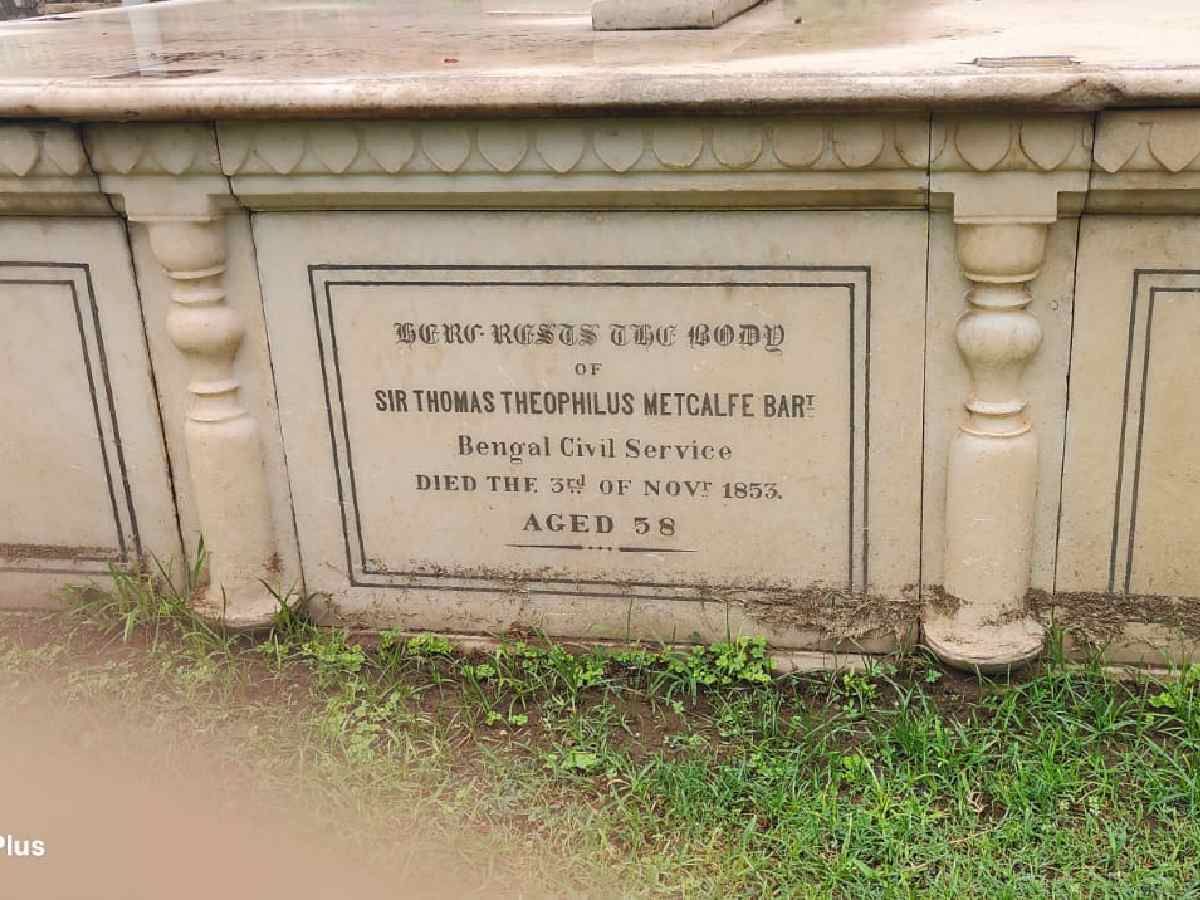
As one exits St James’ Church, a marble plaque catches the eye, bearing the name Sir Thomas Theophilus Metcalfe. After Fraser’s death, Metcalfe took over as Agent and Commissioner, navigating the delicate balance between British and Mughal interests.
Yet, one question endures—where has Fraser’s grave gone? Even Arvind Dass, the dignified caretaker of St James’ Church, has no answer.
At least 50 cases have already been reported this month; NCPCR guidelines mandate help desks,…
DMRC says zero reduction in train trips, attributes decline to security measures and public apprehension…
A Delhi court denied bail to a former DU professor accused of raping a student,…
Delhi Police charged seven dhaba workers in the fatal beating of a Manipuri musician who…
Seven Delhi STPs failed DPCC standards in September, dumping high levels of faecal coliform and…
AISA chief Neha Bora petitioned the Delhi HC against a police notice requiring a peace…

