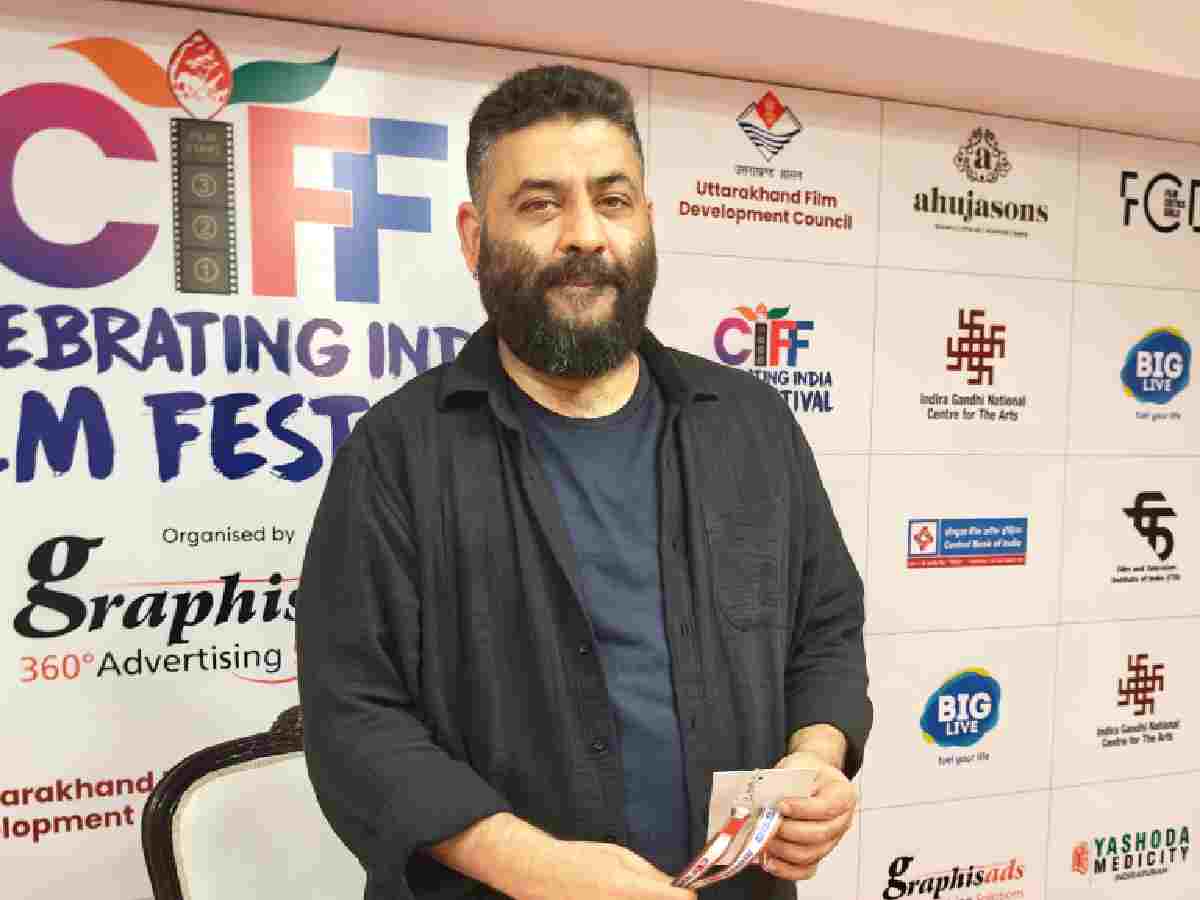
Gaurav Dhingra
When Gaurav Dhingra began his journey in films, there was no clear roadmap — only a desire to carve a different path.
“When I started the journey, I didn’t know what I was doing,” he admits. “But as I went around, I learned. Everyday is a learning.”
Growing up in Delhi, Dhingra realised that standing out in India’s crowded film market — where more than 2,500 films are produced annually — meant doing something truly different.
“ I realised that if you want to make a name for yourself here, you have to do something different. Otherwise, you’ll get lost in the middle of 140 crore people.”
His solution was to think beyond domestic audiences and make films that, in his words, “cross language, culture… appeal to people while crossing all the places.”
Building a studio from scratch
In 2011, Dhingra co-founded Jungle Book Entertainment with director Pan Nalin. When Nalin moved on, Dhingra transformed it into a full-fledged studio, managing everything from concept development to distribution.
“From a production company, it became a studio,” he says. “And now I run it on my own.”
Today, the company’s slate spans fiction films, non-fiction shows like Takeshi’s Castle India with Jaaved Jaaferi, and high-profile service productions including The Amazing Race and projects with YouTube star MrBeast.
Stolen: Tackling a systemic failure
Dhingra’s latest film, Stolen, is a tense drama on mob lynching — an issue he sees as a symptom of deep institutional collapse rather than partisan politics.
“Lynching happens when you don’t trust the system,” he explains. “If it takes 20 years for the system to give justice, people take it themselves. But this is not how a civilised society works. People are not at fault — the system is.”
Premiering at over 40 international festivals, Stolen reached its widest audience after streaming on Amazon Prime, where it trended in 11 countries.
“In festivals, you might have 6,000 people watch it. On a streaming platform, it’s millions. The response was phenomenal.”
A story born from pain
The film’s origins lie in a disturbing viral video of a lynching. Initially conceived as a highly immersive narrative, Dhingra felt it lacked emotional depth.
“That’s when we merged it with a true story of a five-month-old baby kidnapped from a bus station in rural Uttar Pradesh… That gave birth to the film.”
The script went through a painstaking process. “We went through nuances, nuances, over 90 drafts,” he says, smiling. “I think I lost count.” Officially, there were 38 drafts, but “unofficially there are many more” as creative disagreements led the team to write separate versions.
Drafts were shared with a network of international filmmakers and producers for feedback. “Writing is actually not writing — writing is accepting that you’re a bad writer and then becoming a better writer.”
Producing with purpose
For Dhingra, producing is about strategic allocation of scarce resources.
“Bottom line, you never have enough money to do anything. Producing for me, in one line, is knowing where you want to spend that money.”
He recalls a crucial moment during Stolen’s shoot: a costly car sequence had a continuity error. Recognising it as the “money shot,” they reshot the scene the next day. “Better shot, better performance — and that made the film.”
His approach is to cut excess offscreen and put everything on the screen. “No fancy hotels, no business class, no bakwaas… good script, good people — that’s it.” But he insists that the effort must be rooted in purpose: “If you do something which is tough to do, the product will shine… but don’t do it without a purpose.”
The state of Indian cinema
Dhingra is blunt about the challenges facing the industry.
“The industry is in a bad situation because they’re making bad content,” he says. “Films are a reflection of society, and society has crumbled. There are no new ideas, and the market is monopolistic — three or four big buyers control everything.”
In his view, the fiercest competition is not other filmmakers but short-form social media. “My competition is Instagram. If TikTok were still here, that too. People have two free hours in a day — do they watch your film, or scroll reels? You’re fighting Mark Zuckerberg and Sundar Pichai for their time.”
Delhi roots, Mumbai work
Despite his professional base in Mumbai, Dhingra’s heart is firmly in Delhi.
Also Read: RS Prasanna on Sitaare Zameen Par and the thrill of directing Aamir Khan
“I’m a Delhiite. I grew up here, went to Sardar Patel School and Bhagat Singh College. My family’s here, my daughter goes to school here. Mumbai is just where I work.”
He maintains homes and offices in both cities, but chooses to live in Delhi to be close to his parents. “I love them. I don’t want them to change their lives because of me. Their business is here. My wife likes Delhi more than Mumbai.”
He does not romanticise either city. “Both are equally bad — Delhi and Mumbai… There are equal problems in both the cities.”
Advice to newcomers
Dhingra’s counsel to aspiring filmmakers is unvarnished. “Don’t do it. Unless you’re really determined, the market is crashing. It’s a bad situation.”
Yet his own career shows that persistence, purpose, and a willingness to take risks can carve out a place even in a saturated and uncertain industry.
DMRC says zero reduction in train trips, attributes decline to security measures and public apprehension…
A Delhi court denied bail to a former DU professor accused of raping a student,…
Delhi Police charged seven dhaba workers in the fatal beating of a Manipuri musician who…
Seven Delhi STPs failed DPCC standards in September, dumping high levels of faecal coliform and…
AISA chief Neha Bora petitioned the Delhi HC against a police notice requiring a peace…
Average AQI of 171 in the first week of this month; falling temperatures and stubble…
