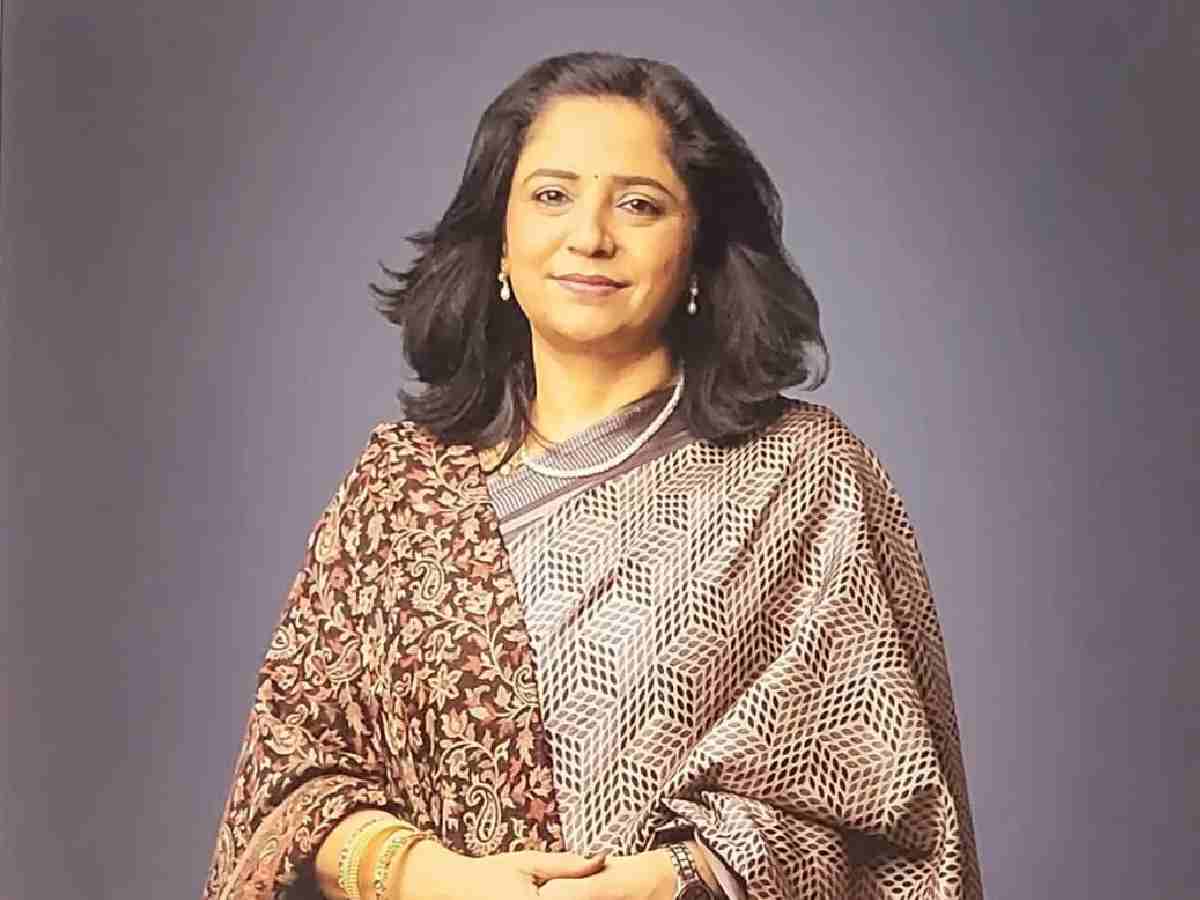
Hina Rizvi Haider, an emerging voice in Urdu poetry, is rooted in the culturally rich milieu of Lucknow, a city long regarded as a cradle of Urdu literature and refined poetic traditions. Raised in a family deeply connected to the language, her journey into poetry seems less like a choice and more like a natural inheritance shaped by her surroundings.
“I myself don’t know when my poetry
started. Because I have been writing
something since childhood. Like small
poems. And because my uncle, and my
grandfather were poets, I was influenced
by them. Though my uncle passed away
when I was two years old. On the other
hand, my mother is a PhD in Urdu. So the
environment was always inclined towards Urdu and poetry. So that’s why I came here. And my passions came here, towards poetry,” she said.
Born into a household where literature was both lived and celebrated, Hina was influenced by generations before her. Her maternal grandfather, Chaudhary Itrat Husain ‘Aashiqui’, was a sahib-e-diwan poet, while her uncle, Chaudhary Qamar Hussain Rizvi, also contributed to the poetic tradition. Her father’s close association with poets meant literary figures were frequent visitors at home.
Legacy in silence
Despite this legacy, Hina’s early engagement with poetry remained private.
“That legacy… now I feel that those
were the genes that came inside me.
Otherwise, when I was growing up, they
were not there, since they had passed
away. But yes, the home environment,
contributed to everyone’s passion for
poetry. My father was also very passionate about poetry. All of his friends who were poets used to come home. While I did not recite my poetry to the elders, I still recited to children and my friends. Belonging to the Shia sect, the gatherings always had Nauha, Salaam, Manqabat,” she said. “My poetry started with Rasai poetry. Then after that, I thought of trying Ghazals, and then I started,” she recalled.
Emotion over academia
A postgraduate in Political Science, Hina emphasises that her academic background does not directly shape her poetry. Instead, she draws from emotional and personal experiences.
“Those (poems) are just emotions. I am
a little sensitive to my health. So when
something good or bad happens in life, it
has an effect on my health. So that also
comes in poetry. So it has nothing to do
with studies. Everything else is just
mental. Where the mind wanders, and the environment, has an effect on the heart,” she said.
Her sensitivity to life’s moments—both joyful and difficult—often finds expression in her verses, lending them an intimate and relatable quality.
Voice of expression
Hina’s poetry spans themes of love, spirituality, and social issues, reflecting a balance between personal introspection and societal awareness.
“See, in the beginning, I used to write
poems. Whenever there was a topic that
affected my heart, it would come through poetry. I say what I want in my poems. I tried my best to write about every social issue. So, even then, many years ago, when there was no Facebook, I wrote a blog. And I used to write on Orkut too. So, I always raised social issues. That was also a way for me to express myself, which I used to organise. Through Ghazals and poetry, my words are more inclined towards God’s love. And there is very little worldly love,” she said.
A journey without struggle
Unlike many artists, Hina describes her entry into public poetry as gradual and unforced.
“No, no. Alhamdulillah, I didn’t face any challenges. Because it was also my choice that I came on stage much later. I never wanted to come. Because I didn’t even feel that I should come. And maybe at that time, I didn’t understand that I should convey my message to my people. I was only understanding the people to whom I was reaching. So, it was a coincidence that I came. And I came to the world of stage much later. Otherwise, I was satisfied only by writing on Facebook. And I was doing the same poetry that I was doing at home. So, it was a coincidence that I came. And I didn’t have to face any challenges,” she said.
Urdu in the modern age
For Hina, Urdu continues to hold strong relevance, especially among younger audiences drawn to its lyrical beauty.
“It is very relevant. Because the language, the beauty of Urdu, and the use of Urdu in poetry, attracts people a lot. And people like to listen to Urdu. And the beauty, I think, the beauty that comes from the use of Urdu words in poetry, has its own unique impression that reaches people,” she said.
She also reflects on how poetry today exists across both traditional stages and digital platforms.
“See, both have their own, and on the stage of poets, a different kind of poetry, a common sense poetry, is read. And on social media, you have a little bit of this kind of traditional poetry, you can put that too. So, that is also different, you get very good poets in it, and if you get praise from them, then there is happiness. And the rest is that the response that comes immediately it gives a different kind of feeling in itself. It is happy to see people’s expressions from the immediate response, that our words reached them and they liked it,” she explained.
Connecting with audiences
For Hina, the true reward of poetry lies in its ability to resonate with listeners. One of her most memorable experiences came through a poem titled Binte Hawa, which addresses women’s rights.
“I feel good when the audience, for example, I have a poem, which is called Binte Hawa. In that, I spoke about women’s rights and women. When I read it for the first time on Rekhta, the response that came after that, and the way the youth, especially the girls came to me and held my hand and cried and told me that you said my words, you said our words. So, that happiness, I did not get it from any other thing. I am very happy about it. And I thank God very much that I was able to say what people said,” she said.
Stage and recognition
Hina is set to participate in poetry gatherings such as the Shankar-Shad Mushaira, where she values both the platform and the audience.
“I am very happy. And I consider myself very fortunate that I was invited. I liked it. And, God willing, I will be happy to join in this programme. I thank the organisers very much for that,” she said.
For her, these gatherings are not merely performances but spaces of connection—where words meet listeners and poetry finds its meaning.
An evolving voice
As she continues to write and perform, Hina Rizvi Haider represents a new generation of Urdu poets who are rooted in tradition yet open to evolving forms of expression. Her work—shaped by legacy, emotion, and lived experience—reflects both continuity and change within the poetic landscape.
“I feel good when my audience connects,” she said. “When they feel that I have spoken their words—that is the greatest happiness.”
Coforge opened its first library in Noida in February 2024; it now claims a combined…
Of the 237 spa centres across 10 zones with valid MCD licences, the South East…
CTI chairman Brijesh Goyal said the Rahul Gandhi rally could affect wholesale and retail markets…
Established to mark the university’s 25 years, Jubilee Hall has witnessed generations of student life.…
Delhi inaugurates the 70th National School Games, hosting over 14,000 participants in 14 sports across…
Delhi High Court asked "Doosra" filmmakers to respond to Sourav Ganguly's plea over alleged violation…
