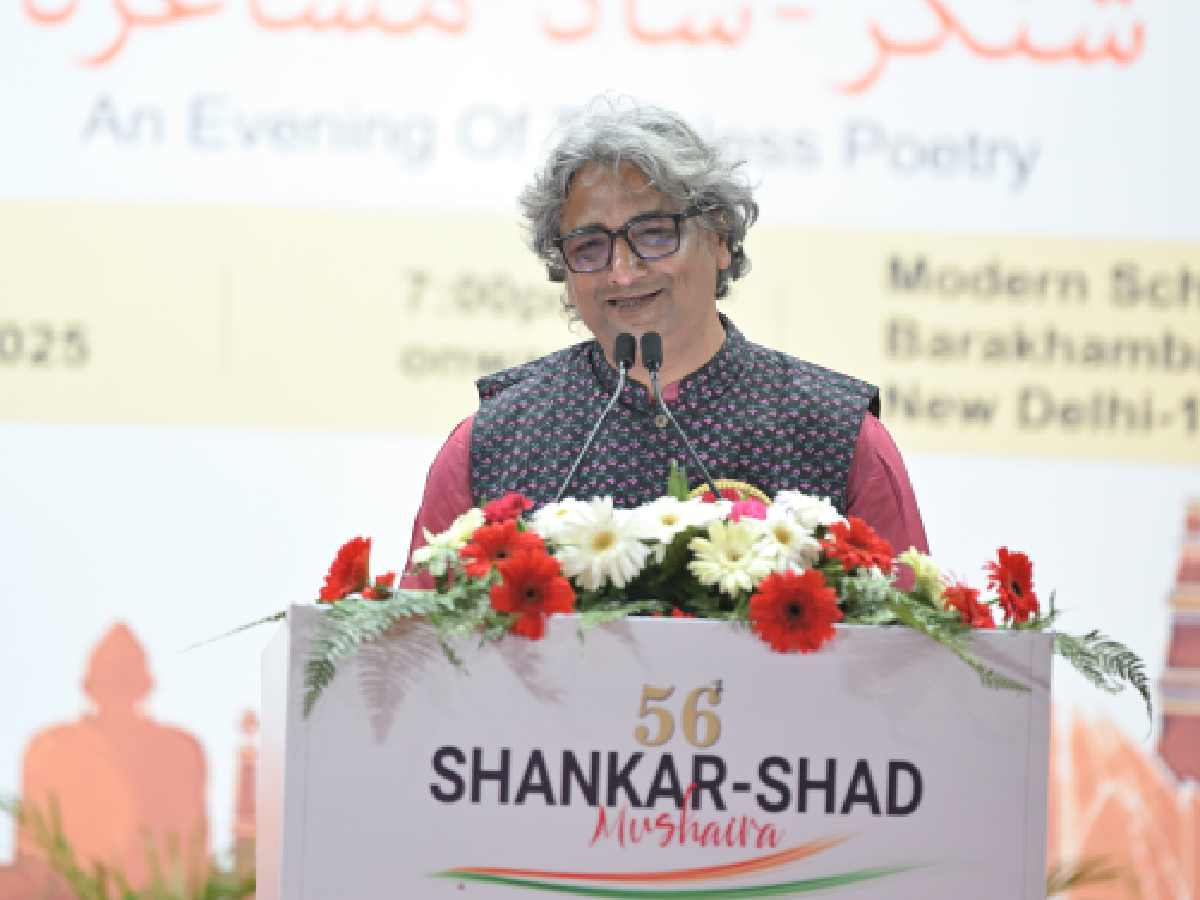
Azhar Iqbal
Urdu poet, scriptwriter, and literary commentator Azhar Iqbal believes that platforms like the Shankar-Shad Mushaira have played a vital role in preserving the Urdu language and its poetic traditions by offering poets a space where their words find true meaning.
“Shankar-Shad Mushaira is not just an event, it’s a legacy,” he told Patriot. He added that poets feel honoured simply by being present, and its history—featuring legends like Faiz Ahmed Faiz, Jaun Elia, and Ahmad Faraz—speaks volumes about its stature. Having continued for 56 years, he said, the mushaira keeps the flame of Urdu poetry alive and offers a rare space where “words find their true essence.”
He said the recently introduced Shankar Shad Shayari Contest has injected new energy into this tradition by offering a platform to emerging voices. More than just a competition, he described it as a way to ensure that the beauty of Urdu shayari flourishes across generations.
Also read: I’m not scared to explore different roles: Fatima Sana Shaikh
Shaped by Budhana and Aligarh
Iqbal, who grew up in Budhana, Uttar Pradesh, and studied at Aligarh Muslim University, said that his early life was shaped by a cultural atmosphere steeped in storytelling and poetry. Surrounded by literary richness at home, his love for language began to grow. Later, his time at Aligarh refined this passion by exposing him to the works of great poets and vibrant literary circles.
“These experiences shaped my voice and strengthened my passion for Urdu poetry,” he said.
Festivals as institutions
Known for his performances at festivals like Jashn-e-Rekhta and Jashn-e-Bahaar, Iqbal considers such events to be more than annual gatherings. For him, they serve as institutions that carry the literary legacy forward. “Poetry is not just about words on paper. It’s about connection, emotion, and expression,” he said, adding that he feels the audience’s energy and shared love for language during live performances.
He also emphasised the importance of intergenerational exchange, saying these events allow poets like him to learn from legends, evolve their craft, and contribute to an ever-growing tradition.
Writing across generations and styles
Iqbal’s ghazals have struck a chord with both young and older audiences. He attributed this wide appeal to the universality of emotions. “I don’t write for any specific age group,” he said. “Love, longing, pain, hope—these emotions don’t belong to one generation. If a verse comes from the heart, it will find its way to the right ears.”
Although best known for his ghazals, Iqbal said he never confines himself to a single form. Some emotions, he explained, require the structure of a ghazal; others flow better in blank verse or a nazm. “Just a few lines can sometimes hold more weight than an entire page,” he said, adding that poetry—like life—is ever-evolving and should not be limited by form.
Modern Urdu poetry: rooted yet changing
As a literary commentator, Iqbal keeps a close eye on contemporary trends in Urdu poetry. He noted that while the classical essence of ghazals and nazms remains strong, many modern poets are now experimenting with themes, language, and structure. According to him, there’s a noticeable shift towards simplicity, where raw emotions are prioritised over ornate metaphors. Poetry, he said, is becoming more intimate and connected to everyday realities, yet there remains a deep effort to retain its classical roots.
A platform for storytelling
In 2015, Iqbal founded the Harfkaar Foundation, a space dedicated to promoting theatre, dastangoi, and literature. He said he started the foundation to nurture the art forms that shaped him. Watching young poets and storytellers find their voices through the platform, he said, has been deeply rewarding. “The response has been heartwarming,” he added.
His parallel careers as a scriptwriter and anchor, he noted, have complemented his poetry. Writing scripts taught him how to weave emotions into narrative arcs, while anchoring helped him understand voice, timing, and audience connection. “Both have made me a better poet,” he said.
The digital age: a double-edged sword
Iqbal described the digital age as both a boon and a challenge for Urdu poetry. While social media has made poetry more accessible, he worries that the depth and patience once required to appreciate it are sometimes lost in quick consumption.
Still, he acknowledged the renewed interest among younger audiences, saying the digital space could preserve Urdu literature—if approached with sincerity. “It’s a double-edged sword,” he said. “Preservation depends on how deeply we engage with it.”
A full-circle moment at Jamia
Iqbal also recalled a deeply personal moment involving Jamia Millia Islamia University. In 2004, while pursuing his master’s degree, he was unable to sit for exams due to short attendance, as he was working at the time. Despite repeated requests, he was denied the chance to complete his degree.
Two decades later, however, he was invited back to the university as a guest. During an interview there, he emphasised the need for empathy in education, saying students should not be penalised for low attendance without considering their circumstances. “We never know what challenges a student is facing, and their entire year shouldn’t go to waste because of it,” he said.
Also read: Nobody sure yet, we are all struggling: Ajay Devgn on performance of Hindi films
Delhi’s embrace and its flavours
Iqbal shares a deep bond with Delhi, a city he visits often for mushairas. Beyond its literary richness, he appreciates its layered culture, warmth, and the unique space it offers to Urdu poetry. “Every visit feels like a return to a city that understands the soul of a poet,” he said.
Asked about his culinary preferences, he smiled and mentioned Karim’s, adding that he particularly enjoys mutton korma and biryani.
At least 50 cases have already been reported this month; NCPCR guidelines mandate help desks,…
DMRC says zero reduction in train trips, attributes decline to security measures and public apprehension…
A Delhi court denied bail to a former DU professor accused of raping a student,…
Delhi Police charged seven dhaba workers in the fatal beating of a Manipuri musician who…
Seven Delhi STPs failed DPCC standards in September, dumping high levels of faecal coliform and…
AISA chief Neha Bora petitioned the Delhi HC against a police notice requiring a peace…
