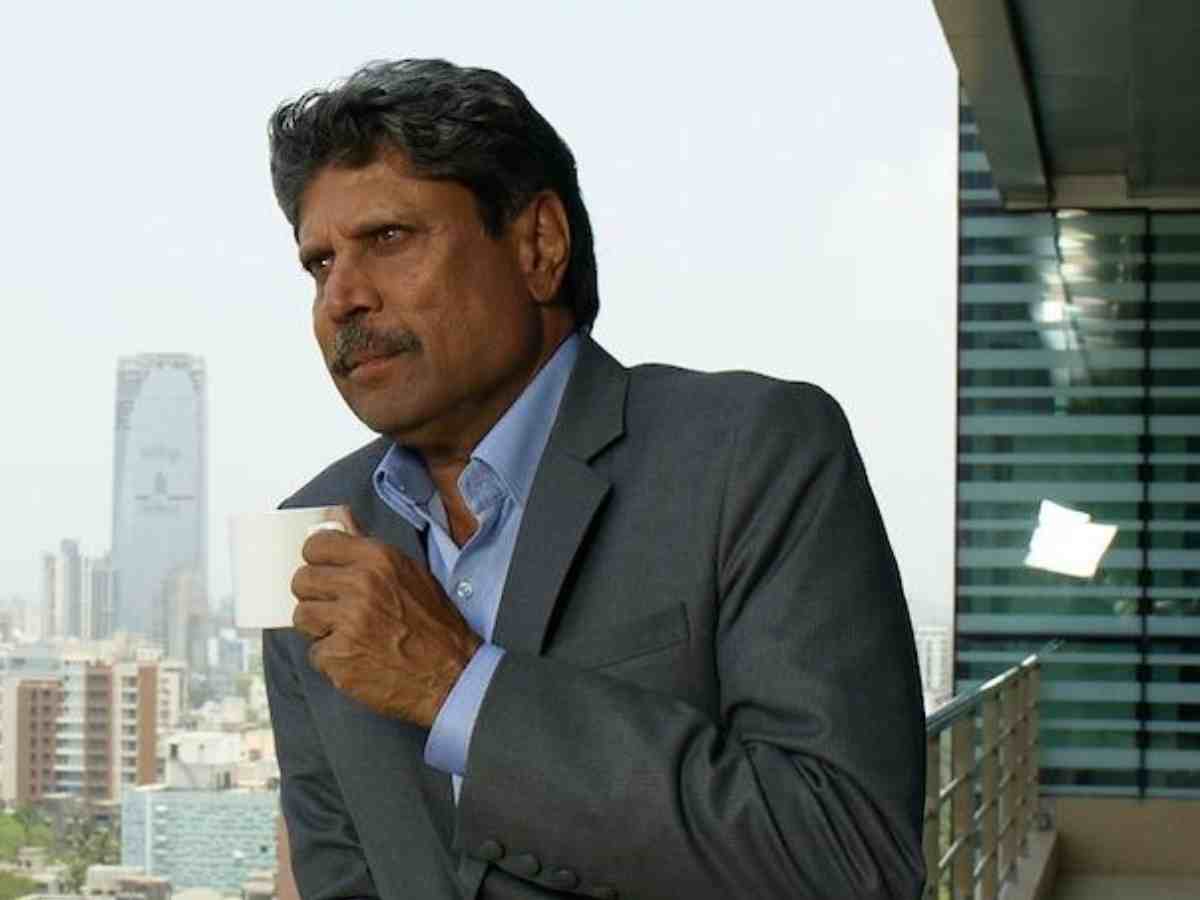
Kapil Dev
Time flies, they say. Exactly 50 years ago, Kapil Dev Ramlal Nikhanj made his first-class debut at a modest venue. The golden jubilee anniversary of that debut falls on November 15, 2025. Today, when he would look back on his cricket career—both domestic and international— he would be content and happy.
Kapil, now in his 67th year, reached the peak of his career twice. On June 25, 1983, he magnificently led India to its first-ever World Cup triumph. Later, on February 8, 1994, he broke the world record for most Test wickets held by New Zealand great Richard Hadlee, claiming his 432nd scalp—a record since surpassed by others.
In a highly decorated career, Kapil played 356 international matches, scored 9,031 runs (including nine centuries), captured 687 wickets, and held 135 catches. He captained India with distinction in 34 Tests and 74 One-day Internationals (ODIs).
For his achievements, the Indian government honoured him with the Padma Shri in 1982 and the Padma Bhushan in 1991. In 2002, Wisden—cricket’s most prestigious publication—adjudged him the Indian Cricketer of the 20th Century, adding yet another feather to his already heavy cap.
An impactful beginning
On November 15, 1975, a strapping 16-year-old Kapil Dev made his entry into first-class cricket. Haryana picked the Chandigarh-based bowling all-rounder for a three-day Ranji Trophy match against Punjab at the inconspicuous Vishwakarma High School Ground in Rohtak, about 80 km from New Delhi.
Kapil made an immediate impact, taking six wickets in the first innings (10-2-39-6) and two in the second, finishing with match figures of eight for 117. In the only innings he batted—as Haryana won by an innings and 101 runs—he scored an unbeaten 26. A great career was off to an impressive start.
Sarkar Talwar, former Haryana captain and off-spinner, remembers that debut distinctly.
“Actually, Kapil was hoping to make his debut in the previous match against Jammu and Kashmir in Hisar. But when he wasn’t picked, he became so emotional that he started crying like a child because he was expecting to be among the playing XI,” said Talwar, whose first-class career spanned 20 years (1967–68 to 1987–88), representing Southern Punjab, Punjab, and Haryana, in an interview with Patriot.
Kapil’s longevity
One of Kapil’s most remarkable qualities was his fitness throughout his career. He played domestic tournaments for 19 years (1975–76 to 1993–94) and international cricket for 16 years (1978–79 to 1993–94).
Ravinder Chadha, a medical doctor who opened the bowling with Kapil in Rohtak and in many matches later, attributes his longevity to several factors.
“The genetic factor is very important. He had an athletic body from the start. He had a perfect side-on bowling action. The advantage to bowlers with such an action is that injuries happen less often to them. He used to pay full attention to his drills like strengthening and stretching exercises because in India, it was not easy to be a fast bowler as pitches were meant for spinners then,” said Chadha, who held multiple responsibilities with the Haryana Cricket Association (HCA) concurrently, speaking to Patriot.
Listing more factors behind Kapil’s endurance, Chadha said, “He had a lot of determination. Kapil started as a bowler, and with time, he improved his batting as well. His fielding was always good as he was a natural athlete. He had a lot of patience; I never saw him overexcited. It was a very good quality in him and a sign of a good sportsman.”
The 74-year-old added that Kapil would talk less and always wear a smile. “I’ve never seen him boasting about his performances; it is an indicator of a good cricketer. There’s no doubt that he is a thorough gentleman and has been totally committed to his cricket,” he said.
Turning points
There were several turning points in Kapil’s career. Talwar recalls one of his most memorable performances. In the match before the Ranji Trophy pre-quarterfinal against Bengal in Rai, Haryana, during the 1976–77 season, Kapil had taken only three wickets.
“In the team meeting before the Rai match, HCA boss Ranbir Singh Mahendra said something like he was expecting a lot more from Kapil. It seems Kapil took it very seriously or, maybe, those words acted like a motivating factor for him. In the second innings, Kapil captured seven wickets (9-3-20-7) and never looked back; he just soared higher and higher. He bowled his heart out and was unplayable in that match. It was his best bowling performance until then, and it propelled Haryana to an 183-run win,” recalled 73-year-old Talwar, who served as Haryana’s chief coach for ten years (1988–1998).
Talwar and Kapil attended the same school and college—DAV School and DAV College in Chandigarh—though Talwar was much senior. “The DAV School and DAV College once played a match of some tournament in Chandigarh. One of Kapil’s balls hit me hard on my thigh and made me see stars in broad daylight. He scored a half-century and bagged five wickets. After that match, I thought ‘here was a good cricketer in the making’,” Talwar said.
Shines globally
Kapil made his international debut in an ODI against Pakistan on October 1, 1978, in Quetta. Aged 19 years and 268 days, he scored an unbeaten 12-ball 13 and took one wicket as Bishan Singh Bedi-led India won by four runs. His Test debut came two weeks later, on October 16, 1978, in Lahore. He went wicketless in the first innings but dismissed Sadiq Mohammed in the second to open his account—and was on his way to stardom.
Kapil went on to play 131 Tests, amassing 5,248 runs, including eight centuries, and capturing 434 wickets, with 23 five-wicket hauls and two 10-wicket hauls, besides taking 64 catches. In 225 ODIs, he scored 3,783 runs, including his iconic unbeaten 175 against Zimbabwe in the 1983 World Cup, and took 253 wickets.
The motivator
As captain, Kapil always led from the front, say his Haryana teammates Amarjeet Kaypee and Salim Ahmed.
“Just the presence of Kapil in the Haryana dressing room was enough to fill the players with josh (motivation). He would motivate us by telling us not to get bogged down at the sight of Test players in the opposition ranks; he would say they have become stars and you are on the way,” recalled Kaypee, a domestic batting stalwart and current chief coach of Haryana.
‘Caught Salim Ahmed bowled Kapil Dev’ was a regular occurrence on Haryana’s scorecards during the wicketkeeper’s 51-match career. Salim and Kapil shared a massive partnership in a match of the north zone inter-varsity tournament.
“We scored 400-plus runs together for Panjab University against Hisar University at Aligarh Muslim University, probably in 1978. Kapil scored a triple century, with 26 sixes, and I scored 78 in that partnership, watched by a huge crowd,” said Salim, a DAV School teammate of Kapil.
“Kapil was tough to keep wickets to. When he and I would play together for Haryana, I’d pray that we didn’t get to field first as it was very difficult to keep wickets to his outswingers [especially in the mornings], as I had to cover the first and second slip for the edges from the batsman, despite fielders being stationed there,” he added.
A new chapter
Well before retiring from international cricket in 1994, Kapil had settled in New Delhi, while his brothers still live in Chandigarh. Besides managing multiple businesses, the cricket legend—an avid golfer—took over as President of the Professional Golf Tour of India in June 2024, marking a new phase in his remarkable life.
Families displaced by the Seemapuri building collapse spend another night on the streets as damaged…
Camera-based enforcement in Delhi generated around 40.6 lakh notices till September, but only about 2…
Delhi government to fast-track Rs 7,000-crore elevated Ring Road project, with two new Yamuna bridges…
Yamuna water quality deteriorated at three locations in Delhi in September, with BOD levels remaining…
Delhi liquor stores will remain shut on October 9 and 10 following police inputs to…
Strike began September 15; ESMA invoked by month-end has barred strikes for six months; drivers…
