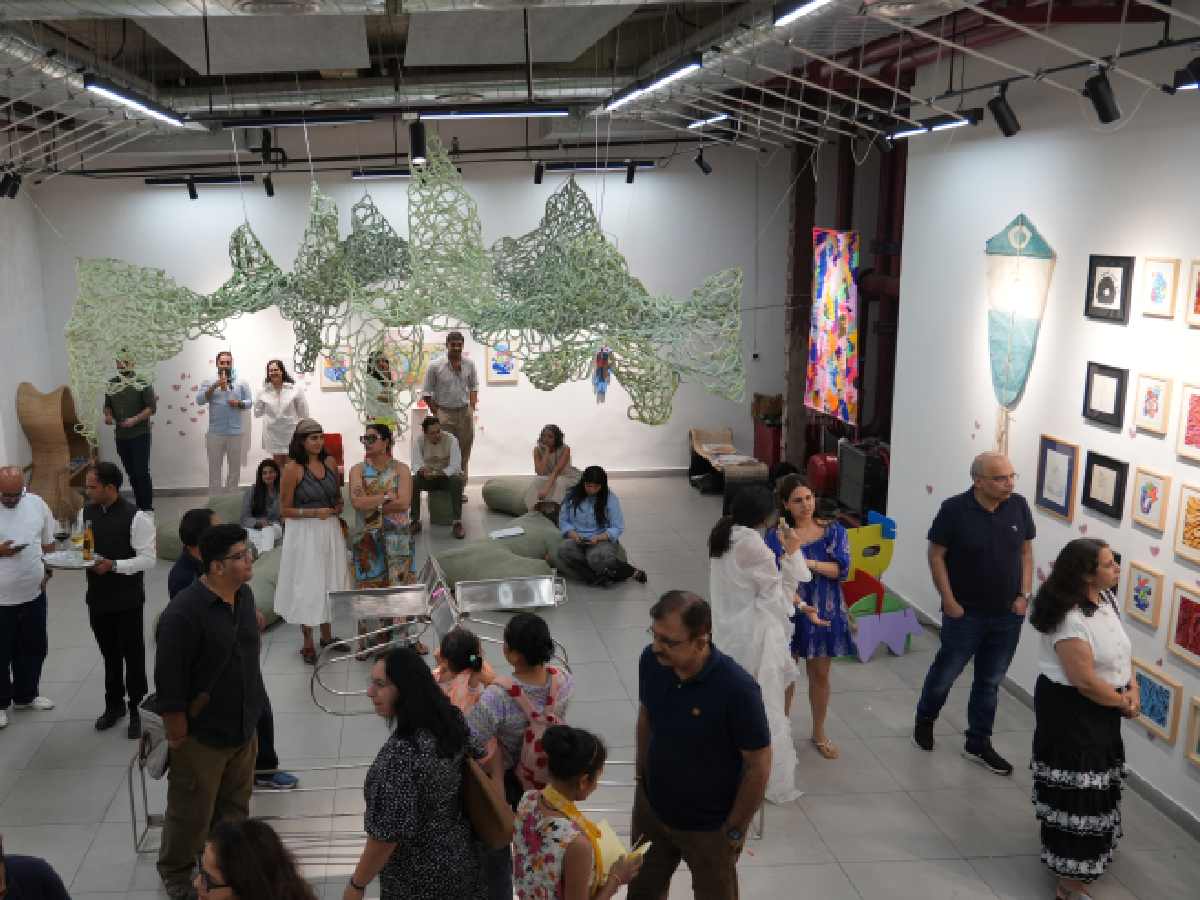
Visitors explore interactive artworks inspired by childhood
Walk into Method Delhi’s basement gallery in Defence Colony and the first instinct is not to admire the artworks from a distance, but to interact with them. Bean bags filled with recycled waste, handwoven installations, colourful kites, sculptural clocks and carpets that children can rearrange share space with works by established artists and school students.
More than a conventional exhibition, Holiday Homework asks visitors to reconsider the environments in which children grow up.
Presented by LOAM and supported by the Ardee Foundation, the exhibition asks what childhood might look like if artists, rather than industries, designed these environments.
LOAM, an arts initiative exploring childhood through contemporary art, brought together 20 artists and 10 finalists selected through an open call to reimagine childhood through play, care and design. Supported by the Ardee Foundation, a non-profit working in education and the arts, the exhibition also features works by school students, placing young participants alongside established artists.
Rethinking childhood
The idea emerged from conversations between LOAM founders Gayeti Singh and Anica Mann about how childhood has changed.
“LOAM is really an effort to answer the question: What if artists, rather than industries, designed childhood and the environments of childhood?” Singh says. “I think that’s really what we’re trying to explore.”
Mann says the exhibition includes artists working across different forms and scales.
“We have 20 artists here. Some of them have even made public projects, while others have made tiny artworks that could be the first art that enters a child’s room,” she says.
Concerns about the amount of waste generated by children’s products also influenced the exhibition.
“A fact that drives us the most is that 80% of everything a child owns ends up in a landfill, and that’s shocking to us,” Mann says. “We want to change it, hoping that if something was artist-produced, you wouldn’t throw it away.”
LOAM wants children to engage with art rather than simply consume products designed for them. The exhibition note argues that imagination, care and creativity should receive greater attention than commercial design in the environments where children learn and play.
Art made from waste
The emphasis on sustainability runs through the exhibition.
Pointing to a seating area, Mann says, “All of this is made of waste. There is waste inside the bean bags as well. This was imagined as a place for reading, relaxation and play.”
Nearby stands artist Ansh Kumar’s playful “talidoscope”.
“It can rotate, and the more movement there is, the more the shapes will change,” Mann says.
She also directs visitors to handcrafted kites by Harshita Sharma and installations that encourage children to participate.
“The rest of the things here are interactive works that children can pull apart and pretty much be architects,” she says.
Mann says ten artists were selected through an open call. Applicants were asked to submit a thesis and discuss what childhood should look like.
The organisers have also tried to make original art more accessible to children.
“Generally, all of these artists are quite well-known, famous artists,” Mann says. “But for children to get their first artwork in their collection, instead of wallpaper that will end up in a landfill, we have asked artists to make works only for Rs 10,000.”
She also credits the Ardee Foundation with bringing children into the project.
“They want us to get into the minds of children and ask children to come as participants as well,” she says.
Children take centre stage
Unlike exhibitions where children remain spectators, Holiday Homework places their work alongside that of established artists.
One participant, Nia Kala,14, explores teenage mental health through an intentionally unfinished artwork (elegy of being).
“I have done it on teenage mental health and how everything feels like it’s almost there, but also not enough,” she says.
“I’ve intentionally left it unfinished and unpolished just to show that it’s okay if everything isn’t perfect or polished to the standards of society.”
The crocheted elements and stitched tags represent “the innermost thoughts and insecurities of most people”, she says.
Another participant, Samayra Bhandari, dedicates her work to parents.
“My parents, and actually all of our parents, take so much stress and ignore their comfort zone just so that we can have a brighter and better future,” she says.
“I made this so that our parents realise that they’re worth more than us, and they’re the reason we survived.”
She concludes with a simple reminder: “Freedom is everything.”
Another artwork recalls the childhood tradition of playing cricket in narrow neighbourhood lanes.
“We’ve based this artwork on nostalgic childhood memories because many people in their childhood used to play gullycricket,” one of the young participants says. “But now, of course, you can’t because of all the bikes and everything going through the gullies. This is just to remind people of what childhood was once like.”
Childhood through memory
Memory runs through several works in the exhibition.
Sanaya Jain’s installation, Where Wonder Found a Home, celebrates childhood imagination.
“There’s a wonder within all of us. It’s similar to an inner child,” she says. “When we grow up, that wonder slowly fades away as we get invested in business and politics and more things.”
The installation was inspired by Roald Dahl’s Charlie and the Chocolate Factory, which Jain, 13, says was “like 90% of my childhood”.
“I hope this piece shows that books aren’t just objects. They’re portals to different worlds of imagination and creativity,” she says.
Rishaan Sahni’s, 11, The Motherboard reflects on a childhood shaped by illness.
“My childhood was very different,” he says. “Instead of going to parks or school, I was hopping between doctors. The doctors’ cure was always medication, but my mother’s nazaria (point of view) was different and equally significant.”
His work combines protective traditions from India, Japan and Ukraine.
“The key represents the baby, like how the mother unlocks the baby’s future,” he explains.
“Like a computer cannot run without a motherboard, likewise, you cannot survive, or actually exist, without a mother.”
Kanak’s visual autobiography compares life to a Formula One race.
“Life is a challenge. Life is a race,” she says.
“People think I don’t care and I don’t feel anything, but it’s not like that. The textual background tells my inner emotions and hidden feelings.”
The collage also looks towards her future. Speaking about her dream car, Kanak says, “I’ll buy it one day through my dreams and my own hard work.”
She says the chillies in the work symbolise her ambition to become a chef because “whenever I walk into a room, it should change the experiences and the vibes of the room”.
Also Read: Botticelli meets Chamunda: one image, two worlds
Krishna Madnani’s 15, mixed-media work (hiraeth) brings together fragments of memory.
“This artwork takes you through a journey through my whole childhood,” he says. “Each puzzle piece depicts a different part of my memory.”
Recalling his fascination with tiny red seeds as a child, Madnani says they “used to be my whole life”.
He also draws on a memory from Arunachal Pradesh.
“I feel connected to animals. Whether they feel pain, joy or sorrow, I feel the same emotions,” he says.
“I hope this work takes you through a journey of my childhood, as it did while I was making it.”
For artist Sanatan Vatsayan, the exhibition connects with his own experience of making art as a child.
“I’ve been doing it since I was a child,” he says. “As this is a kid’s exhibition, I feel this is the most appropriate place for it to be.”
Describing his work, he adds, “It’s mostly about waves and fluidity, which I really love.”
Beyond the gallery
For the organisers, the exhibition also raises questions about the objects and art that surround children.
“A child’s room is the first gallery they will ever know. Their parents, the first curators,” Mann says.
Her comment reflects the exhibition’s larger argument that contemporary Indian art can have a place in children’s everyday surroundings, not only in museums and galleries.
Holiday Homework is on view until August 23 at Method Delhi, Basement, D-59, Defence Colony. The exhibition is open from 12 pm to 7 pm every day except Monday, and entry is free
Each day of closure costs shops in Khan Market and Connaught Place between Rs 60,000…
Delhi generates nearly 15,000 tonnes of waste daily, prompting the government to deploy 1,000 mechanical…
Delhi Police has issued an NOC for the Congress rally at Ramlila Maidan on November…
CJP chief Abhijeet Dipke received conditional bail following his arrest for participating in a Connaught…
The DPCC has floated ₹104 crore tenders to test pilot pollution-control technologies across 40 key…
MCD pushes Bhalswa cleanup to Feb 2027 due to agency transition, leaving over 10 lakh…

