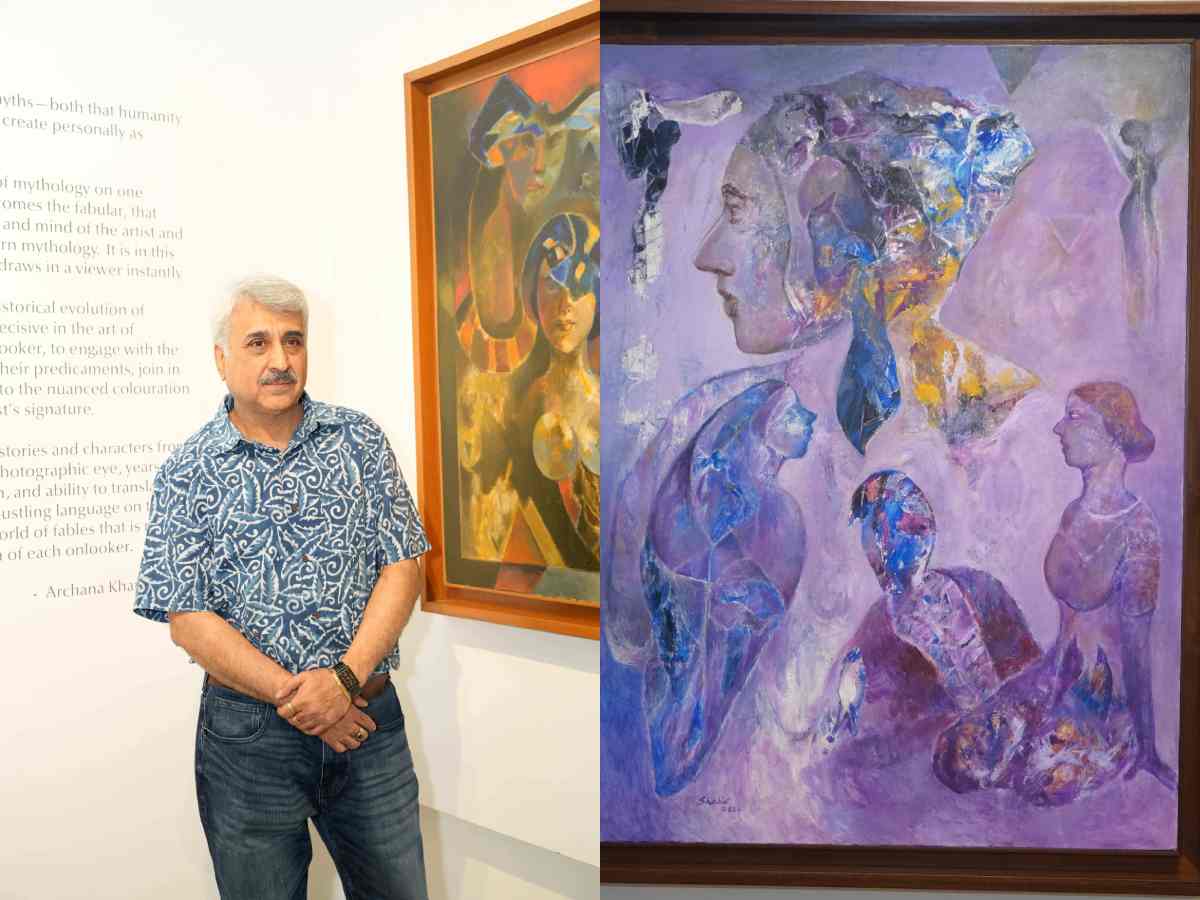
Shabir Hussain Santosh: Hidden in a quiet lane of Bharati Artists’ Colony in East Delhi, Shabir Hussain Santosh’s studio is more sanctuary than workplace. Unassuming from the outside, the space opens into a world of oil paints, handmade brushes, and shelves lined with books on mythology, art, and literature. Here, the artist paints in silence, resisting distractions and embracing solitude.
Born in 1962 in Delhi, Shabir Hussain Santosh is a distinguished Indian artist and photographer known for his evocative abstract works that blend personal heritage with philosophical depth. As the son of the renowned painter GR Santosh—a key figure in the Neo Tantra movement—Shabir was immersed in art from an early age. He earned his Bachelor of Fine Arts in Painting from the College of Art, New Delhi, in 1986.
Though his father’s work was widely celebrated, Shabir never felt the need to compete or replicate.
Also read: Vicky was brilliant in ‘Chhaava’: Riteish Deshmukh
“We shared silence more than words,” he says. “He painted with a deep sense of purpose. That stayed with me.”
There are no paintings by his father on the walls—only books and brushes, objects that speak without display. For Shabir, art is not about legacy.
“It’s not something you inherit. It’s something you search for, quietly, every day.”
That search continues, quietly and persistently, within the four walls of his East Delhi studio.
A language beyond words
Shabir has spent decades crafting a deeply personal visual language— one that neither conforms to trends nor seeks explanation. While his father’s practice was rooted in the sacred geometry of Neo-Tantra, Shabir’s canvases emerge from dreams, memory, and myth. His works drift between the figurative and the abstract.
He does not sketch before painting.
“The brush finds its way,” he says. “I don’t begin with a clear image in mind. It begins as a feeling, or sometimes, a silence.”
His paintings often feature human forms in half-revealed landscapes—faces merging with sky, limbs dissolving into mist. For Shabir, these are not portraits but presences.
“They’re not people I know. But they arrive. Sometimes they stay.”
Kashmir, his ancestral homeland, often returns in his work—not as a topography, but as an emotion.
“Even when I photograph or paint Kashmir, I am not documenting it. I am remembering it. It exists in me as a mood.”
Although born and raised in Delhi, Kashmir exists for him as an interior space—shaped by stories, poems, and his father’s meditative practice.
The act of making
Shabir mixes all his colours by hand—no shortcuts, no digital assistance.
“Colour has to be earned,” he says. “You can’t just squeeze it out of a tube.”
Each hue, each layer, is the result of patience, sometimes developed over weeks. He often paints for long stretches and then leaves a canvas untouched for months. Some works take years to find resolution.
“The painting decides when it’s finished. I just follow.”
He resists naming his works unless necessary. Even then, his titles are lyrical suggestions— phrases like Echo in the Valley or The Dream of the Sleeper.
“Words can trap a painting,” he says. “I prefer when a viewer brings their own silence to it.”
A solitary rhythm
Shabir’s daily routine is grounded and meditative. He begins his mornings with reading— mythology, poetry, and histories of painting. He then paints for several hours, breaking only for short walks or to water the plants that line his small verandah.
He avoids openings and art fairs. “The noise doesn’t suit me,” he says, with a shrug.
His studio is filled with unfinished canvases, dried pigment powders, and black-and-white photographs he has taken on his travels—many in Kashmir. Photography, for him, offers another way of seeing.
“Sometimes I need to leave the canvas. Photography takes me out. But it also brings me back.”
Memory and inheritance
Santosh’s artistic expression is deeply rooted in his Kashmiri heritage. His works often draw inspiration from the region’s landscapes, incorporating motifs of human figures, flora, and fauna. Using a distinctive palette and abstract forms, he creates compositions that invite viewers into a contemplative space.
His art delves into themes of time, memory, and existence— reflecting a philosophical approach that challenges perceptions and encourages introspection.
Throughout his career, Santosh has participated in numerous exhibitions, including solo and group shows at prominent galleries such as Art Pilgrim and Art 18/21. His works are part of esteemed collections, including those of the Lalit Kala Akademi, Sahitya Kala Parishad, and the Chandigarh Museum of Art.
In addition to painting, he is also an accomplished photographer— further showcasing his versatility and depth as an artist.
Also read: Floating identities: A tribute to urban Indian women
A quiet presence in Delhi
Most recently, his exhibition Beyond Myth and Metaphor was showcased at the Shridharani Gallery, Triveni Kala Sangam in Delhi, from April 22 to 30.
When asked about his city, he reflects, “I have spent my life here. Delhi is truly a great city—it offers opportunities for everyone to succeed. I cannot stay away from Delhi now, it will always hold a special place in my heart.”
And what drives him to continue creating?
“I don’t paint to make a point,” he says. “I paint to understand.”
Elected to the Delhi Golf Club general committee, Mansher Singh says he wants to build…
A $780 million market built on pavements, where the pleasure of reading meets the price…
Supreme Court advocate Abhishek Pawar alleges women were denied washroom access for seven to eight…
Each day of closure costs shops in Khan Market and Connaught Place between Rs 60,000…
Delhi generates nearly 15,000 tonnes of waste daily, prompting the government to deploy 1,000 mechanical…
Delhi Police has issued an NOC for the Congress rally at Ramlila Maidan on November…

