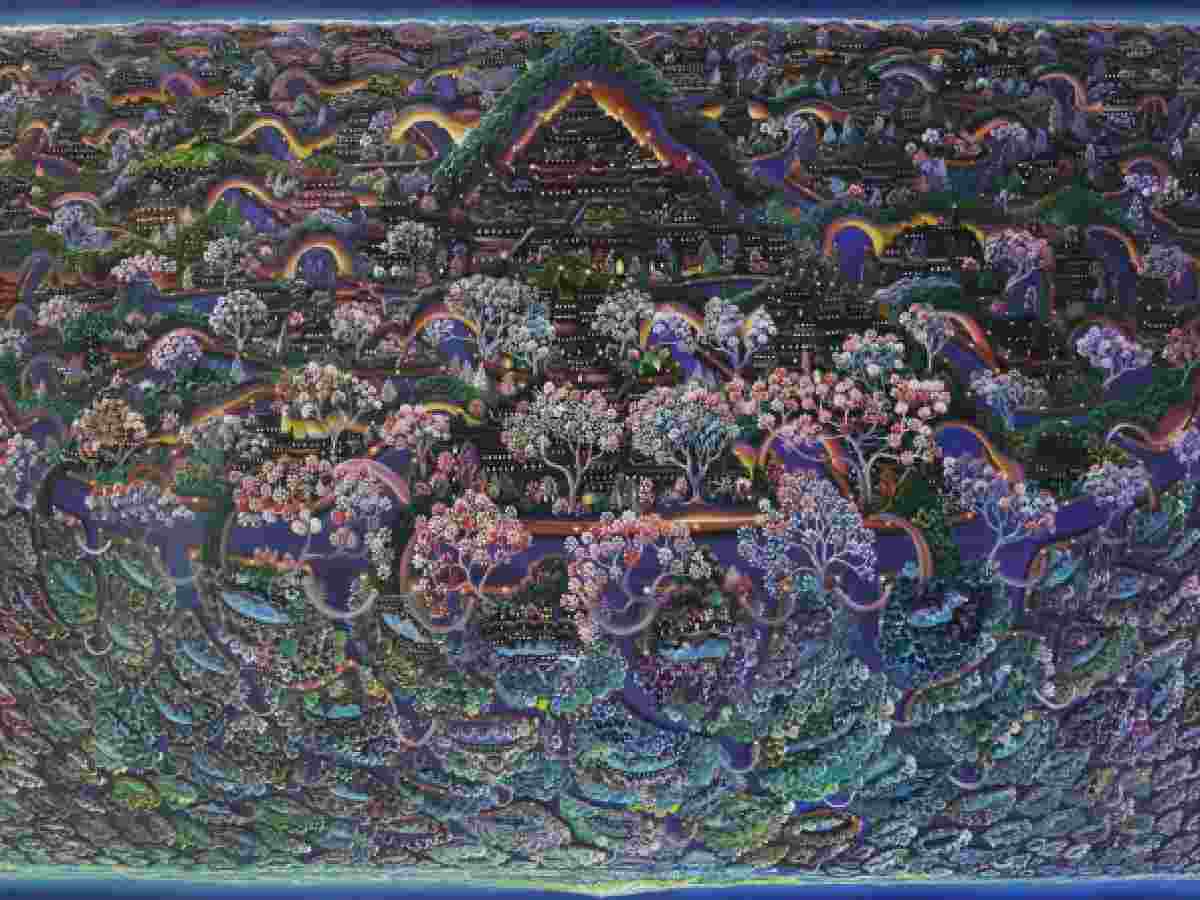
Luminous Twilight
On view at Palette Art Gallery from January 24 to February 20, The Luminous Twilight: Place No Trace / Trace No Place presents a series of paintings by artist Om Soorya that reconsider how landscapes are experienced in a time of constant movement and transformation.
Rather than depicting identifiable locations, the works approach landscape as a mental and emotional terrain shaped by memory, erasure, and the pressures of contemporary life.
The exhibition brings together primarily large-scale canvases drawn from different phases of Soorya’s two-decade-long practice. Across the works, fragmented horizons, floating architectural forms, and corroded surfaces replace conventional markers of place. These elements create environments that appear suspended between rural and urban, past and present, permanence and impermanence.
Soorya, who was born in Kannur, Kerala, and trained in History and Painting at Calicut University, the College of Fine Arts in Thiruvananthapuram, and the University of Hyderabad, has long engaged with questions of belonging and displacement. In this body of work, landscape functions less as a backdrop and more as an active presence shaped by development, surveillance, and everyday human intervention.
“I am interested in landscapes as emotional and psychological spaces rather than physical locations,” Soorya said. “These works emerge from living within shifting terrains, where memory, loss, and light coexist.”
Landscapes without geography
The paintings do not reference specific sites, instead relying on memory and imagination. Soorya often begins directly with paint, allowing uncertainty and material response to guide the composition. The resulting surfaces are built through layered pigments and tonal shifts, marked by corroded textures and muted hues.
Recurring motifs such as pathways, terraced forms, stupa-like structures, and dispersed clusters of light appear across the exhibition. These elements suggest cycles of disappearance and return, evoking landscapes that are continuously formed and dissolved. The absence of human figures further heightens a sense of isolation, placing emphasis on terrain as a carrier of experience.
Curator and writer Shalmali Shetty describes the works as evoking the “emotional residue of history rather than its documentation”, where traces remain even as stable meanings erode.
Also Read: Two exhibitions trace Seema Kohli’s evolving dialogue with body, memory and the sacred
Light plays a central role in the compositions, appearing as glowing orbs, diffused horizons, or faint illuminations embedded within darkened surfaces. These suggest both continuity and decay.
Place, trace, and impermanence
The phrase place no trace / trace no place, which forms the subtitle of The Luminous Twilight, points to the tension at the heart of the work. As landscapes are reshaped by urban expansion and ecological stress, cultural memory too becomes unstable. What remains, the exhibition suggests, are traces without fixed locations, and places without enduring markers.
Rohit Gandhi of Palette Art Gallery noted that the exhibition reflects contemporary conditions of uncertainty. “The Luminous Twilight is a poetic reflection on contemporary existence, where landscapes dissolve and meaning remains in motion,” he said.
Several works demand prolonged viewing. From a distance, they register as expansive, immersive terrains. Up close, they fragment into intricate architectural and topographical details. This shifting visual experience requires the viewer to move continuously across the canvas, reinforcing the sense of instability embedded in the subject matter.
An evening at the gallery
The opening evening saw the presence of figures from the art, fashion, and cultural community, including Sunil Sethi, Rajeev Sethi, Leena Singh, GR Iranna, Sujata Bajaj, Neerja Chandra Peter, and Pratul Dash. Conversations unfolded around the works in an intimate winter setting, creating an atmosphere conducive to reflection rather than spectacle.
Through The Luminous Twilight, Soorya positions landscape as an evolving state rather than a destination. The exhibition invites viewers to consider how places are remembered, altered, and ultimately dissolved, leaving behind fragments that continue to shape individual and collective consciousness.
The Supreme Court deferred pleas on Delhi protests and metro and train service curbs to…
A plea in the Supreme Court challenges restrictions on protests at Delhi’s Jantar Mantar and…
Delhi recorded an AQI of 138 in the moderate category on Tuesday, with the minimum…
A 29-year-old driver was allegedly beaten to death by nightclub bouncers in Delhi following a…
Delhi HC to hear pleas seeking regulation of protests in the capital on Tuesday, with…
From a Sikh family in Tilak Nagar performing Shastar Puja to a Malayali household inscribing…

