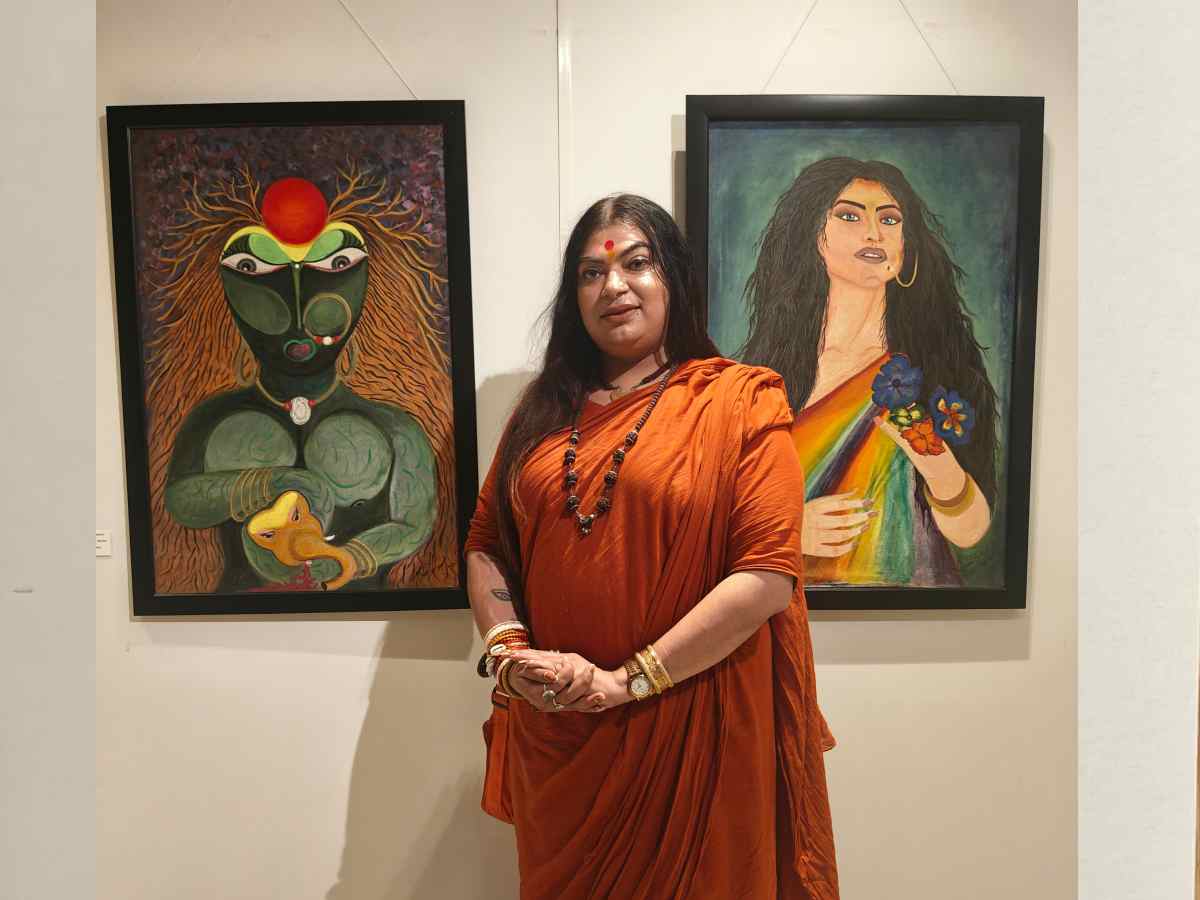
Artist Vaishnavi Jagdamba Nand Giri stands beside her works, which draw on Hindu mythology and her lived experience as a transgender woman
‘Unboxed 2.0’ is a Pride Month exhibition at Art Junction, The LaLiT New Delhi, featuring more than 20 queer artists from across India. The show brings together paintings, photography and mixed media works that explore lived experience through themes of mythology, faith, family, love, loss and belonging.
A woman with expectant eyes looks out from a canvas, waiting for desires that society has never allowed her to fulfil. Nearby, the Goddess Tripura Sundari appears serene before transforming into a fierce protector. Across the gallery, a series of photographs captures nothing more than the moon, clouds and the edge of a terrace — ordinary sights that become meditations on solitude and healing.
At first glance, the works seem unrelated. Yet together they form the emotional landscape of the exhibition.
Resisting labels
“There isn’t one way to describe queer art,” co-curator Praveen Mahto tells Patriot.
“Some artists speak directly about identity, while others are responding to ecology, migration, abstraction or everyday life. What brings them together is that they are queer artists whose work deserves to be seen.”
A shift in focus
Unlike the previous edition, which featured more established practitioners, this year’s exhibition deliberately shifts the focus towards younger and lesser-known artists.
“We wanted to create space for emerging voices,” says Mahto. “Many of these artists are just beginning their journeys. Their work comes from deeply personal experiences, but it also reimagines mythology, explores gender fluidity, love and loss, often drawing upon Indian spiritual and cultural imagery. For many of them, making art is inseparable from claiming space.”
That sense of reclaiming space is visible throughout the gallery.
Myth and identity
Among the most striking works are those of Vaishnavi Jagdamba Nand Giri, a Mahamandaleshwar whose paintings merge Hindu mythology with her lived experience as a transgender woman.
She says her painting, The Manifestation of Tripura Sundari, portrays the goddess as both nurturing and destructive, drawing on the mythological episode in which Parvati transforms into a fierce force after her son Ganesha is attacked.
“Nature itself is Shakti,” Vaishnavi says. “A mother is full of love, but when danger comes to her child, she can transform into any form to protect them. That is the strength I wanted to show.”
Unfulfilled hopes
Her second work, Unmet Desire, leaves mythology behind and turns inward. The painting depicts a transgender woman carrying hopes caught between acceptance and rejection.
“She has many expectations from society,” Vaishnavi explains. “But throughout her life, those desires remain incomplete because society doesn’t fully understand or accept her. If you look into her eyes, she is still waiting. She still believes those dreams can one day come true.”
The work, she admits, is rooted in her own experiences.
“We expected a lot from people, but many couldn’t understand us. There were emotions we couldn’t express because we didn’t receive the support we needed.”
Beyond stereotypes
For Vaishnavi, exhibiting alongside other queer artists is significant in itself.
“People often don’t realise how talented our community is,” she says. “This platform gives us an opportunity to show our work. Society should see us beyond stereotypes and recognise that we contribute in every field.”
For Gurugram-based artist Ember, inspiration comes not from mythology but from everyday life.
“My work is about ordinary things,” they say. “Everything around us carries so many stories, yet we usually take them for granted.”
One painting documents the final day of a trip to Mumbai through the image of packed luggage. Another depicts an abandoned balcony in their parents’ home where neglected plants continued to thrive among discarded bottles and household clutter.
“I kept thinking that maybe being abandoned was exactly what they needed to flourish,” Ember says.
Beyond use
The works also question contemporary consumer culture.
“Everything we own—our phones, clothes or shoes—has a history,” they explain. “There are historical stories and personal stories attached to every object. We don’t really need much more than that.”
When asked whether art should necessarily serve a social or ethical purpose, Ember avoids drawing boundaries.
“I don’t want to say what art can or cannot be,” they say. “Anything can be art.”
Quiet reflections
Elsewhere in the gallery, photographer Renu Dhiman offers perhaps the quietest body of work in the exhibition. Her photographs focus on the moon framed by terraces and drifting clouds, images born out of evenings spent alone.
“I often went up to my terrace and sat there reflecting on life while looking at the moon,” she says. “It became a meditative space for me, and I wanted to preserve those moments through my camera.”
If some artists speak through vivid colours and symbolism, Dhiman’s photographs suggest that stillness itself can become an act of expression.
The curatorial vision
For co-curator Naresh Kapuria, Director of Art and Culture at The LaLiT, the exhibition was never intended as another symbolic Pride Month event.
“‘Unboxed’ is about breaking free from labels and expectations,” he says. “Queer lives in India have always carried stories of resilience, and we wanted to create a space where those stories could exist without being simplified.”
One work that continues to stay with him is The Museum of Masculinity, a self-portrait by a queer artist negotiating masculinity while remaining closeted within their own family.
“The vulnerability, the rage and the quiet grief in that work stayed with me,” Kapuria says. “It reminded me that behind every artwork is someone who has fought simply to be themselves.”
Kapuria also believes younger artists are expanding how queerness is represented in contemporary Indian art.
“They are drawing from drag, internet culture, protest, digital intimacy and everyday life,” he says. “Their work isn’t asking for permission to exist. It is speaking with confidence.”
That confidence is evident as visitors move through the exhibition. Some works revisit mythology through a queer lens, while others dwell on migration, family memories, loneliness or ecological concerns. There are portraits that confront viewers directly and photographs that ask them to slow down instead.
Room for difference
For Keshav Suri, Executive Director of The LaLiT and founder of the Keshav Suri Foundation, creating such spaces remains essential.
“Inclusion is woven into the DNA of The LaLiT,” he says. “‘Unboxed’ is our way of making room for stories that challenge norms, spark conversations and celebrate the power of being exactly who you are.”
Yet perhaps the exhibition’s greatest strength lies in what it refuses to do. It does not attempt to define queer art or speak on behalf of an entire community. Instead, it allows artists to speak in distinctly individual voices—through mythology, photography, abstraction, memory and everyday life.
As Pride Month draws to a close, Unboxed 2.0 leaves behind a simple but enduring impression: that queer artists are not confined to stories of struggle alone. They are storytellers, observers, dreamers and chroniclers of contemporary India, each reshaping the canvas — and the conversation — in their own way.
The exhibition, organised by The LaLiT Suri Hospitality Group and the Keshav Suri Foundation and curated by Kapuria, Mahto and Shashi Baghwar, runs until July 15 and offers free entry.
AAP holds Tiranga march near Rashtrapati Bhavan demanding CEC Gyanesh Kumar's resignation, asserting right to…
Developers create online games like 'Bhaag Neha Bhaag' inspired by Delhi's Jantar Mantar protests, turning…
Flash protests erupt in CP and Mandi House as CJP and students demand SIR rollback…
CJP's Dipke and AISA chief Neha Bohra detained in Delhi while heading to Connaught Place…
Delhi court acquits 7 of murder in 2020 riots case due to lack of evidence,…
From citrus peels and banana skins to tomato pulp and lemon rinds, chefs in Delhi-NCR…


