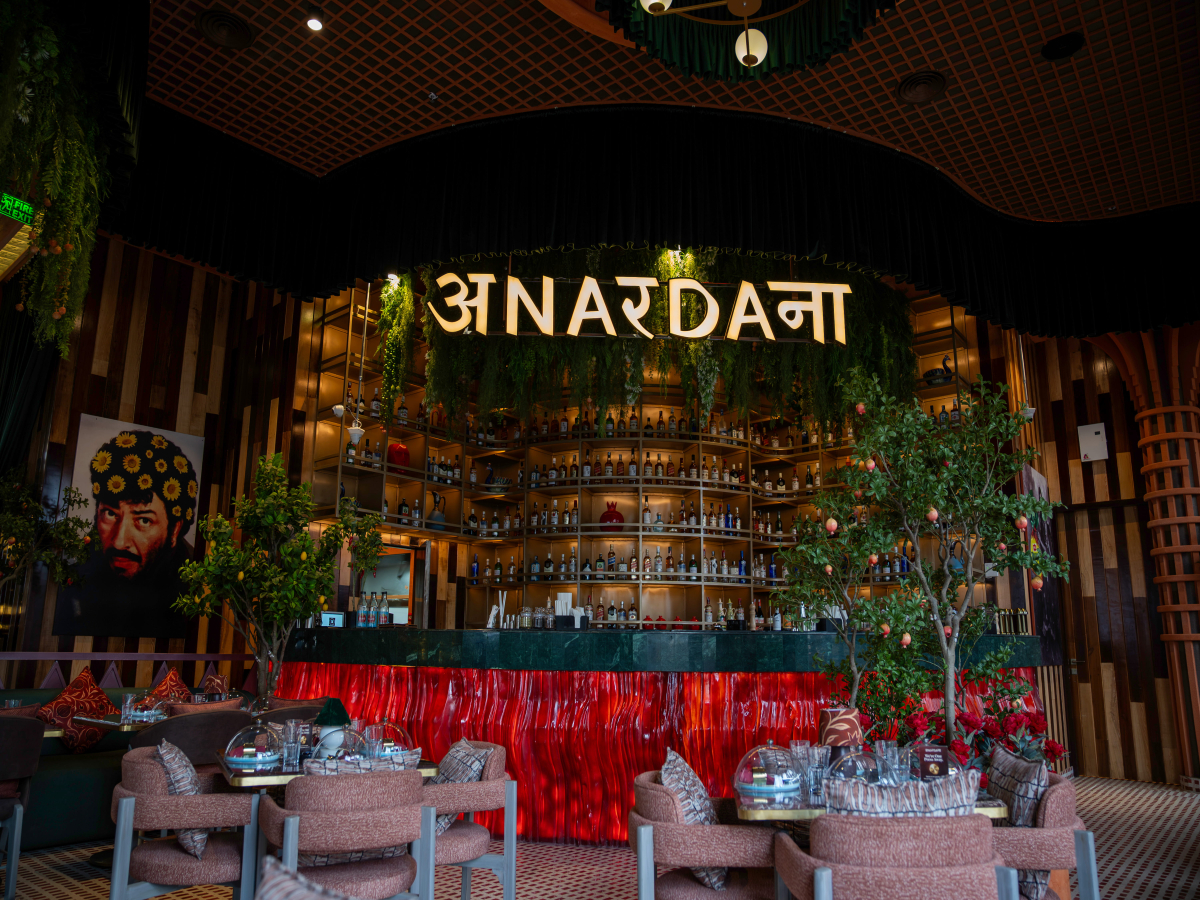
Anardana's interiors
Anardana has opened its 14th outlet in Noida’s Sector 50, its largest location to date, spread across 4,000 square feet. The new restaurant features an expanded menu and contemporary Indian-inspired interiors, with food, music and design forming part of its offering.
Founded in 2018, Anardana now has outlets across North India. The chain specialises in modern Indian cuisine, and its restaurants vary their menus and interiors according to their locations. The Sector 50 outlet is the brand’s largest and marks its latest expansion in the region.
A new flagship
The Sector 50 outlet is the largest in the Anardana chain. According to Anil Giri, Executive President of Anardana Hospitality Private Ltd, it is significantly larger than several of the brand’s existing restaurants, including the 2,000-square-foot outlet in Karkardooma and the 1,600-square-foot outlet in Sangam Vihar.
The restaurant is currently in its soft-launch phase, with a formal opening planned after the brand’s media outreach.
For Anardana, the restaurant is intended to be more than a place to eat. “We do not sell food” is the brand’s tagline, Giri says. According to him, the restaurant brings together cuisine, ambience, music, hospitality and time spent with family.
Giri says the idea was developed with the changing lifestyles of people in the NCR in mind, where nuclear families may have fewer opportunities to spend time together. He says the restaurant aims to cater to different generations and preferences within the same family. Parents can choose familiar Indian dishes such as Dal Makhani and Butter Chicken, while children can opt for dishes such as pizza and pasta. The menu also includes cocktails and mocktails with distinct presentations. The idea, he explains, is to provide a range of food and ambience that appeals to different members of a family.
The music includes a mix of Hindi and English tracks, kept at a volume that allows diners to converse comfortably.
Growing with customers
Anardana now has 14 outlets, a growth Giri attributes in part to customer feedback.
“Today, if we have launched 14 locations, it is only because of customer blessings.”
He says the team regularly reviews customer feedback to understand diners’ preferences and identify areas for improvement.
A local touch
The brand follows a model in which its restaurants share a common identity but are not exact replicas of one another.
Giri says that while the menu is broadly consistent across the chain, around 20% is modified according to the locality and preferences of local customers. The same approach is followed for the interiors. While certain textures and elements are retained to maintain a connection with the brand, around 90% of the interiors differ from one outlet to another.
“These are three or four parameters that Anardana is opening with,” he says, referring to the brand’s approach of adapting its restaurants to local preferences while maintaining a common identity.
A new menu
The Sector 50 outlet has a new menu featuring several dishes that are not currently available at the other 13 Anardana restaurants.
Giri says the restaurant has introduced a Chef’s Special menu with six to seven new dishes, including the Goli Kebab. The idea, he says, is to introduce new dishes with each outlet while maintaining consistency across the chain’s food and beverage offerings.
The new menu includes vegetarian options such as In Pulled Jackfruit Cannelloni, in which ghee-roasted pulled jackfruit is rolled in cannelloni and baked in a saffron cream sauce.
Among the non-vegetarian dishes is Butter Chicken Gujiya, with tandoori chicken-filled gujiyas topped with Parmesan cheese and served with makhani sauce.
Another new dish is the Malai Chicken Roulade, with stuffed malai chicken served with mashed potatoes and smoked red bell pepper sauce. Other new mains include the Achari Chicken Breast, a mushroom-stuffed chicken breast served with a pickle brush and mushroom-pepper sauce with edamame.
The Lamb Ragout Sambusa is served with puffed rice, while the Mutton Goli Kebab comes with gilafi kulcha and three chutneys made with walnut, radish and eggplant.
For dessert, Anardana introduces the Rasgulla Tiramisu, with rasgulla soaked in coffee and rum and layered with mascarpone and cacao, combining elements of the Indian sweet with the Italian dessert.
The new menu has been developed by the kitchen team under the supervision of Chef Aditya Jha.
A fluid interior
The Sector 50 restaurant uses curved forms, different levels and a mix of materials to create a contemporary Indian-inspired interior. Instead of a conventional layout, the space is divided into interconnected areas, with changes in height and perspective creating variation across the restaurant.
A double-height space forms the centre of the restaurant, with sculptural domes, suspended installations and greenery extending into the upper level. Integrated lighting is used throughout the space.
A visual connection
Pomegranate plants and pomegranate-themed fruit installations feature throughout the restaurant, creating a visual link with the name Anardana. Some of the fruit installations are artificial and designed to resemble real pomegranates.
The interiors use terracotta flooring, textured finishes, timber battens, lattice screens and natural stone. Sculptural columns and custom joinery are also used throughout the space.
At the centre, a double-height bar anchors the interior and serves as both a visual focal point and a central point around which the dining areas are arranged. Curved seating, raised platforms and framed sightlines create different sections while maintaining connections between them.
The Indian touch
The design relies less on ornament and more on proportion, materials and the arrangement of the space. The architecture is intended to play as much a role in the dining experience as the food, combining contemporary elements with Indian influences.
According to Giri, the design process is driven by customer needs and feedback, while also seeking to differentiate every Anardana outlet.
The restaurant’s in-house architectural team works on the designs, with the core design vision coming from Anardana founder Dr Ritesh Malik. Giri says Malik’s previous experience with interiors and his work with Innov8 co-working spaces has contributed to the brand’s approach to restaurant design.
Malik had earlier managed around 2.1 million square feet of commercial space at Innov8 before selling the business, Giri says. The design team also includes Chrome Design, Abhigyan and Anardana’s internal team led by CDO Seel.
A familiar face
A picture of actor Amjad Khan is a recurring visual element across Anardana outlets. Giri says it appears in most of the chain’s restaurants and has been popular with customers since the brand’s early days.
The image, which shows a sunflower placed on Amjad Khan’s head, was chosen for its distinctive appearance rather than as a personal favourite, he says.
Pomegranate and other fruit installations are also used across the restaurant, with some designed to resemble real fruit despite being artificial.
The double-height bar is another prominent feature of the new outlet. Its design has led to suggestions that it could eventually be given the name “Anardana Bar.”
The name Anardana was chosen when the brand was launched in 2017. Giri says the team wanted a name that would be familiar and easy to remember across India.
A stronger foothold
For Anardana, the Sector 50 outlet marks a deeper presence in Noida, where the brand already operates a restaurant in Sector 129. Co-founder Shruti Malik says the response to the earlier outlet encouraged the company to expand its presence in the city. “Noida has always been an important market for us, and the love we’ve received at our Sector 129 outlet gave us the confidence to deepen our presence in the city,” Malik says.
The brand expects the Sector 50 outlet to become a key dining destination in Noida as it enters its next phase of expansion. For Giri, the measure of success is simpler: the continued acceptance of the concept among customers. Asked if he was satisfied with the journey so far, he said he was “100%” satisfied — as was his team.
Read More: A café for every hour: the story of AFETO
BJP veteran LK Advani, has been admitted to Apollo Hospital in Delhi with a chest…
Women's groups marched to Delhi Police HQ to demand action against officers accused of sexually…
Delhi Police registered multiple FIRs after crowds defied prohibitory orders during CJP's 'Lehra Do Tiranga'…
One was killed and five were injured when a DTC bus lost control after hitting…
From Urdu dialogues in Faridabad to Delhi’s historic celebrations, Ramlila has many stories to tell
Delhi Police issued Flag Code guidelines following CJP's 'Lehra Do Tiranga' march, emphasizing proper display…
