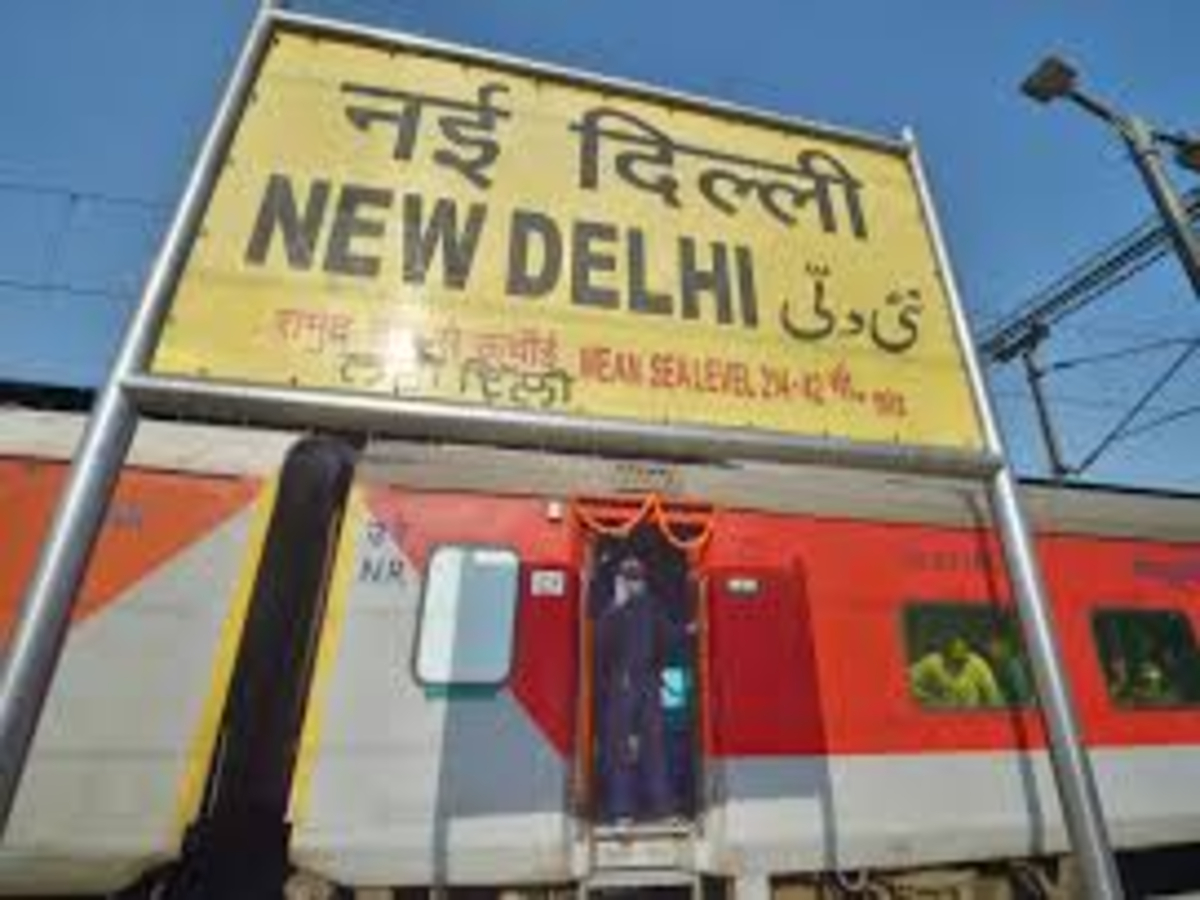
New Delhi station
Nearly a century ago, New Delhi could have been called Imperial Delhi, Raisina or Delhi South. After years of official deliberations, King George V formally approved the name New Delhi on December 31, 1926.
There was no separate committee tasked with naming the city. The decision emerged from the broader process of planning and building the new Capital. The chosen name retained its connection with older Delhi while distinguishing the new administrative centre being built to its south.
As New Delhi approaches the centenary of its official naming, the effects of that decision remain visible across the city, even as its roads, buildings and neighbourhoods continue to change.
From Calcutta to Delhi
The roots of the decision stretch back to December 1911, when King George V and Queen Mary arrived in Delhi for a grand coronation durbar.
On December 12, before an assembly of princes, officials and members of the public, the king announced that the Capital of British India would be moved from Calcutta to Delhi.
Delhi had long been a seat of power, serving as the Capital of several sultanates and the Mughal Empire. It would now become the centre of British India’s imperial administration.
For years afterwards, the area was referred to simply as the new capital, the imperial city or the new imperial capital. Plans took shape gradually, and land was acquired to the south of the Mughal city of Shahjahanabad. The question of an official name, however, remained unresolved.
The First World War slowed the project as funds and building materials became scarce. Construction nevertheless continued, while official letters and documents used different names for the emerging city.
Choosing New Delhi
Historian Swapna Liddle records in her book Connaught Place and the Making of New Delhi that the names considered included Imperial Delhi, Raisina and Delhi South.
Imperial Delhi emphasised the city’s intended role as the seat of the British Empire in India. Raisina connected it with the hill on which the principal government buildings were being constructed, while Delhi South described its geographical position in relation to the older city.
The options were considered through official correspondence and discussions rather than by a committee constituted specifically for the purpose.
Officials eventually selected New Delhi. The chosen name retained Delhi and added the word “New”, connecting the new Capital with the older city.
On December 31, 1926, King George V formally approved the name. A Home Department notification preserved in the National Archives of India announced that the King-Emperor had approved New Delhi as the name of the new Capital and that it would be brought into use immediately.
The city was formally inaugurated by Viceroy Lord Irwin on February 13, 1931. By then, the name New Delhi had already entered common use.
Names that connected past and present
British historian Percival Spear lived in Delhi and taught at St Stephen’s College while the new Capital was taking shape. He later wrote Delhi: A Historical Sketch, published in 1937, and Delhi: Its Monuments and History.
Spear observed how several roads had been named after figures from Indian history. Akbar Road, Shahjahan Road and Tughlaq Road appeared alongside streets named after British viceroys and officials. The road names reflected both India’s history and the city’s colonial administration.
Spear has also been associated with the selection of road names, although the extent of his role remains uncertain. His writings documented several of the choices made during the development of the new Capital.
A transformed Capital
Much of the city built during that period remains visible nearly 100 years later.
The avenues planned for the new Capital continue to run through central Delhi, while trees planted along them shade the pavements. Rashtrapati Bhavan, formerly the Viceroy’s House, rises over Raisina Hill. The North and South Blocks, India Gate and Connaught Place remain among New Delhi’s most recognisable landmarks.
The North and South Blocks have now been vacated by the Union Government and are set to become part of the proposed Yuge Yugeen Bharat National Museum. Several road names, including Akbar Road and Ashoka Road, have survived unchanged.
“We all know that nothing is permanent. Our Capital is changing fast,” said University of Delhi Professor Anirudh Deshpande, who heads its Department of History.
Recalling the transformation of the area in which he once lived, he said, “My house, or I should say the area known as Barron Road near Ramlila Ground, is not there. All new buildings have come up there.”
Power has passed from colonial hands to an independent republic, he noted. Metro trains now run beneath the old avenues, while office towers and apartments fill the skyline. Traffic fills roads that once carried only a few cars and horse-drawn carriages.
“Yet the name endures. It carries a quiet memory of that winter day in 1926 when a formal decision settled years of uncertainty,” Deshpande said.
The name New Delhi has survived even as several colonial-era road names have disappeared. King George’s Avenue, for instance, was renamed Rajaji Marg after Independence.
Read More: Five turning points for Delhi since 1947
MCD pushes Bhalswa cleanup to Feb 2027 due to agency transition, leaving over 10 lakh…
BJP veteran LK Advani, has been admitted to Apollo Hospital in Delhi with a chest…
Women's groups marched to Delhi Police HQ to demand action against officers accused of sexually…
Delhi Police registered multiple FIRs after crowds defied prohibitory orders during CJP's 'Lehra Do Tiranga'…
One was killed and five were injured when a DTC bus lost control after hitting…
From Urdu dialogues in Faridabad to Delhi’s historic celebrations, Ramlila has many stories to tell
