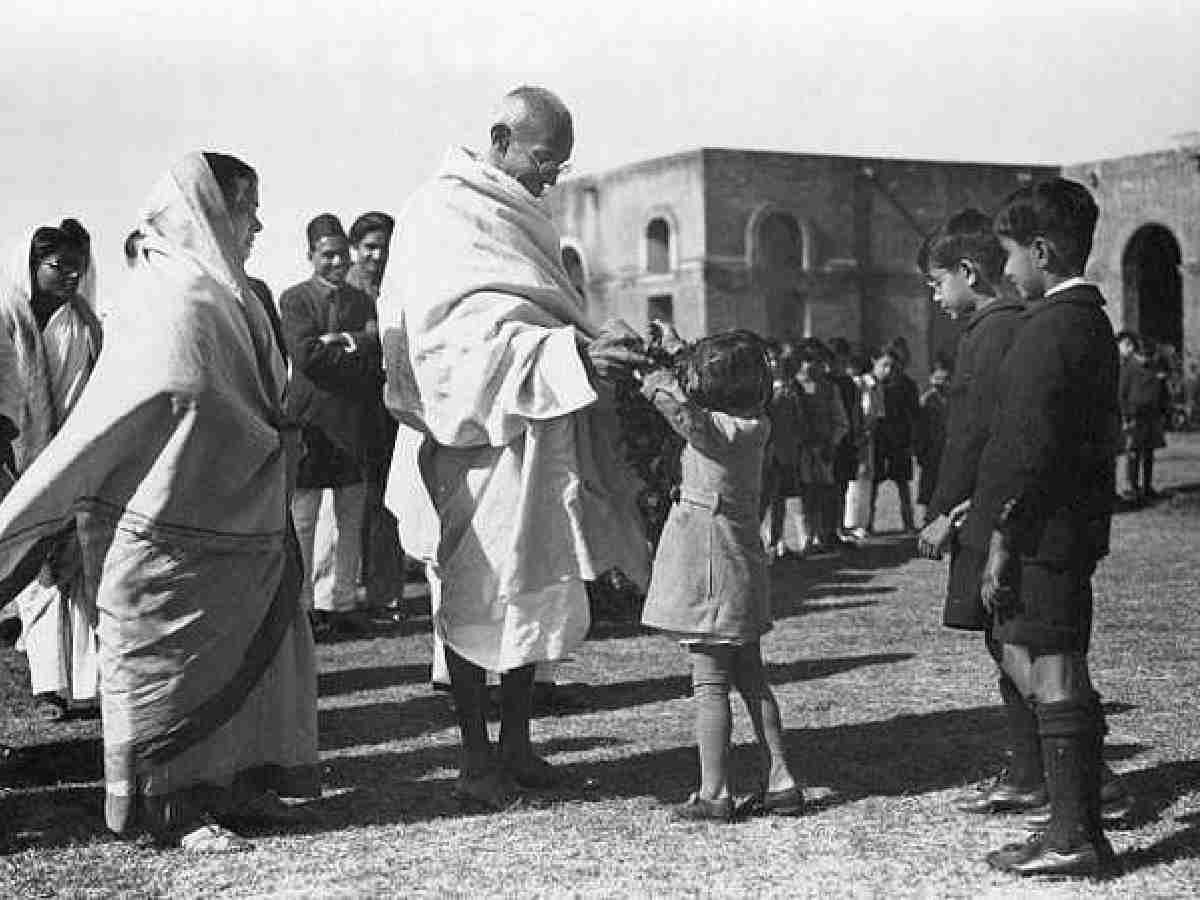
Mahatma Gandhi interacting with children
Mandir Marg is a street of temples – some devoted to worship, others to learning. It is said to have more schools than any other street in Delhi.
It is also a street associated with Mahatma Gandhi, who confronted questions of untouchability and caste here. Did the presence of schools on the street influence his decision to teach? Perhaps. What is certain is that, during his stay at Valmiki Mandir, he took on the role of a teacher in a particularly direct way.
Open to all
On March 12, 1939, Gandhi inaugurated Birla Mandir on the condition that it be open to all. Social worker Pritam Dhariwal, who knows this stretch of Mandir Marg well, tells visitors the story: Gandhi agreed to open the temple only if people of every caste were allowed to enter.
For days, 64-year-old Krishna Vidyarthi has been refurbishing the small room in Valmiki Mandir where Gandhi lived and taught. On Gandhi Jayanti, an interfaith prayer meeting will be held there. Vidyarthi, who has the air of a seer, is the temple’s caretaker.
But Gandhi’s association with Mandir Marg began several years before his stay at Valmiki Mandir.
Two temples on one street bear Gandhi’s imprint. For him, they were not only places of worship but also settings in which he sought to challenge the practice of untouchability.
He believed that Hindus then described as “low caste” had the same right to enter temples as anyone else. He secured a commitment from the Birla family that no one would be stopped at the gate because of their birth. That commitment remains visible today: near the main entrance, a plaque records that entry is not barred on grounds of caste.
A different faith
Beside Birla Mandir stands another place of worship that Gandhi inaugurated in 1939: the Mahabodhi Temple, Delhi’s first Buddhist temple. On Buddha Purnima, its courtyard draws diplomats from Japan, Korea, Thailand, Sri Lanka, Vietnam and other Buddhist countries. Over the years, Rajendra Prasad, S Radhakrishnan, BR Ambedkar and Indira Gandhi have also visited on special occasions. Inside stands a statue of the Buddha presented by Jawaharlal Nehru and carved by sculptors from Myanmar. Sri Lankan pilgrims have long visited this quiet corner of Mandir Marg.
“I have been visiting here with my parents and other family members since my childhood,” says Ravinder Kumar, a noted author. “This Mahabodhi Temple is very special for the Buddhist community of Delhi.”
The teacher
In April 1946, Gandhi began living among Valmiki families on the temple campus. During those 214 days, he was a teacher in the fullest sense. He believed that education was essential to changing the circumstances of the Valmiki community. When he arrived, many Valmiki families still lived in slums and worked as sweepers in Gole Market, on Irwin Road and around Connaught Place.
Krishna Vidyarthi recalls the story of Gandhi the schoolmaster. After moving into the temple complex, Gandhi went from house to house and found that many of the residents were illiterate and had never attended a classroom. He asked their families to send their children to him and offered to teach them himself.
He arranged classes in the morning and evening. So closely did he adhere to the schedule that he sometimes postponed meetings with prominent leaders of the freedom struggle so that a lesson could continue. Class began before the daily prayer, and during both the lesson and the prayer he did not receive visitors.
The American writer Louis Fischer discovered this for himself. He came to Valmiki Mandir for an interview, but Gandhi met him only after the prayer was over. Fischer spent more than a month in Delhi in 1946 gathering material for his book, The Life of Mahatma Gandhi.
Where Gandhi lived
Today, if you walk into Gandhi’s small room, the past remains visible on its walls. Old photographs, yellowed with time, show him with Lord and Lady Mountbatten, Acharya Kripalani, Khan Abdul Ghaffar Khan, C Rajagopalachari, Sardar Patel, Maulana Azad and Jawaharlal Nehru.
Also Read: Delhi’s Town Hall: the building that never left the people
Those months were among the busiest in India’s political life. The Cabinet Mission was in Delhi, and talks on the transfer of power continued day after day. Congress leaders came to the Valmiki colony to consult Gandhi. Yet he continued to make time for children who had never held a book. He taught them Hindi and English. The class, which began with about 30 children, soon grew to about 75, with boys and girls coming from Gole Market, Paharganj and Irwin Road.
One faded painting offers another glimpse of those classes. Several children cling to Bapu’s feet, though the painter’s name has been lost. A carpet covers the floor. In the centre stands the wooden table at which Gandhi wrote; to the right is the simple bed on which he slept, with a small spinning wheel beside it. Little in the room has been altered, and it remains much as it was during his stay.
More than lessons
For Gandhi, the lesson was not only about letters and words. Education was also a way of challenging the idea that some people were born to be treated as less than others.
Krishna Vidyarthi continues to maintain the room and the rhythm associated with it. On Gandhi Jayanti, the prayer meeting will begin as it did in Bapu’s time, with bhajans that Gandhi loved. The small room will then be opened to visitors, who will see the table, the bed and the charkha, along with the photographs and the painting of the children at his feet.
Delhi HC will rule Oct 23 on AISA chief Neha Bora’s plea against a police…
A CREA analysis shows Delhi's winter AQI has seen no steady gain since 2022, with…
DMRC will plant over 28,000 saplings across 991 MCD parks in 3 months to offset…
Delhi HC quashed an FIR against an SSC aspirant, ruling mere presence at a protest…
CJP leaders Saurav Das and Ashutosh Ranka sought more time to join the Delhi Police…
Delhi Police held 3 more people, including a couple using a minor to sell heroin…

