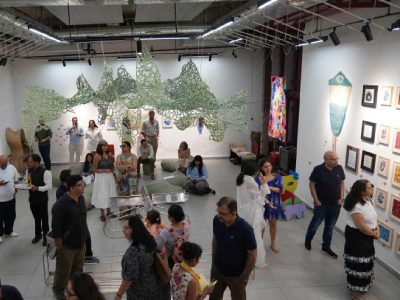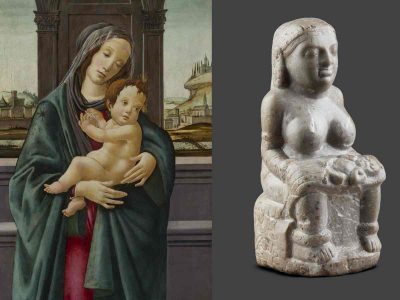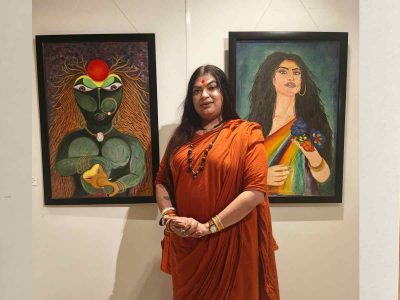
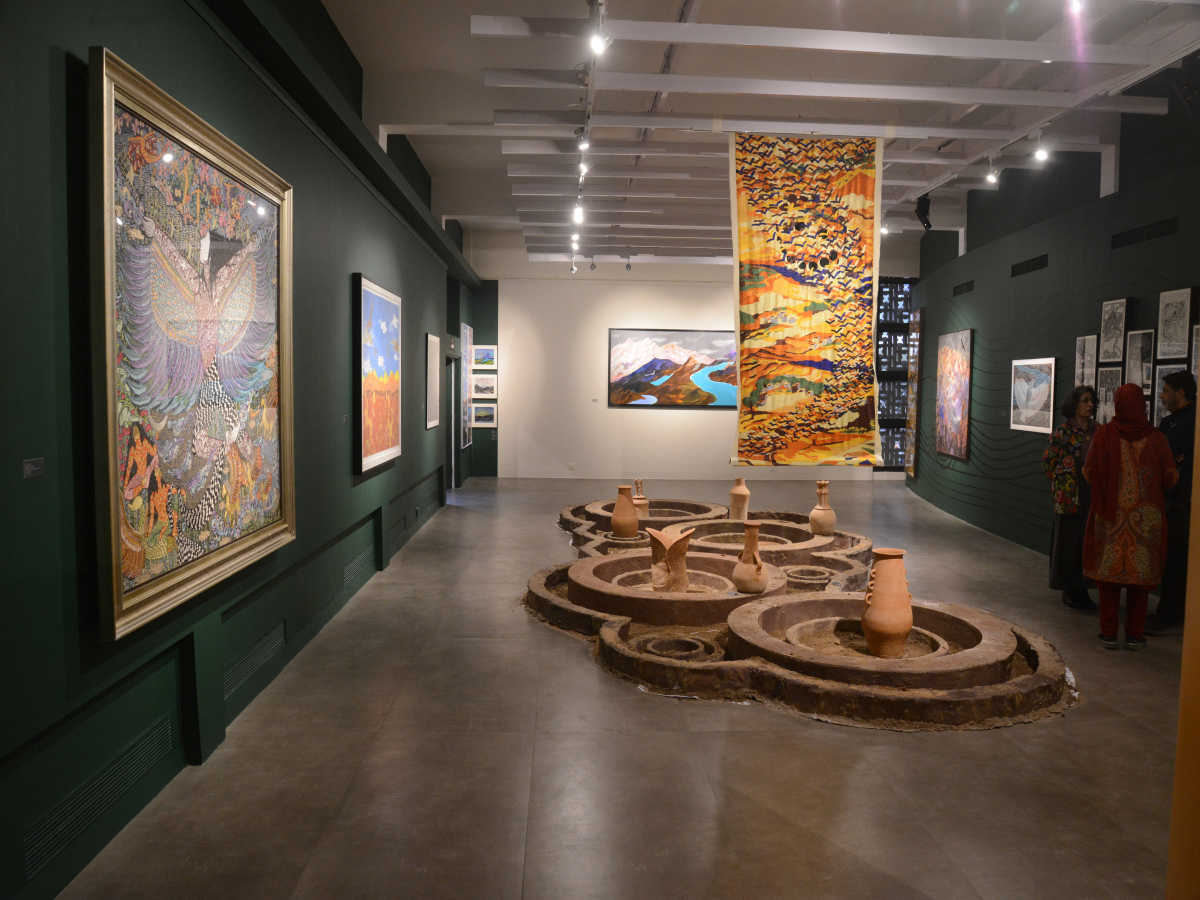
At Triveni Kala Sangam, Gallerie Nvya brings together two exhibitions by Seema Kohli—Bodies of Sky, Bodies of Earth, curated by Satyajit Dave and presented at the Shridharani Gallery, and With Her Hair Running Wild at Gallerie Nvya’s own space. Opening on January 18, 2026, the shows run concurrently, creating a rare opportunity to engage with Kohli’s work across time, material, and emotional register.
Together, the exhibitions bring into view over four decades of Kohli’s artistic practice, tracing multiple strands of her engagement with the body, the sacred, memory, and feminine self-making. Bodies of Sky, Bodies of Earth remains on view till January 25, while With Her Hair Running Wild runs till March 15.
An evolving continuum
Seen together, the exhibitions reveal Kohli’s work not as discrete phases but as an evolving continuum. While Bodies of Sky, Bodies of Earth explores, in the artist’s words, “the idea of the body as an archive of earth, species and stories”, With Her Hair Running Wild draws upon “stories of undomesticated goddesses and impassioned gods”, rooted as much in lived experience as in mythic imagination.
Living archives
In Bodies of Sky, Bodies of Earth, Kohli’s multidisciplinary practice—spanning terracotta, wood, printmaking, embroidery, sculpture, and mixed media—foregrounds material as memory. Forms appear animated by the processes that shaped them: earth fired into vessels, wood bearing the trace of pressure, embroidered birds suggesting migration and continuity. Goddess figures recur not as icons but as composite bodies holding forests, species, and layered narratives within their skins.
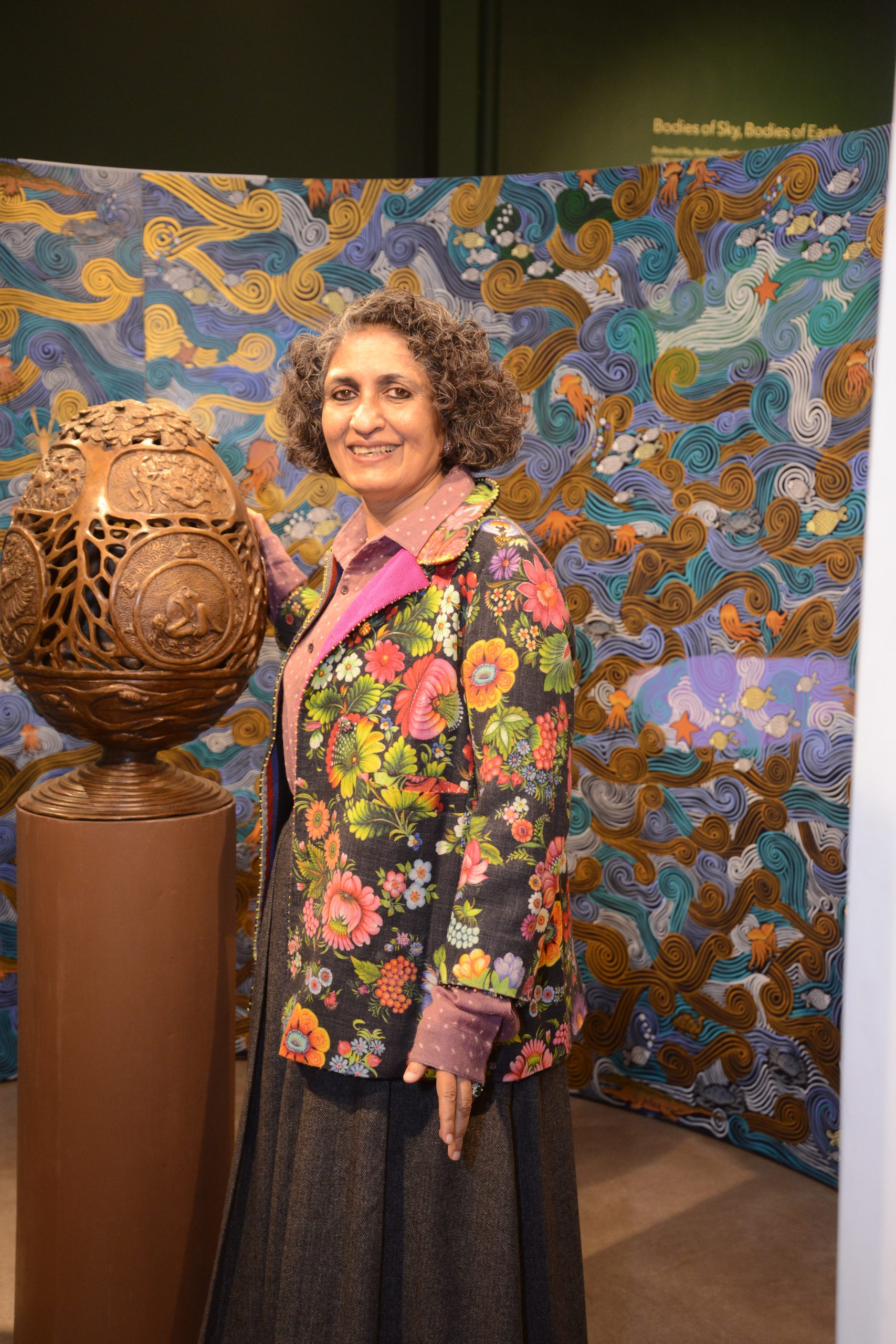
This expansive understanding of the body reflects Kohli’s long-standing engagement with fluidity and transformation. “A lot of my work naturally leans towards the transformational energies of the feminine,” she has said. “What really attracts me… is the vast, deviating variant of the energy forms of the feminine that I am constantly exploring through my practice.”
Drawing upon ancient metaphysical texts and mythological figures, Kohli’s work resists fixed gender binaries. Through figures such as Ardhanarishwar and the many ambiguous beings of the Hindu pantheon, she has come to understand “gender as a spectrum”. Sexuality, in her work, emerges not as a biological marker but as a creative force. “I have systematically deconstructed sexuality, which figures as a voracious fecundity and creative potential that cuts across the sexes,” she explained, describing it as an energy that “exonerates the body from the hegemonic structures of binary gender”.
Night sketches and liberation
If Bodies of Sky, Bodies of Earth turns outward to the elemental and cosmic, With Her Hair Running Wild turns inward, tracing Kohli’s artistic evolution against domestic constraint and social regulation. As curator Adwait notes, the exhibition “marks different phases of her artistic journey—from a time when she was reduced to making quick sketches during the night to her trepid explorations of colour at Triveni, and the emergence of bold palettes and patterns that have come to define her oeuvre”.
The exhibition brings together works from the 1980s onwards, beginning with pen-and-ink drawings made furtively at night, when paints were frowned upon in her marital home and time for art had to be carved out of exhaustion. “Behind these frames lie stories of domestic breakout, unexpected support and solidarity, and a gradual cobbling together of a space of one’s own from conjugal ruins,” Adwait writes.
These early works gravitate towards figures of unrestrained femininity—most notably Kali—whose wild hair, abject body, and transgressive presence offered Kohli a language of resistance. Alongside Kali appear figures such as Sati and Shiva, through whom the artist interrogates patriarchal rituals and the emotional economies of marriage. In one drawing, Shiva’s feminised form signals a turning point, as Kohli realises she must become “her own saviour”.
Some works move beyond myth into overt political critique, questioning the violence of the gaze and the policing of women’s bodies long before such debates entered mainstream discourse. Against these diktats, Kohli advances the image of the wild woman—uncensored in appearance, affect, and desire.
From restraint to colour
The exhibition also charts Kohli’s return to painting in the late 1990s and early 2000s, following her association with Triveni Kala Sangam and mentorship under Rameshwar Broota. Oil paintings from this period, produced on these very premises, reflect what Kohli describes as years of inner negotiation. “My art is a conversation with myself and my environs; my body with the trees, birds, skies and rivers,” she has said.
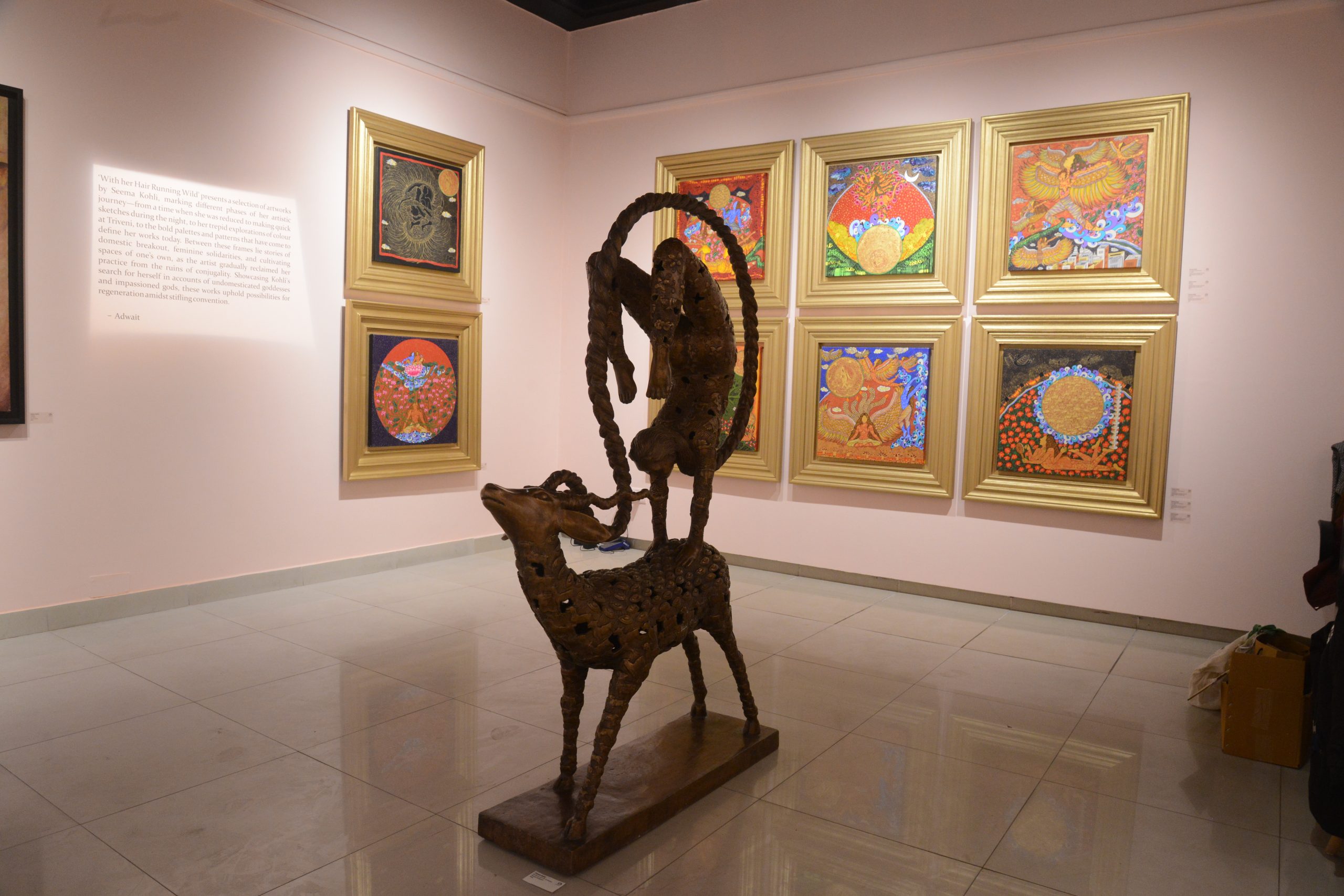
Symbols of confinement—bars, plumb bobs, chained figures—hint at a stalemate between conjugality and creativity. Yet resistance persists. Gradually, colour enters the frame “on padded paws”, prefiguring the exuberant chroma of later works such as the Golden Womb series, produced after Kohli carved out a space of her own and redefined domesticity on her own terms.
Memory and spirituality
Running beneath both exhibitions is Kohli’s deep engagement with memory, spirituality, and philosophical inquiry. “It is through the visual language of art that I grasp the metaphysical truth of existence and the cosmic energy that is responsible for all creation,” she said.
Personal history also permeates her practice, particularly works inspired by her father’s autobiography and memories of ancestral landscapes across the Partition divide. “This story transcends our family—it is emblematic of any cultural community,” Kohli noted, describing her work as an ongoing dialogue with memory and absence.
Equally central is her engagement with Bhakti and Sufi poetry, Tantra, and multiple philosophical traditions. “Art, to me, is akin to my life. It is not separated as ‘work’,” she said, citing Kabir, Bulleh Shah, Lal Ded, Vedanta, Kashmir Shaivism, and Western philosophy as formative influences.
Seen together, Bodies of Sky, Bodies of Earth and With Her Hair Running Wild offer a layered portrait of an artist for whom art is inseparable from living—an ongoing act of resistance, remembrance, and regeneration, where the body becomes both archive and horizon.
Read More: From Seoul to Sicily: Delhi’s cafés serve up the internet’s hottest desserts