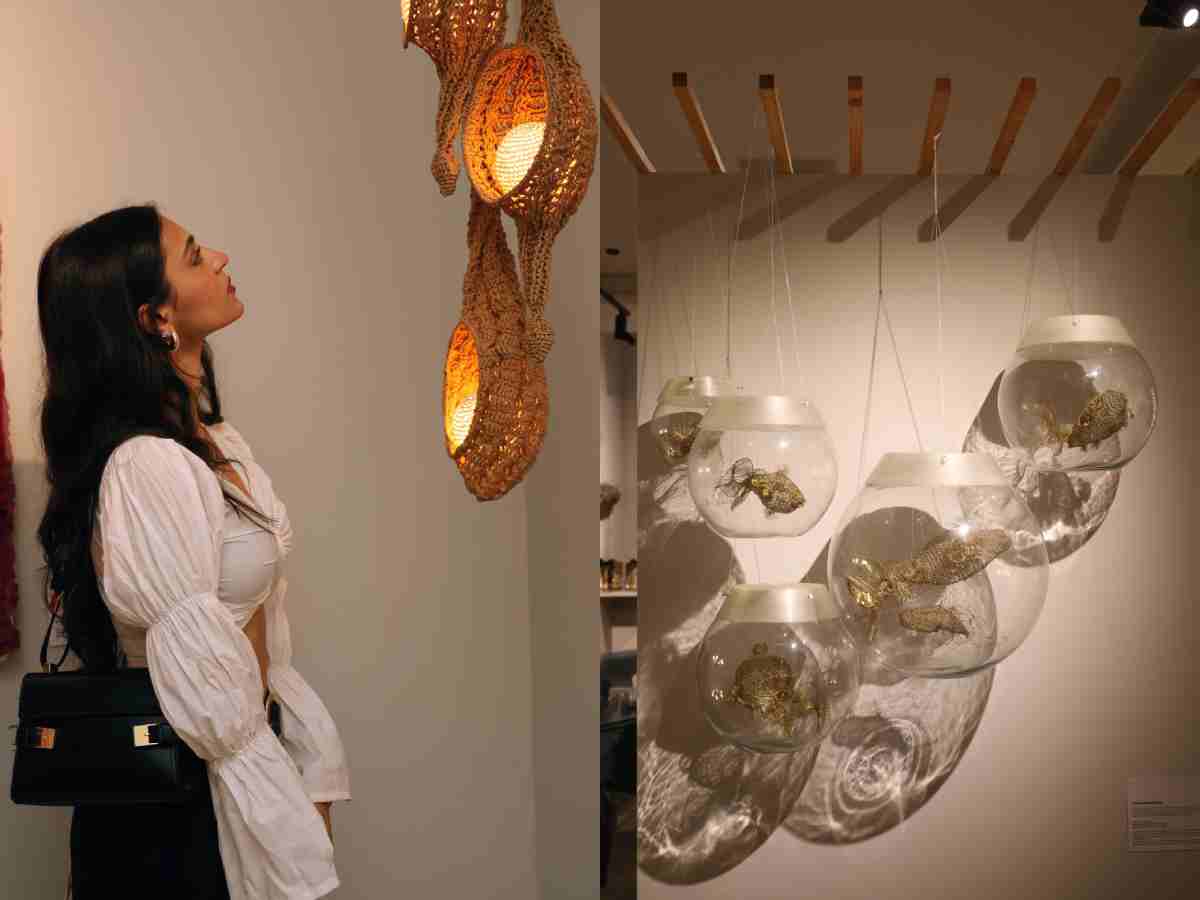
As visitors step into Gallery Kolkata’s newly opened space in New Delhi, they encounter an exhibition that moves beyond conventional categories of art, architecture, and design. Pancha-Tattva: Material Matters, curated and designed by Ankon Mitra in collaboration with Meghna Agarwala, unfolds as a meditation on materials—not merely as mediums, but as active participants in the creative process.
Bringing together 29 practitioners across generations, the exhibition reflects a growing interdisciplinary dialogue, while grounding itself in something more elemental: the intimate, almost philosophical bond between maker and material.
Returning to the elements
At the heart of the exhibition lies the ancient philosophy of the Pancha-Tattva—the five cosmic elements of Space, Air, Water, Earth, and Fire. These are not treated as abstract ideas but translated into tangible materials: concrete, wood, glass, textile, and metals such as copper, brass, and bronze.
“The idea was to go beyond categorisation and return to the origins of making,” curator Ankon Mitra said. “Material is not passive—it has its own voice, its own intelligence. The maker engages in a dialogue with it rather than imposing form upon it.”
The exhibition begins conceptually with the notion of the cosmic void—a quiet space from which creation emerges. From here, it draws on the interplay of the three gunas—Sattva, Rajas, and Tamas—to frame the creative act.
“Sattva is the inherent nature of the material, Rajas is the energy the maker brings, and Tamas reflects the deeper impulses that guide creation,” Mitra explained. “What we see in the final work is a convergence of all three.”
Where disciplines dissolve
In recent years, art fairs and exhibitions have increasingly blurred boundaries between disciplines. Pancha-Tattva embraces this shift but pushes it further, dissolving distinctions altogether.
Architects, designers, and artists share equal footing here, their practices intersecting through a shared engagement with material exploration. From concrete shaped by heat and pressure to textiles that move with air, each work reflects a process where the physical evolves into something emotional and, at times, spiritual.
“The act of making is transformative—not just for the material, but for the maker,” said Meghna Agarwala, who presents the exhibition. “This show is about recognising that exchange, that sacred relationship which connects all creative practices.”
A spectrum of practices
The exhibition features a diverse mix of voices. Senior artists such as Kavita Nayar, Arunkumar HG, Sheela Chamariya, and Srila Mookherjee bring decades of experience in engaging with material vocabularies.
They are joined by established designers like Siddhartha Das, Joya Nandurdikar, and Amrita Guha, alongside contemporary names including Arjun Rathi, Malavika Singh, Babar Afzal, Amrita Nambiar, and Bandana Jain, whose work bridges function and form.
Architects such as Sushant Verma, Nitin Barchha, Jwalant Mahadevwala, Kanishka Jain, and Piyusha Patwardhan contribute cross-disciplinary perspectives, challenging the silos that traditionally define their field.
Meanwhile, artists like Aakriti Kumar, Pintu Sikder, Parth Parikh, and Jenjum Gadi explore distinct material languages, while emerging practitioners including Revati Jayakrishnan, Mayadhar Sahu, Abhishek Chakraborty, Chandrapal Panjre, Srinia Chowdhury, and Keshav Gupta bring fresh energy to the exhibition.
“There is no hierarchy here—only different approaches to understanding material,” Mitra noted. “Each participant engages with their medium in a way that reflects both tradition and experimentation.”
Material as a living presence
Walking through the exhibition, one senses that materials are not static. Concrete holds traces of fire, wood carries the memory of earth, glass captures the fluidity of water, textiles echo the movement of air, and metals suggest the expansiveness of space.
The works collectively propose that material is not merely shaped but also shapes the maker in return.
“In the age of rapid technological advancement, it becomes even more important to reconnect with the tactile and the elemental,” Agarwala said. “Material reminds us of our relationship with the natural world—with what is fundamental and enduring.”
An evolving dialogue
Rather than offering definitive interpretations, Pancha-Tattva: Material Matters invites viewers to engage, reflect, and respond. It is less about finished objects and more about processes—about how ideas take form through touch, resistance, and transformation.
“We hope visitors experience a shift in perception—that they begin to see material not as a tool, but as a collaborator,” Mitra said.
As Delhi’s cultural landscape continues to expand, the exhibition marks a significant moment—not just as the inaugural show of a new gallery space, but as a reminder that at the core of all creative practices lies a shared language of making.
In that sense, Pancha-Tattva is both a return and a renewal—an exploration of how, even in an age shaped by technology, the elemental bond between human and material remains the true source of creation.
The exhibition is open for viewing at Gallery Kolkata, E-46, Greater Kailash II, New Delhi, from 11:00 AM to 7:00 PM daily, and will continue until April 20, 2026.
At least 50 cases have already been reported this month; NCPCR guidelines mandate help desks,…
DMRC says zero reduction in train trips, attributes decline to security measures and public apprehension…
A Delhi court denied bail to a former DU professor accused of raping a student,…
Delhi Police charged seven dhaba workers in the fatal beating of a Manipuri musician who…
Seven Delhi STPs failed DPCC standards in September, dumping high levels of faecal coliform and…
AISA chief Neha Bora petitioned the Delhi HC against a police notice requiring a peace…

