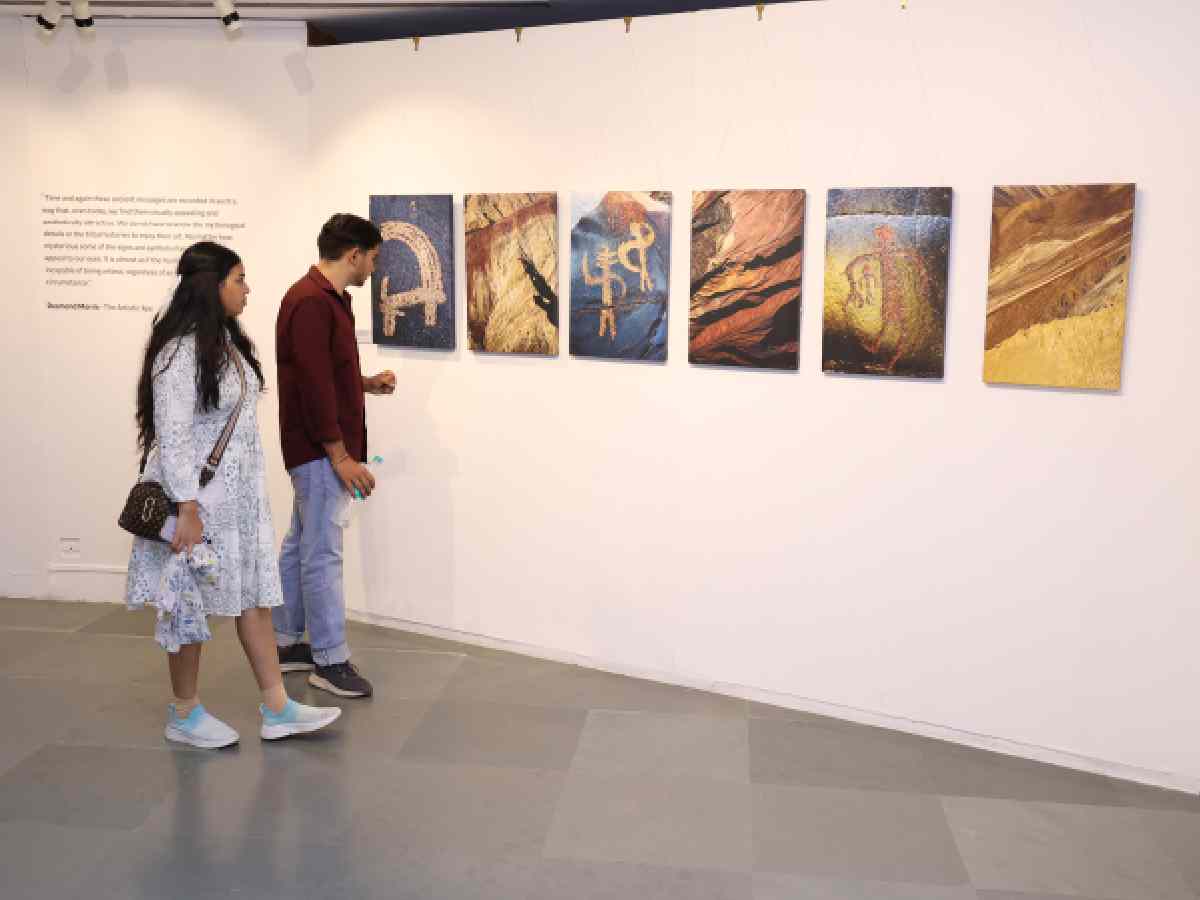
Art: After a celebrated two-month run in Paris, Speaking Stones: Rock Art of Ladakh arrives in New Delhi with its spellbinding visuals and urgent message. The solo exhibition by photographer, writer and independent researcher Ahtushi Deshpande, on view from May 15 to 28 at the India International Centre (IIC), is more than a showcase of images—it is a deeply personal and political act of archiving a fading heritage.
Deshpande has spent over ten years traversing Ladakh’s harshest terrains to document its ancient rock carvings— petroglyphs etched into stone surfaces by communities long gone. The result is a striking visual archive that combines aesthetic clarity with an underlying urgency: many of these carvings are vanishing, either eroded by time or destroyed by road-building and construction.
Born in 1969, Deshpande’s artistic journey spans fashion photography, reportage and cultural documentation. A stage-four cancer survivor, her expeditions across Ladakh’s unforgiving landscape are as much spiritual as they are physical.
“These expeditions changed me,” she said. “They taught me patience, humility, and how to see.”
Also read: Power of Energy: A solo exhibition of paintings by Nilansu Bala Sasamal
A chance encounter sparked the journey
“It began with a chance discovery,” Deshpande recalled, describing her first visit to Changthang in 2011. “I came across these engraved stones by the river, completely unguarded, completely exposed. That moment stayed with me. I knew I had to return.”
And she did—again and again, through 18 expeditions across Ladakh’s cold deserts, mountain passes and remote valleys. Much of what she encountered had never been formally documented. Her work evolved into a visual chronicle, shaped by someone attuned not only to history but to the land itself.
Unlike conventional archaeological records, Deshpande’s photographs treat petroglyphs not simply as relics, but as living inscriptions—creative expressions that echo with human resilience, migration and belief. Shot using long exposures and light painting—often in challenging night-time conditions—the images draw attention to minute details: a herd of ibex scratched into a boulder, a lone figure, a solar motif, each whispering its own story.
The exhibition is based on her 2024 book Speaking Stones, recently shortlisted for the Banff Mountain Book Award in the Image and Text category. Many of the images being shown publicly for the first time are from this body of work.
“I wanted the photos to feel intimate,” she said. “These carvings aren’t in museums. They’re out in the open—on cliff faces, by rivers, near old trade routes. The land itself is the gallery.”
A rare convergence of art and anthropology
Art historian Alka Pande calls Deshpande’s work “a monumental cultural archive.” Others see it as a rare convergence of art and anthropology.
“This is not just great photography,” said Dinesh Khanna, photographer and curator. “It’s preservation, interpretation—and a remarkable act of storytelling.”
The images span Ladakh’s vast geography—from the stark plateaus of Changthang to the rocky outcrops near Kargil and Zanskar—areas where even basic field research is physically demanding. Deshpande worked largely alone, often on foot, using rudimentary tools.
“You need more than stamina,” she said. “You need stillness. And a lot of trust in the landscape.”
Quiet power over spectacle
There is no spectacle in these visuals. No digital enhancement or cinematic colour. What emerges instead is a kind of quiet revelation: the elegance of a primitive drawing, the erosion of a figure, the slow reclaiming of rock by time. It is this restraint that lends the exhibition its emotional weight.
The scale of the work is also notable. One wall-sized image feels almost like a mural—a meditation on time and disappearance. In another, a solitary figure appears to fade into the stone, barely visible. Some of these petroglyphs, Deshpande notes, no longer exist.
“That’s the hard part,” she said. “You go back to a site, and it’s gone. Bulldozed, repaved, or just shattered.”
Although the exhibition does not push a conservation agenda in a didactic manner, the implications are clear. Ladakh’s rock art, despite its immense cultural and historical significance, remains unprotected. Without documentation, much of it may be lost before it is even recognised.
Still, the tone of the show is not mournful. There is a reverence in the way the images are presented—sharp, textured, and free of distraction.
“There’s something profoundly moving about how our ancestors chose to communicate—with no written script, just stone,” Deshpande said.
Also read: Of myth and memory: The contemplative world of Shabir Hussain Santosh
A journey of solitude and resilience
A former fashion photographer and writer whose work has appeared in National Geographic Traveller, GEO and Outlook Traveller, Deshpande brings a rare blend of artistic training and field experience. She also credits her cancer diagnosis for deepening her connection to solitude and slowness.
“You begin to notice the small things,” she said. “What survives. What doesn’t.”
For those unfamiliar with Ladakh’s lesser-known histories, the exhibition opens up new ways of seeing. It does not romanticise the region—it reveals it. Through ancient etchings and stark imagery, Speaking Stones invites viewers to witness the endurance of art in the face of impermanence.
Elected to the Delhi Golf Club general committee, Mansher Singh says he wants to build…
A $780 million market built on pavements, where the pleasure of reading meets the price…
Supreme Court advocate Abhishek Pawar alleges women were denied washroom access for seven to eight…
Each day of closure costs shops in Khan Market and Connaught Place between Rs 60,000…
Delhi generates nearly 15,000 tonnes of waste daily, prompting the government to deploy 1,000 mechanical…
Delhi Police has issued an NOC for the Congress rally at Ramlila Maidan on November…

