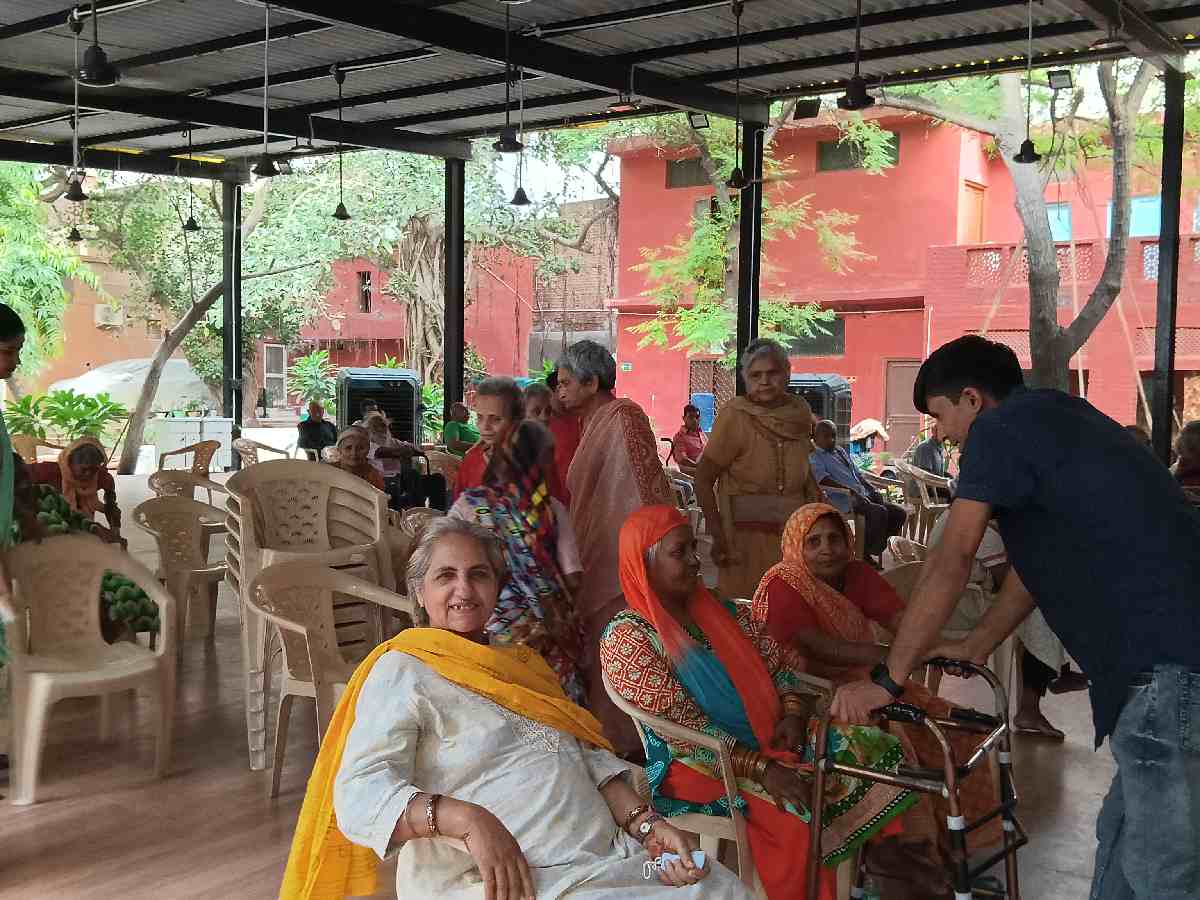
Seated on one of the many hospital beds spread across the ends of the old age home at the heart of South East Delhi’s Okhla, Raju awaits patiently for the death knell to strike. Originally a resident and a cook by profession from Maharashtra’s Nagpur district, it was sheer bad luck that brought him to the national capital.
He said he had been working as a cook in Nagpur when he met with an accident. The incident, he recalled, led to total vision loss and severely affected his motor functions. As his condition deteriorated, his sons convinced him to travel to Delhi for cheaper medical treatment at Ram Manohar Lohia Hospital.
“They told me that they were going to get my medicines,” he said, voice shaking. “But there I was, stranded. I waited for hours—one turned to two, then three.”
He said he remained there the entire day, alone and confused. “Nobody showed up. I have never cried like that in my entire life,” he added, still shaking.
How the abandoned elderly survive in Delhi
Raju’s story is not unique at the Saint Hardyal Educational and Orphans’ Welfare Society (SHEOWS) ashram in Okhla. According to its founder, GP Bhagat, many residents there suffer from either physical or mental illnesses. Their presence at the facility, he said, is often the result of abandonment—something that no longer surprises him or the inmates.
Also Read: First Census in Delhi: A walk down memory lane
India’s cultural norms place great emphasis on the responsibility of children to care for their ageing parents. Multigenerational households, where grandparents live with their children and grandchildren, have long been the societal norm. Nursing homes and hired caregivers remain rare and often stigmatised.
Yet, this tradition is under strain. With longer life expectancies, caregiving has become more demanding. Urbanisation has led younger generations away from their family homes. The influence of Western lifestyles has also weakened the custom of living with and supporting elderly parents.
As a result, many senior citizens find themselves neglected and alone—left to navigate a society that once cherished them.
India’s systems are struggling to cope. Courtrooms are flooded with cases filed by elderly parents seeking support from their children. Public spaces—footpaths, metro stations, alleyways—now serve as makeshift homes. Non-profits operate with strained resources, trying to provide shelter, care, and dignity.
SHEOWS currently runs three centres across the National Capital Region—Garhmukteshwar, Sarita Vihar, and Okhla. The Garhmukteshwar centre is the first and largest. Sarita Vihar has been converted into a hospice for patients with critical conditions.
Much like Raju, many residents suffer from a combination of physical and mental ailments. He recalled spending weeks at the same spot outside the hospital, surviving on occasional food donations from strangers.
“Most days, I went without eating,” he said.
Eventually, a worker from RML noticed his condition and brought him inside. “They diagnosed me and then shifted me to an ashram—I don’t know which one,” he said.
Raju stayed there for 15 days. Due to his limited mobility from the accident, he had to be assisted constantly. When his health worsened, the staff transferred him to the SHEOWS centre.
“I had slipped into a coma during the course of the procedure,” he said. “The infection, they told me, was getting worse. However, I pulled through and now I am much better. I am still awaiting complete recovery.”
He also later discovered that his sons had tricked him into signing property documents under the guise of health insurance paperwork.
A pattern of abandonment and loss
Similar stories of deception and abandonment are common in the facility.
Some residents, like 65-year-old Kusum Lata, came voluntarily—but only because they had no choice.
She described her harrowing experience of living at her daughter’s home in Govindpuri. “I was so scared,” she said. “My arms were aching, my back was in so much pain.”
Kusum said she was repeatedly taunted and abused by her daughter and son-in-law. “I thought, if I stay here, my life will be in danger.”
Her husband had long passed away, and she had no one else to turn to. Summoning what strength she had, she decided to leave. “I used all my strength, thinking God would take me there,” she said.
Eventually, a child—an unknown boy—guided her to the ashram. “He held my finger and took me there,” she recalled, her eyes softening. “I thought, God has come to me.”
Kusum said her 15-day stay at her daughter’s home was marked by beatings, scoldings, and starvation. “I wanted to leave as quickly as possible, but my daughter had taken all of my money as well,” she said.
She seized an opportunity one night when her daughter was unwell. “I managed to take back some amount of money that I had brought and snuck out of there,” she said.
She later learnt that her daughter had died just a few days after her departure in February. “I got to know later that my daughter breathed her last,” she grimaced.
Shashikant Sharma, 76, recounted a similar experience. He had returned to Delhi from Gujarat after a cataract operation and needed a place to stay temporarily. But when he approached his brother for help, he was turned away.
“They just told me that they could not have me at their place,” he said. “I was just looking for somewhere to rest my head until I got a job.”
Sharma said he tried searching for work across New and Old Delhi but had no success. Eventually, he approached a rain basera (homeless shelter).
“They told me I wouldn’t be able to adjust there and asked me to leave,” he said. “They referred me here. Unfortunately, ever since I have been here, I have not been in touch with my family.”
Ram Bodhan, a resident from Raebareli, came to Delhi about fifty years ago. Three days before Holi, he arrived at SHEOWS Okhla.
“I’ve been here since, and I’ve no complaints,” he said. “Everything’s good here—truly, everything’s good.”
His life, however, had once been quite different. Bodhan had worked at the DTO and owned two houses. He never married so that he could care for his widowed younger sister and her family.
“I looked after my sister, got her ready, saw her married,” he said. “I helped her find work, and we built a house together.”
Even after her passing, Bodhan continued to support her son. But the same nephew, now an adult, eventually forced him out of the house.
“The child for whom I never got married finally kicked me out of my own home,” he said. A police officer offered to help file a complaint, but Bodhan declined.
“I did not want to see my sister’s son get humiliated,” he explained. “As it is, his alcohol habit will spell doom for him one of these days.”
“I would rather stay without a house than see him and his family be humiliated,” added the Sai Baba devotee.
Why abandonment is on the rise
According to GP Bhagat, the number of elderly being abandoned is set to increase.
“There’s a generational divide,” he said. “The fabric of society is altering.”
He explained that nuclear families and urban migration have weakened traditional systems of support. Children move away for work—sometimes to other states or countries—and often cannot take their parents with them.
“When they secure a job elsewhere, they cannot stay with their parents,” he said.
He added that this isolation becomes especially harmful after the death of a spouse. Elderly individuals, already vulnerable, may suffer from dementia or depression.
“When one is left alone, their mental troubles begin,” Bhagat said. “Unfortunately, memory loss sets in many cases, and they wander off or become lost.”
With both partners often employed in modern households, he questioned: “Who will look after the parents?”
As families struggle to manage, elderly people with mental or physical ailments are often neglected—or intentionally abandoned.
“They head to the park and lose their way,” Bhagat added.
Are there any legal safeguards for the elderly?
The Maintenance and Welfare of Parents and Senior Citizens Act, 2007, passed by Parliament and overseen by the Ministry of Social Justice and Empowerment, mandates that children must support their parents financially, emotionally, and medically.
The Act defines “parents” broadly—including biological, adoptive, or step-parents—and defines “maintenance” to cover food, clothing, housing, and healthcare.
Sections 4 and 5 allow senior citizens unable to support themselves to claim maintenance. Children or relatives can be ordered to pay up to Rs 10,000 per month to ensure a “normal life”.
In 2013, an amendment made abandonment a criminal offence. Parents can now file complaints against neglectful children. However, sons-in-law and daughters-in-law are not legally obligated to provide support. In 2019, the Bombay High Court clarified, “The law protects parents, not in-laws.”
The Act also contains provisions for voiding property transfers made under coercion or fraud if the promised care is not delivered. States are directed to set up old-age homes and improve elderly access to healthcare.
Penalties are stringent. In Hemant Gamanlal Mehta vs State of Maharashtra, the High Court upheld a tribunal’s ruling that a son and his wife must vacate an 88-year-old mother’s flat and pay Rs 10,000 monthly.
In Manmohan Singh vs UT Chandigarh, the Punjab and Haryana High Court ruled that children are only licensees in their parents’ home.
“Children have no inherent right to stay if parents object,” the court declared.
An appellate tribunal is available for anyone dissatisfied with the tribunal’s decision, ensuring fairness for all parties.
Delhi HC will rule Oct 23 on AISA chief Neha Bora’s plea against a police…
A CREA analysis shows Delhi's winter AQI has seen no steady gain since 2022, with…
DMRC will plant over 28,000 saplings across 991 MCD parks in 3 months to offset…
Delhi HC quashed an FIR against an SSC aspirant, ruling mere presence at a protest…
CJP leaders Saurav Das and Ashutosh Ranka sought more time to join the Delhi Police…
Delhi Police held 3 more people, including a couple using a minor to sell heroin…
