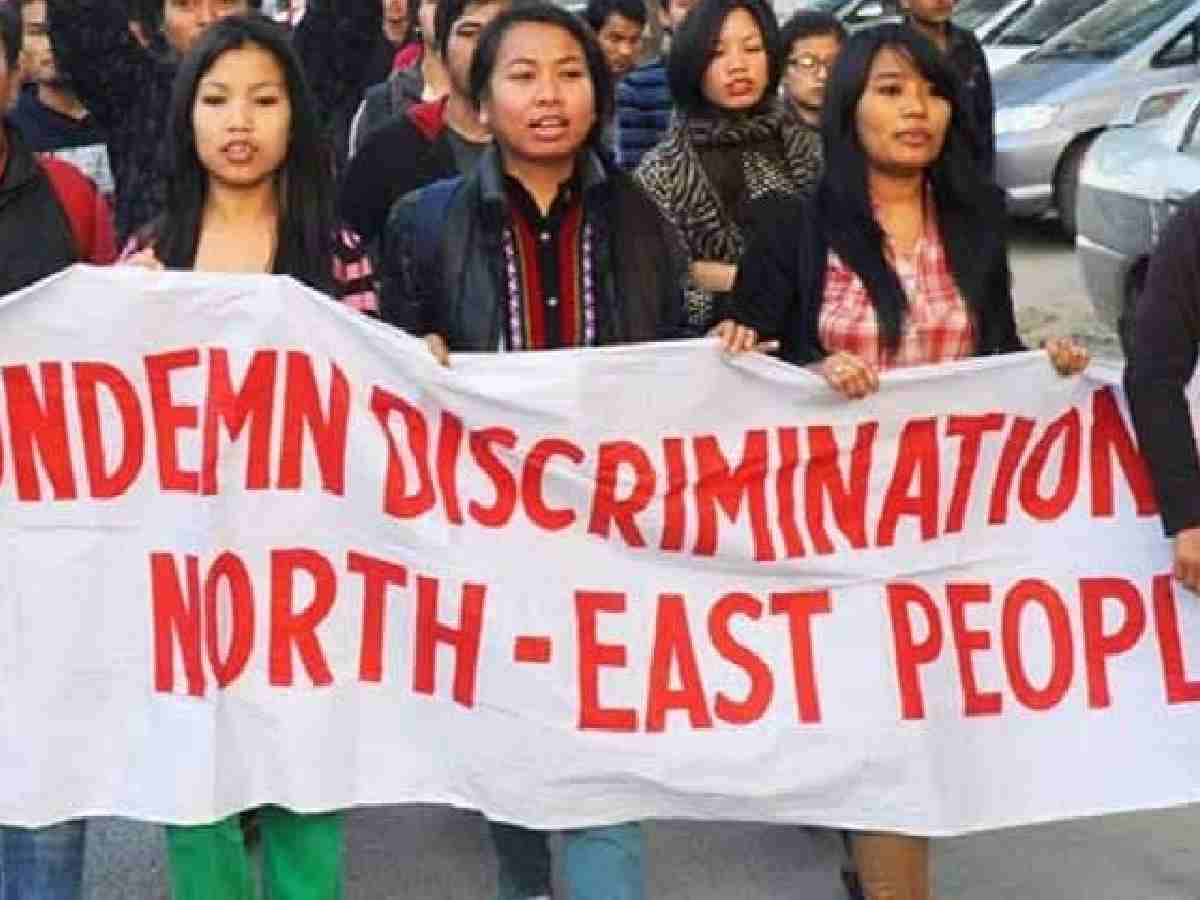
Delhi: The warm February air clings to Lobsang’s skin, heavy and dreary, thick with the scent of exhaust fumes and frying parathas. For those who migrate from the mist-shrouded hills of the “Seven Sister” states to the concrete expanse of the capital, the city can feel like a sensory bombardment. But beneath the noise of traffic lies the silence of exclusion.
In urban villages such as Humayunpur and Majnu-ka-Tilla, alleys smell of fermented bamboo shoots and smoked pork — the only semblance of home in a concrete jungle. Outside these invisible borders, however, the city often feels like a battlefield where the weapons are stares, whispers and the casual, cutting edge of a slur.
Gauntlet of the daily commute
For Lobsang, a 22-year-old graphic designer from Tawang in Arunachal Pradesh, the morning commute on the Yellow Line of the Delhi Metro is a daily exercise in psychological endurance. Even in a carriage packed so tightly that breathing feels like a luxury, a “buffer zone” often forms around him.
“It’s as if the shape of my eyes, the bridge of my nose, is a sight to see. They do not say anything, but the amount of stares just becomes a struggle to tackle,” he said. “Sometimes, it gets worse when mothers try to get their children a little further from where I am standing — that is when you get to know you are actually different to them.”
Despite his father having served in the Indian Army, in the heart of the capital Lobsang is treated as a foreigner.
“Sometimes they call me Chinese and all such words, but it’s better to stay silent than take them head on. There’s no telling what they are willing to do,” he said.
A dozen pairs of eyes meet his in the carriage, then quickly dart away, fixed on mobile screens. The silence is deafening — the silence of a city that sees him as a guest who has overstayed his welcome rather than a citizen in his own home.
Prejudice behind closed doors
If men from the Northeast are viewed as interlopers, women often face a more sinister gaze.
Maya (name changed) works at a high-end spa in Vasant Vihar. Her experience, she said, is a cocktail of xenophobia and hyper-sexualisation.
“A client asked me how much I cost,” Maya said, her voice trembling after a shift. “Not for the massage. For the night.”
To many in Delhi, women from the Northeast are labelled “exotic” or “easy” simply because they wear Western clothes or do not conform to local conservative norms. This is the dual edge of prejudice — they are fetishised for their appearance while simultaneously reviled for their culture.
Yet housing, they say, is where humiliation often becomes most acute.
Standing in the doorway of Lobsang’s flat, his landlord once barked about the “stink” of their dinner — a simple stew of dried fish.
“This is a decent colony,” Gupta had spat. “We don’t want this filth here. And I saw your sister coming home late. In this house, we have values.”
To the self-appointed “moral police” of Delhi’s residential colonies, members of the Northeast community say they are treated as a threat to traditional sensibilities. The result is a rental market that appears to operate on a social filter.
“The flat was just taken,” brokers often say.
Workplace erasure
The prejudice is not limited to the streets; it permeates institutions as well.
Rin (name changed), a senior nurse from Mizoram with a decade of experience, described what she called a “professional ceiling” built of bias.
She recalled a patient who refused to let her draw his blood, demanding a “proper Indian” nurse. Despite her expertise, her ethnicity became the primary signifier of her identity. In Delhi, she said, professional excellence can feel like a temporary permit for presence — the moment they stop being “quiet”, the permit is revoked.
History as an afterthought
For the younger generation, such as 19-year-old Ishan Bodo from Bodoland in Assam, the racism often takes an academic form. A student at Delhi University, Bodo described it as “the racism of erasure”.
“In the hostel, they ask if I need a visa to come to Delhi. They ask if we eat snakes,” the 19-year-old said. “But the real hurt is in the classroom. Professors speak of ‘Indian Culture’ as if it ends at the Siliguri Corridor.”
When he attempts to discuss the Ahom resistance or tribal histories, he said, the room goes silent. To the capital, the Northeast is framed as a “strategic interest” or a “tourist destination”, but rarely as a collection of communities whose histories are central to the national narrative.
When disputes turn racial
Earlier in February, three young women from Arunachal Pradesh and Manipur — one of them a Union Public Service Commission aspirant — became targets of racial abuse by neighbours in Malviya Nagar.
Harsh Singh and his wife Ruby Jain allegedly began hurling racial slurs during what was initially a petty dispute over drilling dust emanating from the fourth floor.
According to the complaint, the couple subjected the women to a barrage of derogatory labels, calling them ‘momos’, ‘sex workers’, ‘parlour ladies’ and ‘drug addicts’.
During the altercation, Jain was heard asserting in Hindi that the women worked at massage parlours for a mere Rs 500, before mockingly telling them to ‘go and sell momos’. Her husband reportedly labelled them ‘gutter chaap’ — a term implying they were trash or uncivilised.
A video of the confrontation later went viral on social media, triggering national outrage. An FIR was subsequently lodged against the couple under sections 79, 351(2), 3(5) and 196 of the Bharatiya Nyaya Sanhita, covering offences related to outraging a woman’s modesty and promoting enmity on the grounds of race.
While the couple has been placed in judicial custody till March 11, no arrests had been made at the time of reporting.
One of the victims, speaking in the video that circulated widely, posed a question that strikes at the core of Indian identity.
“Why are we treated as outsiders simply because of our origin? We are as much Indians as anyone else.”
Also Read: Exiles from Manipur rebuild lives far from home
Her words serve as a stark reminder that for many from the Northeast, acceptance in Delhi remains elusive — a daily battle against deep-seated prejudice that continues long after the headlines fade.
A $780 million market built on pavements, where the pleasure of reading meets the price…
Supreme Court advocate Abhishek Pawar alleges women were denied washroom access for seven to eight…
Each day of closure costs shops in Khan Market and Connaught Place between Rs 60,000…
Delhi generates nearly 15,000 tonnes of waste daily, prompting the government to deploy 1,000 mechanical…
Delhi Police has issued an NOC for the Congress rally at Ramlila Maidan on November…
CJP chief Abhijeet Dipke received conditional bail following his arrest for participating in a Connaught…
