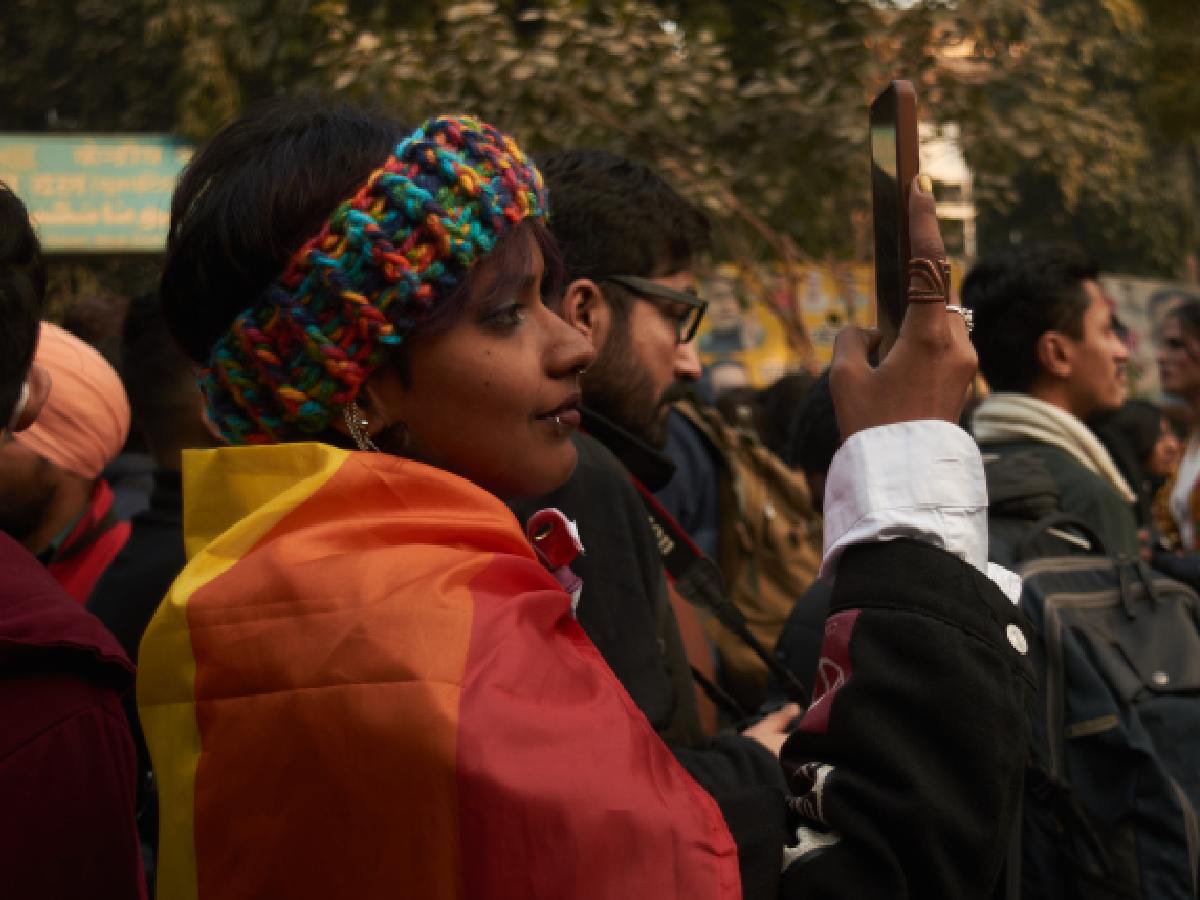
Scampering off a fairly worn, narrow stairwell, Ritika, now 24, glides across with peacock-like grace. A dog resting right under their feet keeps barking incessantly, taking some time to get acclimatised to strangers. However, the momentary din slowly subsides as it becomes habituated. Ritika’s presence calms the dog down after a point.
A fairly close-knit community, the Mitr Trust-run Garima Greh is the only shelter for transgender people functioning in Delhi under government supervision. Housing around 25 transgender persons, according to rough estimates provided by residents, it has offered a temporary but safe space ever since it started. However, the sense of security remains limited to its four walls, and its location in the far-flung outskirts near Janakpuri’s Dabri Mor has made it somewhat inaccessible for a significant section of the community.
Their fight, while initially for survival, has now turned into one for existence.
What is the amendment Bill about?
On March 13, the Ministry of Social Justice and Empowerment tabled the Transgender Persons (Protection of Rights) Amendment Bill, 2026, in the Lok Sabha. Following its introduction, outrage was palpable.
To put matters into perspective, the primary objective of the amendment is to narrow the 2019 Act’s definition of a “transgender person” by excluding those with “self-perceived” gender identities or varying gender expressions. The government argues that the earlier definition was too vague, claiming the law was intended only for those facing social exclusion due to “biological reasons” rather than personal identity or gender fluidity.
Under the new proposal, the legal category would be restricted to specific socio-cultural groups — such as Kinner, Hijra, Aravani and Jogta — and individuals with medically verifiable intersex variations or congenital conditions. The amendment also explicitly includes those who have been “compelled” to adopt a transgender identity through forced medical procedures such as mutilation or castration.
By removing the right to self-perceived gender identity, the Bill shifts the framework from one of individual autonomy to one rooted in biological and medical verification.
Unfortunately, these decisions, allegedly, were taken without consulting members of the community. This has led to widespread concern, as the question remains — is this an attempt to push them further to the margins?
Survival on tenterhooks
Ritika, a transwoman, feels so. Having built a life for herself, the burden now feels heavier than ever.
“I have only been trying to ensure that I have enough money to pursue my Master’s. I do not receive any support from either the government or my family, and if they try to erase our existence, it just pushes all of us to the margins yet again,” she said.
A Bachelor of Science graduate in Biology, Ritika is presently on Hormone Replacement Therapy (HRT). After completing her undergraduate studies in Rajasthan, she moved to Delhi.
“I had come to Delhi to look after a friend who was ailing and also to look for a job. I had to carve out a place for myself in society since I was not receiving any support from my family,” she said.
They are now only a few steps away from being excluded from ever identifying as part of the community.
“I still have not been operated upon, so technically that means I am not a ‘transgender’ person, according to the Bill. I have a transgender identity card (TGID), but I do not think it means anything now. Honestly, many people did not even know about the TGID wherever I went,” she said.
Where should the TGID go now?
The TGID was introduced as part of the 2019 Act. It is an official document issued by the Ministry of Social Justice and Empowerment, allowing individuals to identify as transgender under the Transgender Certificate and Identity Card system.
The card enables holders to change their gender and name on other government documents, including Aadhaar and PAN cards, and is mandatory for accessing welfare schemes such as the SMILE scheme.
However, with the new rules, only a limited group of people who meet the amendment’s criteria would be able to officially identify as transgender.
“This just seems like they are trying to tell us that we only belong to the listed communities. All our effort to become mainstream has been in vain. Especially when society was beginning to accept us, the government is trying to halt that progress,” Ritika said.
While the government maintains that the Bill aims to support economically disenfranchised transgender communities, it fails to address concerns raised by groups left out of the list.
Legal implications of the Bill
Raghavi Shukla, one of the first transgender lawyers to practise before the Supreme Court, suggests that the most contentious aspect of the amendment is its “seismic” shift in defining who qualifies as transgender under the law.
By narrowing this definition, the proposed revision grants legal recognition primarily to individuals within specific socio-cultural groups and those with certain intersex variations. Consequently, transmen, transwomen and gender-queer individuals who do not fall into these categories risk being excluded entirely.
The Bill is explicit about this exclusion, stating that the legislation was never intended to cover the broader spectrum of gender identities or those with “self-perceived” gender fluidity. This marks a departure from the principle of self-determination, moving instead towards a rigid, biology-based framework.
For transmen in particular, the amendment raises concerns of complete legal erasure. Unlike hijra communities, which have long-standing socio-cultural recognition, trans-masculine identities in India rarely align with specific traditional categories. Apart from the Nupamanba community in Manipur, there are few recognised frameworks.
The amendment also replaces the 2019 Act’s self-identification process with what many describe as a multi-layered institutional process. Individuals would need to undergo medical intervention, appear before a medical board, and receive approval from a District Magistrate.
“It is no longer about who you say you are. It is about whether the system agrees,” Shukla said.
For those without the financial means to access gender-affirming healthcare, this process could make legal recognition nearly impossible.
The Bill also introduces provisions requiring medical institutions to report gender-affirming procedures to district authorities. Activists warn this could discourage individuals from seeking care.
“If patients know their medical decisions will automatically be reported, some may avoid accessing care,” said activist Krishanu.
Further, Section 18 introduces stringent penalties for “forced transgender identity”, including life imprisonment in certain cases. While intended to prevent exploitation, critics fear it could criminalise traditional support systems such as the gharana network.
“There is no indication of evidence or data showing that existing laws were insufficient to address such harms. It risks criminalising care,” Shukla said.
Future ahead in a fragile shelter
Sitting inside the Mitr Trust shelter, Ritika wonders about what the future holds for her and many others who continue to live on the margins while daring to dream.
“If somebody like me does not want to be operated upon, what authority does the government have to tell me that I am not aware of my identity?” she asked.
“The fact is that they do not want us to exist and interact with society like normal people. They are trying to push us to the fringes and tell us that we are not who we think we are.”
Her existence has rarely been questioned to such an extent — until now.
“They never fault the parents or external factors that may contribute to gender dysphoria. There are instances where children are made to wear certain clothes, and nobody questions it then. But later, when they assert their identity, it is seen differently. That thinking is flawed,” she said.
Even the shelter continues to struggle.
“Despite all our efforts to provide for those who come here, we face a lack of government support. Our funds have been pending for a year, so most of the expenses are covered from our personal resources,” said Kanta, the supervisor of the Garima Greh.
For many residents, the survival of the shelter is tied to their own.
Even in Delhi, they still have just one place to call home.
Over 130 volunteers, doctors and lawyers mobilised legal, medical and mental health aid for CJP…
Delhi Police released a video claiming Dipke was informed of his grandmother’s death in custody…
MCD acted against 1,046 properties over illegal construction and unsafe buildings in Delhi between September…
AAP accused Delhi Police of using force against protesters and vowed to continue the CEC…
Saffron-clad groups allegedly attacked Delhi protesters, with Hindu Raksha Dal chief claiming responsibility for the…
Delhi Police issued fresh notices to CJP leaders in a case involving allegedly morphed objectionable…

