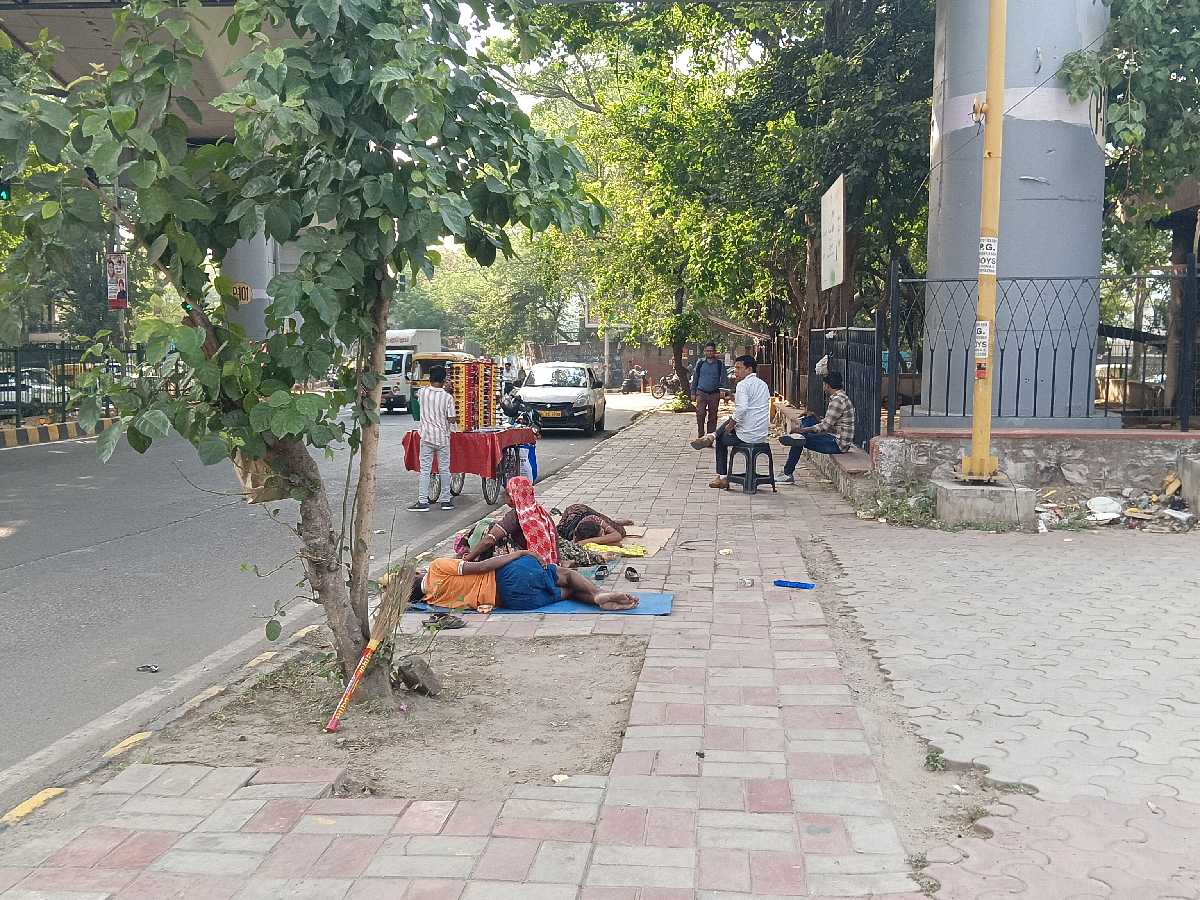
Residents at the Nehru Place night shelter prefer resting under the shade than the shelter itself
While the national capital received some respite from the heat earlier this month, the relief is unlikely to last long. The mercury has already begun rising again. Earlier in April, the National Human Rights Commission (NHRC) directed 21 States and Delhi to take advance action and implement relief measures to protect vulnerable populations during heatwaves.
The States involved are Andhra Pradesh, Assam, Bihar, Chhattisgarh, Gujarat, Haryana, Himachal Pradesh, Jharkhand, Karnataka, Kerala, Madhya Pradesh, Maharashtra, Odisha, Punjab, Rajasthan, Sikkim, Tamil Nadu, Telangana, Tripura, Uttar Pradesh, and West Bengal.
The commission observed that the increasing frequency, duration, and intensity of heatwaves disproportionately affected marginalised and economically weaker sections, outdoor workers, and homeless persons because of inadequate shelter and limited resources. It noted that elderly people, children, infants, and newborns were especially vulnerable to the health impacts of extreme heat. The commission also pointed out that heatwaves often led to livelihood losses and a heightened risk of fire accidents.
Consequently, in a letter addressed to the Chief Secretaries of these States and the Union Territory of Delhi, the commission stressed the urgent need for integrated and inclusive measures.
Rising concern
Citing National Crime Records Bureau (NCRB) data showing that 3,712 people died due to heat or sunstroke in India between 2019 and 2023, the panel urged authorities to ensure the seamless implementation of relief measures.
These measures were expected to follow Standard Operating Procedures and guidelines issued by the National Disaster Management Authority (NDMA) to mitigate the impact of heatwaves and prevent casualties.
Highlighting the physical toll of soaring temperatures, auto-rickshaw driver Santosh Hazra described skin burns and health complications caused by exposure to the ‘loo’, the strong, dusty, hot, and dry summer wind that blows during afternoons in May and June.
“Skin gets burnt during a heatwave; the ‘loo’ also affects health. There is ample availability of free water in Delhi, but there is a shortage of shaded areas to rest,” he said.
Daily hardships
Another driver, 24-year-old Prashant Kumar, complained of feeling drowsy during the hot season. Having worked for eight years, he said summers had always been difficult because the heat quickly exhausted workers and reduced their working hours.
“I’ve been working for eight years now, and summers have always been difficult, as the heat greatly affects health. We get tired quickly, which limits our working hours. Delhi’s pollution also impacts us; we can feel it even during summer,” he said.
However, the scorching heat brings financial distress alongside physical hardship. Forty-five-year-old Sarabjeet Singh, who operates a fruit cart near the Red Fort, said the heat affects his income.
“Due to the scorching heat, we get tired very easily. It affects our earnings. Also, there are no customers between 12 pm and 4 pm,” he said.
Similarly, 42-year-old Mohammad Haseem said the combined effects of heat and humidity reduce work opportunities and increase expenses, as people remain indoors and workers spend much of their modest earnings on water and lemon juice.
Urban heat
Environmentalist Bhavreen Kandhari said the expansion of concrete landscapes at the expense of tree cover had intensified the urban heat island effect.
“The expansion of concrete landscapes at the expense of tree cover has intensified the urban heat island effect, aggravating temperatures to extremes,” she said.
She added that a comprehensive long-term strategy was required, including protecting tree cover to improve biodiversity and adopting sustainable urban planning practices to mitigate excessive concretisation.
In 2025, a report by the NGO Sustainable Futures Collaborative warned that while cities were taking short-term emergency measures, long-term heat resilience strategies — such as occupational cooling, insurance for lost wages, and heat mapping of urban hotspots — remained weak or absent.
Thirty-four-year-old Jaspreet Singh, a food cart operator, said that while he had become accustomed to the heat, he frequently witnessed people fainting because of the weather.
“We have become accustomed to this heat now, but we witness people fainting every now and then because of the weather,” he said.
Also Read: Delhi’s shelter homes struggle amid relocation drive
Narendra Shah, a 70-year-old rickshaw puller, added that the weather had become harsher much earlier this year, affecting his earnings as the sole breadwinner of his family.
“This year, the weather became severe very early. I am the sole breadwinner of the family, and my earnings are affected during this period. However, I must mention that there is ample availability of free water across the city,” Shah said.
Medical warning
Medical professionals warned that the effects of prolonged heat exposure were often underestimated. Dr Sanjay Verma, Senior Consultant, Internal Medicine, Fortis Escorts, Okhla, observed that heatwaves exerted a profound physical toll on outdoor workers through heat stress and dehydration.
“Heatwaves exert a profound physical toll on outdoor workers through heat stress and dehydration, as prolonged exposure leads to the loss of vital fluids, causing fatigue, dizziness, and muscle cramps. This condition can progress from heat exhaustion to life-threatening heatstroke, where body temperature exceeds 40°C and organs begin to fail,” he said.
Dr Verma added that repeated dehydration also posed a severe risk of acute and chronic kidney injury, particularly because the urban heat island effect prevented workers from recovering adequately at night.
“To mitigate these risks, practical interventions such as shifting work hours to cooler periods, providing mandatory rest breaks in shaded shelters, and ensuring access to electrolyte-supplemented water are necessary,” he said.
He further stated that while the risk to an individual may appear limited, the danger became significant at a population level, with many fatalities occurring due to multi-organ failure or cardiac events.
“Ultimately, these tragic outcomes are preventable through structured interventions, acclimatisation, and robust policy enforcement,” he added.
On the other hand, Seema Dhir, Unit Head and Senior Consultant, Internal Medicine, Artemis Hospitals, said prolonged outdoor work during extreme heat could become fatal.
“Heatwaves can have serious effects on outdoor workers, placing continuous stress on the body. Prolonged exposure to high temperatures can lead to dehydration, fatigue, dizziness, and poor concentration, increasing the risk of accidents,” she said.
Relief measures
Dr Dhir added that in extreme cases, such exposure could result in heat exhaustion or heatstroke, a life-threatening condition in which the body loses its ability to regulate temperature.
“Workers in construction, agriculture, and delivery services who spend long hours in direct sunlight are particularly vulnerable. Repeated exposure over time can also affect overall physical health, slowing recovery and increasing long-term health complications,” she said.
She further said that taking appropriate precautions could significantly reduce risks.
“The main solutions are regular water breaks, rest breaks in shaded areas, and lighter work schedules during the hottest hours of the day. Wearing breathable clothing and monitoring early symptoms such as headaches or nausea can also help prevent complications. Employers need to provide training and emergency support,” Dr Dhir said.
She added that fatalities could occur, especially when conditions such as heatstroke were not treated quickly, and the risks increased during severe heatwaves, particularly for older workers and those with pre-existing illnesses.
The Delhi government recently launched ‘cooling zones’ and mobile relief points to help residents cope with the intensifying summer heat.
Under the 2026 Heatwave Action Plan, these sites provide cold water, ORS packets, and shaded rest areas for outdoor workers, homeless persons, and commuters. Authorities have also used satellite data to identify thermal hotspots and activated emergency systems to treat heat-related illnesses as the heatwave continues across north India.
Each day of closure costs shops in Khan Market and Connaught Place between Rs 60,000…
Delhi generates nearly 15,000 tonnes of waste daily, prompting the government to deploy 1,000 mechanical…
Delhi Police has issued an NOC for the Congress rally at Ramlila Maidan on November…
CJP chief Abhijeet Dipke received conditional bail following his arrest for participating in a Connaught…
The DPCC has floated ₹104 crore tenders to test pilot pollution-control technologies across 40 key…
MCD pushes Bhalswa cleanup to Feb 2027 due to agency transition, leaving over 10 lakh…
