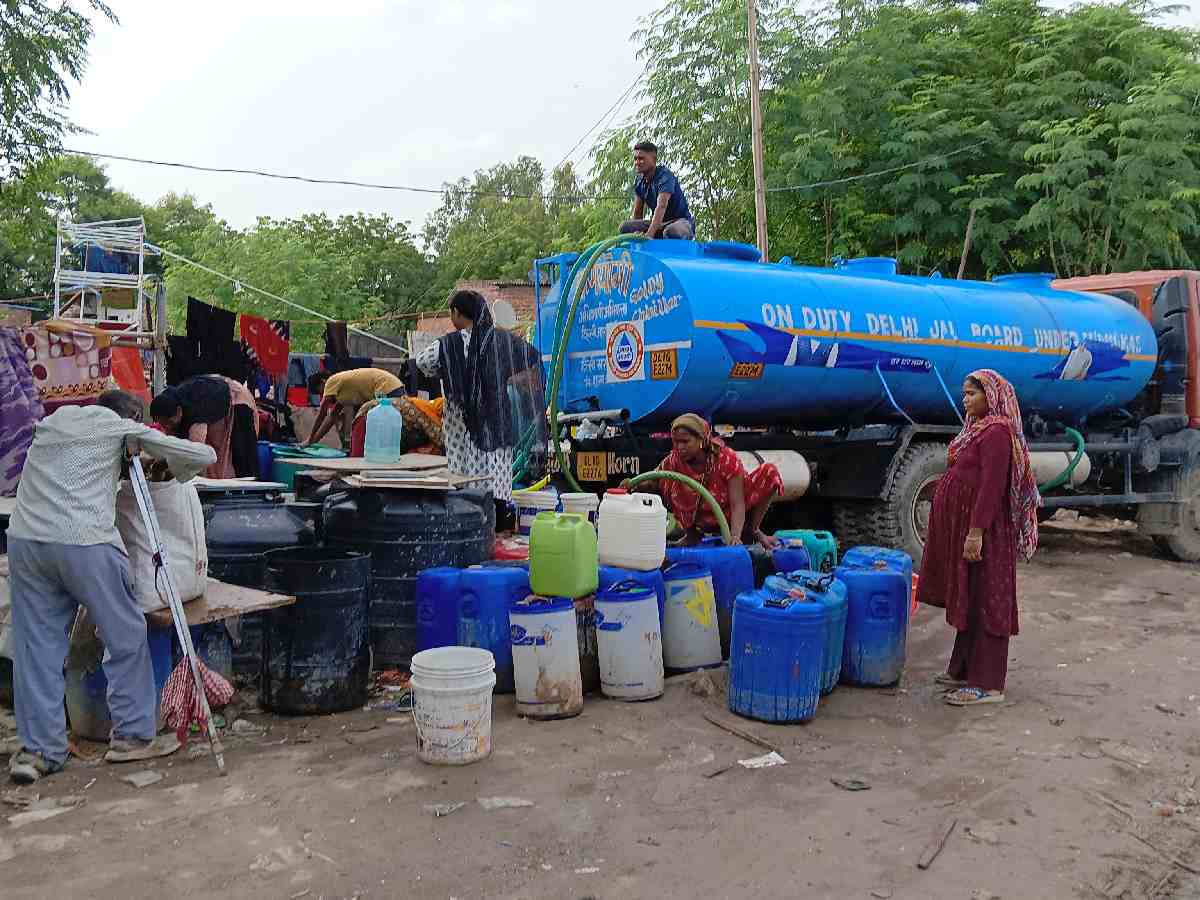
Residents filling up containers from a DJB water tanker
The latest National Family Health Survey (NFHS-6) presents a reassuring picture of access to drinking water in Delhi. According to the survey, 99.8% of households in the national capital have access to an ‘improved drinking-water source’, a marginal increase from 99.4% recorded in NFHS-5.
Yet for many residents across Delhi, the reality is far less comforting. From Hauz Khas and Vasant Kunj to Gulmohar Park and Old Gupta Colony, households report dry taps, low water pressure, contamination, and prolonged reliance on private tankers, highlighting a gap between official indicators of access and the quality and reliability of supply on the ground.
The NFHS defines improved drinking-water sources as piped water connections, public taps, tube wells, protected wells and springs, tanker supply, bottled water and community RO plants. While these measures capture access, residents say they do not always reflect whether water is available when needed or fit for everyday use.
Filed a complaint
Akshay Jaiswal, a resident of Hauz Khas, said this was the first year water availability had been so limited in his area. “We have already filed a complaint, and it has been over a week. I last heard from them when I had filed it, but ever since then, it’s radio silence,” he said.
Several affluent areas have also faced water shortages, including Vasant Kunj, which houses a number of High Commission offices. Rupa Mittal, a resident of Sector C, said that although water is reaching taps, the low pressure makes it difficult to use. “Even when we get water, the pressure is so low that it is unusable for almost anything. What is the use of access to water if there is none to be used? We have barely touched our RO purifier for the past couple of weeks,” she said.
Old Gupta Colony
These problems are also being reported in other parts of Delhi. In West Delhi’s Old Gupta Colony, residents say the area has faced water-related issues for more than a year. Despite multiple complaints, they say the Delhi Jal Board (DJB) has continued to ask for more time.
“We have been stuck with sewage water since last June. It all started when they dug up the road, promising it would take a week. Instead, they dug another hole nearby and pushed the timeline to three weeks. Then they claimed new water lines were needed, delaying clean water until December. It’s now June—a full year later—and we still don’t have clean water. They’ve only just restarted digging after a 10-month pause,” said Malvika Vaid, a UPSC aspirant and resident of the area, who said she has been dealing with the issue regularly.
Increase in illness
The situation worsened in the last week of May when residents of Gulmohar Park reported water scarcity and contamination, which they said was followed by an increase in illness.
The DJB is repairing the pipeline to address the water contamination issue affecting households across all four blocks of the estate—A, B, C and D. In recent days, teenagers, older residents and children have been affected, with cases of diarrhoea, vomiting and fever rising after water quality deteriorated.
‘Foul-smelling water’
“The water’s colour and smell are different from normal drinking water. We stopped using the mains water supplied by the DJB for drinking and cooking, as the health of my son and grandchildren was affected after drinking contaminated water,” said Lekha, a resident.
Meenakshi Jain, another resident, said her daily expenses have increased because she is spending money on bottled water, jerry cans, tankers and cleaning storage tanks. “Our neighbours, including the kids, have been visiting hospitals due to water-borne issues,” she added.
The water department currently operates nine water treatment plants that draw raw water from three sources: the Yamuna through Haryana, the Ganga through Uttar Pradesh via the Upper Ganga Canal, and the Bhakra Nangal system via Punjab.
Approximately 40% of the city’s raw water comes from the Yamuna through Haryana.
Water infrastructure
The Yamuna enters Delhi at the Wazirabad barrage, where the pondage serves as a holding reservoir. From there, raw water is channelled to the Wazirabad and Chandrawal water treatment plants. As a result, a drop in the river level at this point immediately restricts supply to both facilities.
Meanwhile, the plants drawing water from the Ganga canal system—Sonia Vihar and Bhagirathi—are operating as usual.
Even at full production capacity, Delhi’s water supply falls short of demand.
Delhi has a population of 23 million and requires an average of 1,380 million gallons of water per day (MGD). However, DJB data shows it receives 1,000 MGD.
Of this total supply, the Wazirabad plant provides about 110 MGD, while Chandrawal accounts for around 90 MGD. Together, they supply roughly one-fifth of the city’s total water.
For both treatment plants to operate at full capacity, the pondage at the Wazirabad barrage must be maintained at 674.5 feet above sea level.
Drop in supply
A drop to 668 feet sharply limits the volume of raw water that can be diverted to the treatment facilities.
According to DJB officials, water levels at the Wazirabad plant fell by 30% to 40% this month, while the Chandrawal plant recorded a decline of 15% to 20%.
Residents in the affected areas said they have received no water for days at a time, or water that was unfit for use.
Demand for water tankers has also exceeded available supply.
Among the worst-affected areas are parts of Rani Khera, Begumpur, West Patel Nagar, Rajinder Nagar, Subhash Nagar, Sewak Park (Dwarka Mor) and Patel Nagar.
Each day of closure costs shops in Khan Market and Connaught Place between Rs 60,000…
Delhi generates nearly 15,000 tonnes of waste daily, prompting the government to deploy 1,000 mechanical…
Delhi Police has issued an NOC for the Congress rally at Ramlila Maidan on November…
CJP chief Abhijeet Dipke received conditional bail following his arrest for participating in a Connaught…
The DPCC has floated ₹104 crore tenders to test pilot pollution-control technologies across 40 key…
MCD pushes Bhalswa cleanup to Feb 2027 due to agency transition, leaving over 10 lakh…

