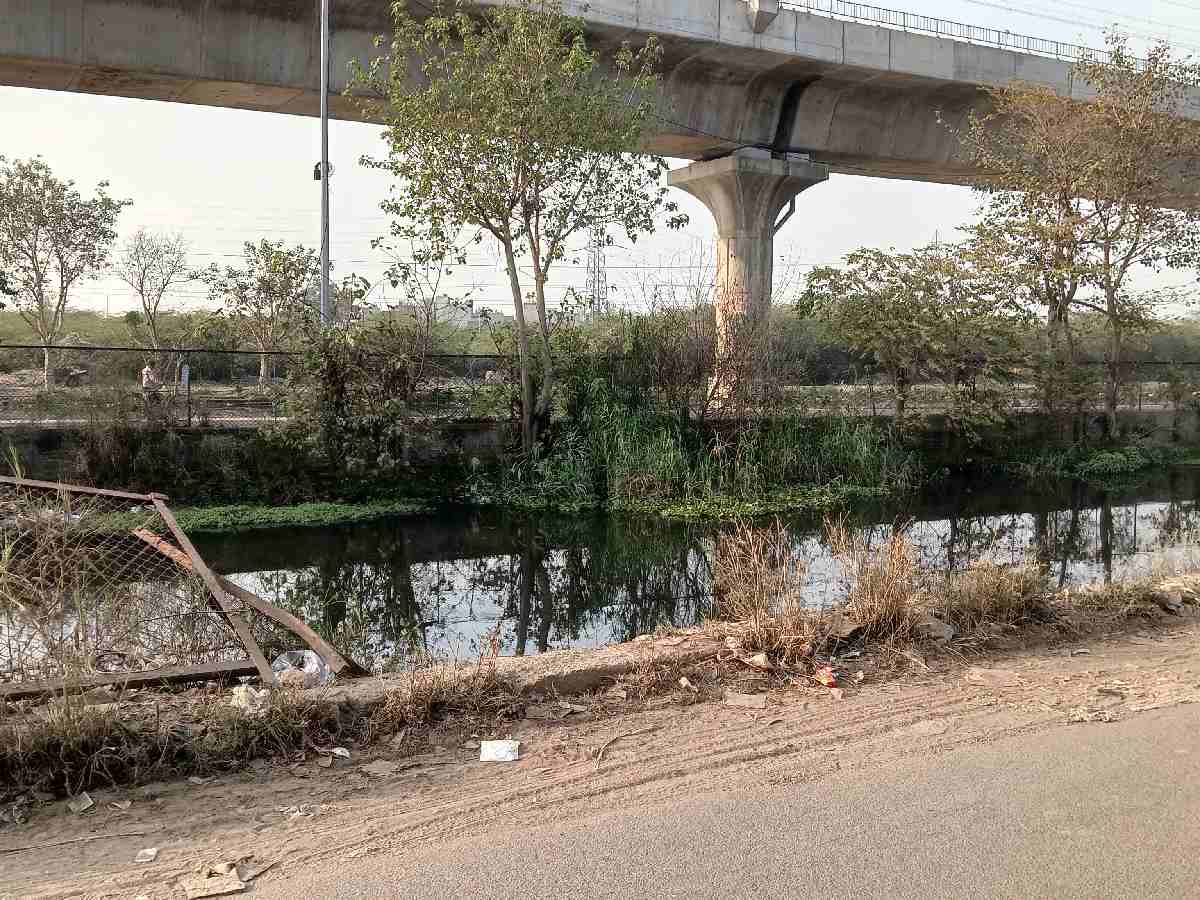
On August 7, 18-year-old Ankit Kumar was swept away by a strong current while attempting to cross a drain in Madanpur Khadar.
His body was recovered near the Agra Canal on the evening of August 8 after a day-long search-and-rescue operation by the Delhi Police, Delhi Disaster Management Authority and Delhi Fire Service.
Kumar was his parents’ elder son. His father, Sunil Kumar, works in the pantry of a private firm. The family lives in a rented house in Bhim Colony, Ali Village, for which it pays Rs 5,000 a month.
Kumar’s death was one of several drownings reported in Delhi in recent months. Between April and August 2026, at least six major incidents claimed 12 lives, most of them children.
Although consolidated figures for 2026 are not yet available from the Delhi Police or the National Crime Records Bureau, reports of recent incidents point to a recurring pattern: Unsecured rainwater pits, flooded roads and unprotected drains and riverbanks turning public spaces into death traps.
Civic activists and residents have repeatedly blamed institutional negligence, pointing to broken boundary walls, poorly marked water-filled pits and inadequate stormwater drainage.
Children among most victims
On April 30, three children aged between eight and 10 drowned while bathing in a deep pond on a golf course estate in Dwarka Sector 24.
On July 12, four boys drowned after being swept away by strong currents while bathing in the swollen Yamuna near Hiranki village in Alipur.
Infrastructure failures continued to prove fatal in late July and August. On July 27, a 20-year-old student died in Vasant Kunj after his vehicle plunged into a submerged open drain overflowing after heavy rain.
On August 13, two boys, aged nine and 11, drowned while swimming in an unsecured rainwater pit on a vacant Delhi Development Authority plot in Narela. The pit was between five and seven feet deep.
A day later, a 32-year-old man died after accidentally slipping into a water-filled pit on a vacant plot in Prem Nagar during intense rainfall in north-west Delhi. The pit was between eight and 10 feet deep.
Drowning the leading cause of accidental deaths
Data presented in the Delhi Assembly shows that 239 people died in accidents and natural disasters in the Capital between January 2024 and December 2025, with drowning accounting for more deaths than any other single cause.
Of the 239 deaths, 89 were caused by drowning. Many occurred not in deep rivers but in underpasses, waterlogged streets and other urban spaces affected by poor drainage.
The government data identified several hotspots, including the Sarita Vihar underpass, Barat Ghar near Ali Vihar, Kalindi Kunj Canal, DND Flyway and Jaitpur.
During the same period, fires claimed 53 lives, while 46 people died in building collapses during heavy rain. Three people died from electric shocks, and 48 were killed in other natural or human-made disasters.
Experts have warned that poor drainage, unsafe urban infrastructure and delays in emergency response continue to put residents at risk.
Heavy rain exposes drainage failures
Delhi’s inadequate drainage infrastructure came under renewed scrutiny earlier in August, when 12 hours of torrential rain inundated neighbourhoods and submerged roads under as much as four feet of water.
Vehicles were stranded and traffic was disrupted across the city following three consecutive days of heavy monsoon rain.
Safdarjung, Delhi’s base weather station, recorded its wettest first week of August since 2011. It received 127 mm of rain during the first seven days of the month until 8:30 am on August 7, followed by another 77.1 mm during the day.
This took the station’s rainfall for August to 204.1 mm by 8:30 pm, equivalent to 90% of the normal average for the entire month.
Authorities received around 90 complaints concerning wall collapses, fallen trees, power outages and severe waterlogging. Commuters were trapped in traffic for hours across the city, from Mehrauli-Badarpur Road in south Delhi to Mahipalpur, ITO, Shakarpur and Chhatarpur. Some motorists abandoned their vehicles on flooded stretches, while office-goers struggled to book taxis.
Some of the worst flooding was reported on Mehrauli-Badarpur Road. Two deaths were also reported in nearby Gurugram following a building collapse.
In Delhi, rainwater entered Safdarjung Hospital and the entrance to Greater Kailash Metro station. Kapashera, near the airport, resembled a river. Floodwater covered pavements in Greater Kailash 2 and entered Jahanpanah City Forest, while residents struggled to negotiate waterlogged stretches in Okhla, Sadar Bazaar, Mahipalpur and Saket.
Images from Chhatarpur showed schoolchildren wading through knee-deep water as vehicles crawled along submerged roads. In Sangam Vihar, residents pushed vehicles through waist-deep water, while several two-wheeler riders remained stranded.
In Valmiki Basti in Fatehpur Beri, residents waded through waist-deep water. Schoolchildren who were unable to cross flooded lanes were carried by residents on large plastic sheets used as makeshift rafts.
Traffic moved slowly along Sardar Patel Marg, Teen Murti Marg, Panchsheel Marg, Mother Teresa Crescent, Ashoka Road and C-Hexagon, as well as near the Gol Dak Khana roundabout and ITO.
The India Meteorological Department’s Pushp Vihar station recorded the city’s highest rainfall, at 147.5 mm, between 8:30 am and 8:30 pm. It was followed by Chhatarpur at 131 mm, Palam at 88.7 mm and Ayanagar at 87.4 mm.
An active monsoon trough passing through Delhi made the four-day period ending August 8 the wettest spell of this year’s monsoon.
Residents blamed clogged drains, poorly designed roads and institutional inaction for the disruption. Public Works Department Minister Parvesh Verma, however, said water had been cleared from the city’s major waterlogging hotspots. He added that inundation was largely restricted to some villages and rural areas where drainage projects were underway.
Uncovered drain poses persistent danger
Not all drownings are directly linked to the monsoon. Residents say the absence of barriers around drains and other hazardous sites poses a risk throughout the year.
In east Delhi’s Dallupura, a body was recovered from a section of a drain that residents have long described as accident-prone. According to the Zonal Integrated Police Network, the area has witnessed several similar incidents.
Residents have repeatedly complained about poor sanitation and the absence of safety barriers along the East Delhi-Noida section of the drain.
In January, another unidentified body was recovered from an uncovered section of the drain stretching for nearly two kilometres. The body reportedly showed no signs of bloating or decomposition, but the person could not be identified.
“The drain runs alongside both a motorable road and a residential area, but neither is properly barricaded,” said resident Iftekhar Ali, who works as a mechanic along the stretch.
“There are parts where the fencing has broken off. Nobody comes to help us because it is not a well-to-do area. We have complained many times. People have fallen into the drain repeatedly. Many have died; some have been saved.”
In 2017, soon after the road was constructed, a car reportedly veered off it and fell into the same drain.
Delhi HC will rule Oct 23 on AISA chief Neha Bora’s plea against a police…
A CREA analysis shows Delhi's winter AQI has seen no steady gain since 2022, with…
DMRC will plant over 28,000 saplings across 991 MCD parks in 3 months to offset…
Delhi HC quashed an FIR against an SSC aspirant, ruling mere presence at a protest…
CJP leaders Saurav Das and Ashutosh Ranka sought more time to join the Delhi Police…
Delhi Police held 3 more people, including a couple using a minor to sell heroin…
