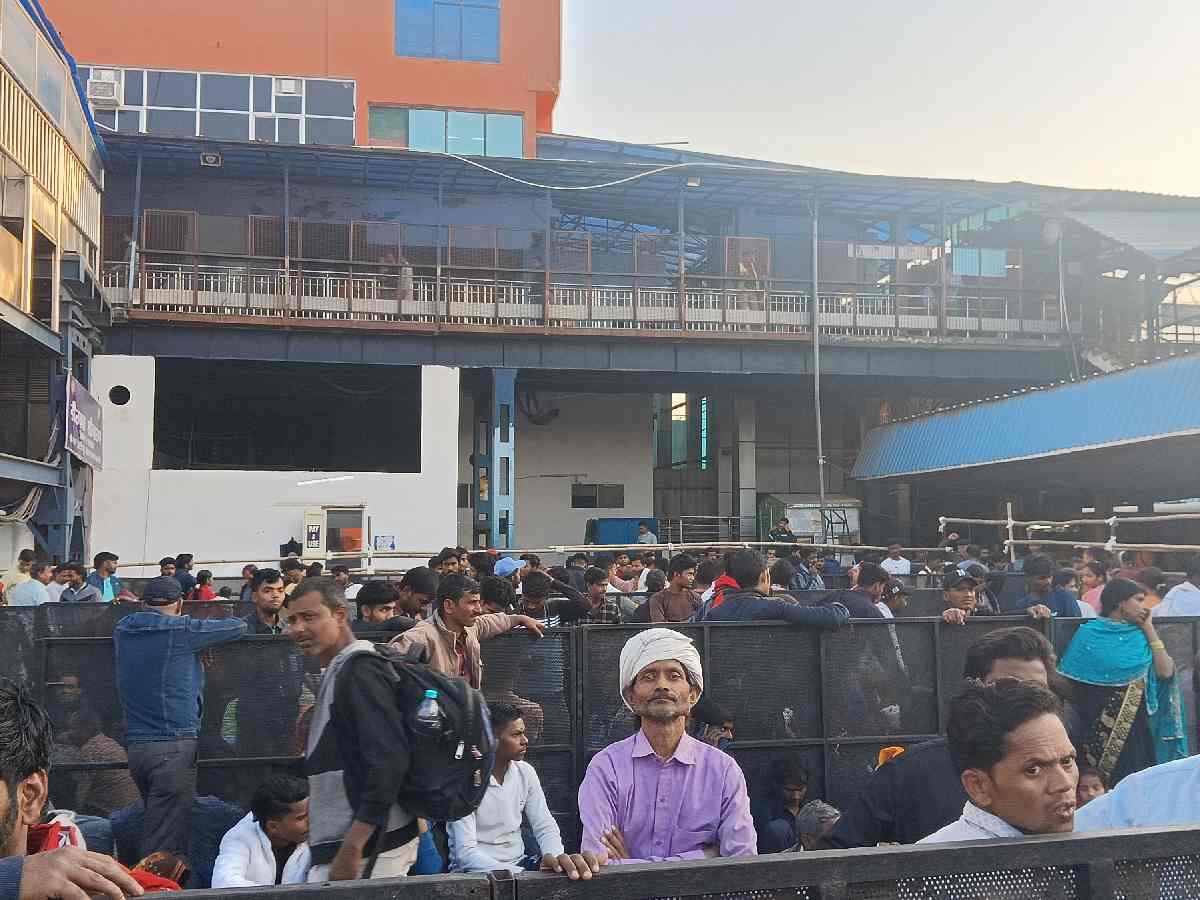
The belt barrier remains jampacked with unreserved ticket holders Photo: Kushan Niyogi
Delhi stampede: Seated haphazardly along the winding belt barrier leading to the entrance of New Delhi Railway Station, scores of passengers wait in agony for the next special train. The wait stretches for hours, their frustration mounting with each passing moment.
All are bound for their pilgrimage, yearning for a spiritual cleanse that will absolve them of sins and offer them a fresh start. Their three-day struggle to board a train will soon be forgotten as they take the sacred plunge, but the indignities they endure in the process remain deeply etched in their memories.
After tragedy, a fragmented response
Following the recent Delhi stampede that claimed 18 lives and injured 15 others, authorities have taken measures to streamline passenger movement. At present, only Platform 16 is designated for general ticket holders heading to Prayagraj. Consequently, an entire fleet of passengers has been restricted from accessing other platforms, with one of the three foot overbridges leading to them blocked off.
Dev Kumar, a contractual labourer from Etawah, Uttar Pradesh, sat with his wife and two children, frustration evident on his face. Wiping a trickle of sweat from his brow, he expressed his dissatisfaction with the arrangements. “We have been waiting outside for a very long time. We spent the night in the enclosure meant for Kumbh passengers. As morning came, we rushed to the queue, but many families had already gathered before us. They are checking tickets on a first-come, first-served basis when trains arrive. If a stampede cannot happen on the platform, it may just happen outside, given how overcrowded the belt barrier route has become,” he said.
Enduring the elements
As passengers wait under the warm February sun, many families—especially those with only one male member—fear leaving their place in the queue. With no water dispensers in sight, they ration what little they have. “If we leave, someone else will take our spot. I do not want my family to wait any longer than necessary and miss the train. If I leave, who will stay with them?” asked Ashu Vishwakarma, a resident of Ballia.
Though an enclosure has been set up for unreserved ticket holders travelling for Mahakumbh, the anxiety of missing a train remains constant. “There is just one water dispenser here, which is nowhere near enough given the number of people waiting. They have not even asked if we need food. Now that the tragedy has already happened, what is the point of making these arrangements? Passengers are still anxious about securing a seat. They have announced multiple ‘special’ trains, but they are unreserved, so they will get overcrowded anyway. Children are sitting on the ground outside the platform, suffering just like the rest of us,” said Prasad Jatav, a resident of Varanasi.
The forgotten casualties
Every few hours, a special train pulls into Platform 16, all headed to Prayagraj. Yet, despite this turmoil, it is the country’s poor who continue to bear the brunt of the crisis, their plight forgotten in the larger scheme of things.
Also Read: New Delhi Railway Station Stampede: A disaster rooted in mismanagement
Experts highlight that the condition of India’s underprivileged has remained an issue for generations, only drawing attention when disaster strikes. Nivedita Ghosh, an associate professor at Delhi University, noted that systemic neglect has numbed the poor to their hardships. “There is a deep class divide in India, and the poor have been conditioned to accept their fate. The government is not doing enough to bridge the gap, and by segregating the railway station in this manner, it is only reinforcing the divide. Unfortunately, this will not lead to any widespread outrage or change because those affected have been kept subdued by the powers that be,” she said.
Meanwhile, security personnel at the station are grappling with gruelling work shifts. “After the tragedy, they realised we were severely understaffed. Now, our shifts stretch to 12 hours, from noon to midnight and vice versa,” said a Railway Protection Force (RPF) officer.
As the trains continue their slow trickle out of the station, the resilience of those waiting—sitting on the floor, deprived of basic amenities—remains a silent testament to the systemic neglect they endure.
Delhi inaugurates the 70th National School Games, hosting over 14,000 participants in 14 sports across…
Delhi High Court asked "Doosra" filmmakers to respond to Sourav Ganguly's plea over alleged violation…
Delhi L-G appointed Paralympian Suvarna Raj as State Commissioner for PwDs following her gold win…
DDA is planning Delhi's longest 24-km cycling track along the Yamuna floodplain, linking key eco-projects…
Police detained several anti-SIR protesters heading to the ECI headquarters in Delhi as mass gatherings…
An exhibition that revisits the significance of Indian Modernism through works from earlier and defining…
