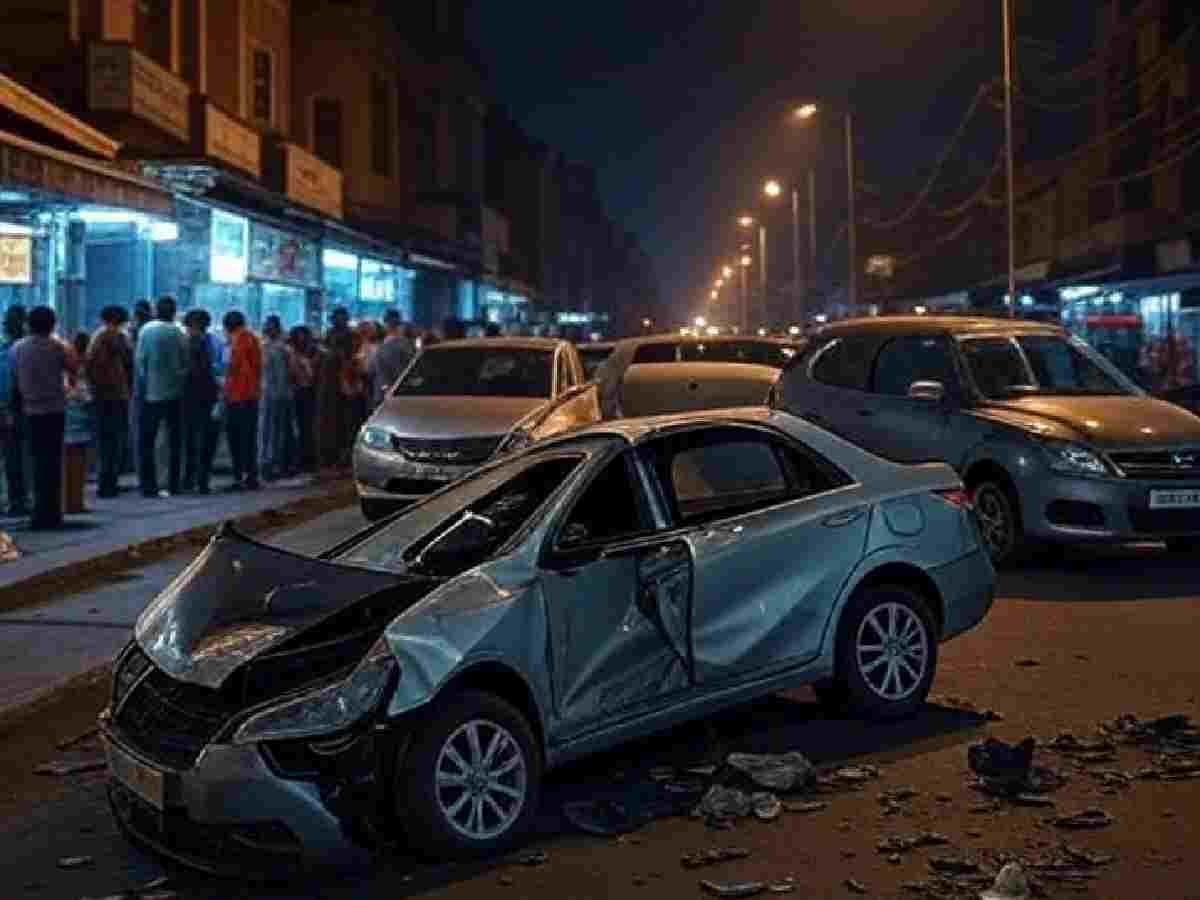
On June 25, Sarthak Mattoo was killed after an SUV allegedly struck him near the Rajokri Flyover in southwest Delhi.
Mattoo, who worked for an event management company, was riding his motorcycle from Gurugram to Noida for work when the SUV allegedly hit him from behind. His birthday was two days away.
Police identified the driver as Apurv Singh, a private-sector employee. The Karnataka-registered SUV belonged to a Bengaluru-based company and had been leased to Singh’s friend Sagar Saha.
Saha told the police that Singh was driving and that he was in the passenger seat when the crash occurred. Singh was arrested on June 27 and later granted bail.
Mattoo was among the hundreds of people killed on Delhi’s roads during the first six months of 2026.
Marginal rise in deaths
According to data from the Delhi Traffic Police, Delhi recorded 749 fatal crashes between January 1 and June 30, 2026, compared with 758 during the corresponding period in 2025.
Although the number of fatal crashes declined by nine, the number of deaths increased from 778 to 782.
The rise was marginal, but it continued a worrying trend. Delhi recorded 1,617 road deaths in 1,578 fatal crashes in 2025, the highest annual toll in seven years. In 2024, 1,551 people were killed in 1,504 fatal crashes.
Five major roads accounted for around 28% of the fatal crashes recorded in the capital in 2025, according to data shared by the Delhi Traffic Police.
Five roads account for 28% of fatal crashes
The Ring Road recorded 130 fatal crashes in 2025, the highest for any road in Delhi. The Outer Ring Road followed with 113.
GT Karnal Road recorded 95 fatal crashes, while Rohtak Road and Mathura Road reported 64 and 31, respectively.
The Ring Road and Outer Ring Road are among the busiest parts of the capital’s road network. Their wide carriageways, flyovers and long stretches without interruptions allow vehicles to travel at high speeds, particularly when traffic is light.
The risk is especially high near metro stations, bus terminals and intersections, where fast-moving vehicles encounter heavy pedestrian traffic.
Although foot overbridges are available at some locations, designated crossings are often far apart, leading many pedestrians to cross multi-lane roads at ground level.
In 2025, the Ring Road recorded 50 fatal crashes involving pedestrians, while the Outer Ring Road recorded 38.
GT Karnal Road, which connects North Delhi with Haryana and Punjab, carries heavy goods vehicles alongside cars, two-wheelers and pedestrians. Rohtak Road and Mathura Road similarly carry a combination of local and highway traffic.
The absence of adequate separation between heavy vehicles, two-wheelers, pedestrians and local traffic increases the risks faced by vulnerable road users.
Safety concerns on Urban Extension Road-II
Urban Extension Road-II (UER-II) has also witnessed fatal crashes since it opened.
In February, a 30-year-old motorcyclist was killed after a car hit his two-wheeler near Dichaon Kalan in southwest Delhi’s Dwarka. The crash occurred on the carriageway towards the airport and was reported at around 6 pm.
“We are in consultation with civic agencies to bring about a proper permanent solution to the issue that we are facing with enforcement in the area,” said Special Commissioner of Police (Traffic) Manish Kumar Agarwal.
“The problem is that it’s a highway, so that means that no actual enforcement can be done for running traffic, and it’s through infrastructural development that accidents can be avoided here,” he added.
The officer’s name, designation and remarks should be checked against the interview recording before publication.
Pedestrians remain vulnerable
Pedestrians remained Delhi’s most vulnerable road users in 2025. They accounted for 649 deaths during the year.
Unknown vehicles were involved in the highest number of pedestrian crashes and deaths. Among vehicles that were identified, private cars were involved in the largest number of pedestrian deaths, followed by motorcycles and heavy goods vehicles.
Non-injury crashes fell from 84 in 2024 to 61 in 2025, a decline of more than 27%. This fall, however, was not accompanied by a reduction in fatal crashes or road deaths.
Dangerous driving also remained a concern. Cases of triple riding on motorcycles increased by 63% in 2025.
The Delhi Traffic Police issued thousands of challans for offences including speeding, drink-driving, wrong-side driving and triple riding. The precise offence-wise figures should be checked against the Traffic Police records before publication.
Road improvements planned
The Delhi Traffic Police has identified 143 locations across the city for road-design improvements.
Proposed interventions include installing or improving signs, repairing damaged stretches, introducing speed-calming measures and making pedestrian crossings safer. The measures required will vary according to the problems identified at each location.
The authorities have also increasingly adopted the term “crash” instead of “accident” to emphasise that road deaths can often be prevented through better engineering, safer driving and effective enforcement.
The New Delhi Road Safety Declaration, launched in February 2026, calls for roaddeaths and serious injuries to be reduced by at least 50% by 2030.
It follows the “safe system” approach, which recognises that road users will make mistakes and seeks to ensure that those mistakes do not result in death or serious injury.
Enforcement intensified
The Delhi Traffic Police has launched a zero-tolerance campaign at Madhuban Chowk, Rithala Metro Station, Shahbad Dairy, Badli Metro Station and Sufiyabad Crossing.
The police identified these locations as areas with frequent violations and severe congestion during peak hours.
Specialised teams and camera surveillance have been deployed to act against motorists jumping red lights, driving on the wrong side and parking improperly.
Separate enforcement drives have also been conducted at Azadpur Chowk, Shalimar Bagh Chowk and Bikaner Chowk in Karol Bagh.
While enforcement may help curb dangerous driving, reducing Delhi’s road deaths will also require lasting improvements to road design, pedestrian access and the separation of high-speed traffic from vulnerable road users.
The Supreme Court will hear a plea on Sunday seeking contempt action against authorities for…
Over 7,000 protesters, including CJP chief Abhijit Dipke, were detained as security forces sealed off…
Mamata Banerjee called Delhi’s crackdown “beyond Emergency” after being detained during a protest against Gyanesh…
From kuttu ki poori and sabudana to paneer and festive desserts, these restaurants have put…
Sonam Wangchuk condemned the arrests of student and youth leaders in Delhi, calling the situation…
Court said Sharjeel Imam apparently violated bail conditions by contacting media but refused to cancel…
