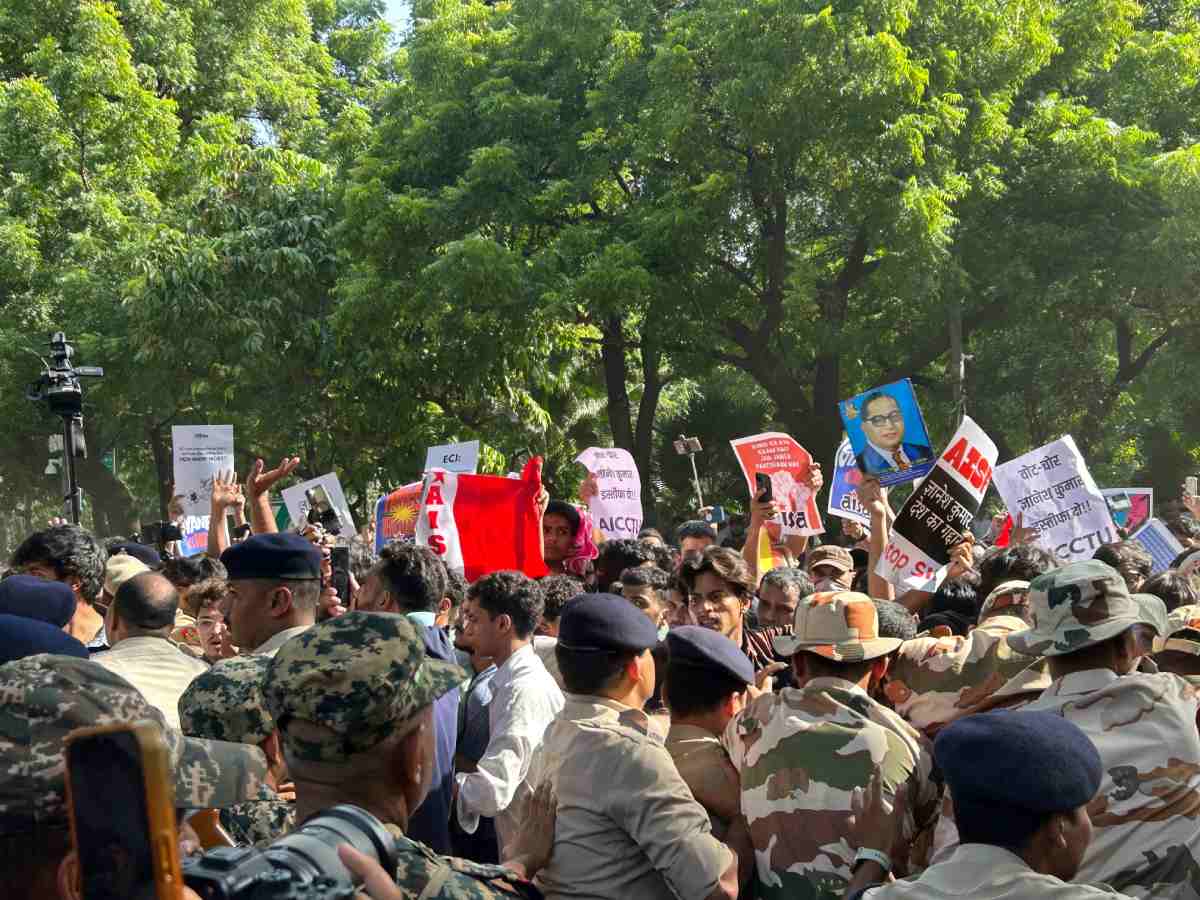
At least 6,000 people were detained, mobile internet suspended and more than 30,000 security personnel deployed across Delhi over three days of protests against Chief Election Commissioner Gyanesh Kumar. The crackdown swept up journalists, minors and opposition leaders, and saw the INDIA bloc marching to the Supreme Court on October 12.
Out of confines
A day earlier, a kick at the window of the detention bus leaving Rajiv Chowk Metro station’s Gate No. 7 captured much of the story of the protests in Lutyens’ Zone. Multiple kicks later, a portion of the window lay shattered, with glass shards scattered everywhere.
Most of the detentions took place between October 10 and 12, with at least 6,000 protesters picked up from Delhi and elsewhere in response to calls to assemble at Connaught Place. While the Delhi Police has maintained a day-to-day estimate of the number of protesters detained, officials said they could not provide a complete list of detainees.
The demonstrators, led by the Cockroach Janta Party (CJP), the All India Students’ Association (AISA) and opposition parties, demanded Kumar’s resignation and raised concerns about the integrity of the electoral process.
Thousands held
The CJP had called for a demonstration at Jantar Mantar on October 10, but a heavy police deployment prevented the rally from taking place as planned. Authorities detained thousands of demonstrators, including CJP founder Abhijeet Dipke and several opposition leaders. The crackdown extended to journalists covering the protests, many of whom were detained despite identifying themselves as members of the press.
Police also imposed restrictions on gatherings, suspended mobile internet services in parts of the Capital and closed several Metro stations. The detentions prompted further protests on October 11, including demonstrations organised by student groups such as AISA.
Delhi was placed under an extensive security lockdown over the three days, with more than 30,000 police and paramilitary personnel deployed across the Capital ahead of the October 12 INDIA bloc march.
The mobilisation included more than 120 companies of the Central Armed Police Forces (CAPF) assisting the Delhi Police, barricades across central Delhi, vehicle checks at city borders and heightened security at railway stations and bus terminals. Authorities also restricted access to several Metro stations and monitored online activity for attempts to mobilise demonstrators. The deployment followed the detention of thousands of protesters over the weekend, with police citing law-and-order concerns.
Prohibitory orders
According to a police official, the goal was to prevent any form of organisation or coordinated gathering, with Section 163 of the Bharatiya Nagarik Suraksha Sanhita (BNSS) being implemented across Connaught Place and surrounding areas. On October 12, the same announcements kept blaring across Connaught Place, especially along the road leading to Jantar Mantar, a previously notified protest site. “Do not congregate. Anyone caught loitering, organising or sloganeering will be detained,” said the loudspeaker at regular intervals. The loudspeakers stand along the road overlooking the LIC building, the road leading to Patel Chowk, and several other areas.
The main concern, however, has been the scale of the crackdown on protesters, who made it through October 10 and 11 in the face of alleged excesses. Despite being detained and dropped off at multiple places across Delhi, they always found their way back.
Paresh, a protester who reached Delhi before authorities began detaining people and stopping trains, is one such example. He arrived from Madhya Pradesh on October 6 and thought he was fortunate to have made it. “They stopped all the trains, but they could not stop the protesters who found their way. My friend and I reached Connaught Place in the morning [on October 10], and immediately we were picked up and put into a bus. They left us around Safdarjung, but we made it back,” he said.
‘Minors picked up’
In front of the LIC building, a number of minors were allegedly detained. The orders, protesters said, were to detain anyone present at the spot, so that even the possibility of a gathering was met with officials hauling people away. According to protesters, multiple minors had been detained.
A 15-year-old protester alleged that during the protest on October 10, he and his sister were hauled into a detention bus, from which they were able to escape. “We were picked up from around the Central Park area. After that, we were able to escape through the window and have been evading the police since then. They do not care about the age of the person they are detaining and are apprehending everyone they spot. I was trying to protect my sister from being manhandled by the police, as they tried to drag her,” he said. The minor was later detained after this conversation with the reporter, alongside almost 15 other protesters.
Under Section 46(4) of the BNSS, no woman shall be detained or arrested after dusk and before daybreak unless there are exceptional circumstances. In such cases, the woman police officer should seek written permission from a First Class Judicial Magistrate in the region where the offence is being committed or where an arrest is to be made.
The Juvenile Justice (Care and Protection of Children) Act sets similar limits, stating that no child can be detained or arrested between sunset and sunrise, and cannot be kept at a police station during that period. Protesters, however, have alleged that the police did not adhere to these guidelines.
‘No comments’
Police officials have refused to comment on such detentions.
On October 11, the police put a bus of multiple women protesters on the road, alongside Students’ Federation of India (SFI) leader Aishe Ghosh. Inside, dozens of women protesters were crammed in, while a few male detainees were also present. Security personnel, mostly male, manhandled and tried to overpower the detainees. One of the protesters successfully broke down the window that remained behind a grille. “Male officers are attacking us,” she alleged, telling the media personnel present at the site.
Journalists from several media houses were also detained.
30 scribes detained
According to the media outlet The Wire, at least 30 journalists were detained over October 10 and 11.
One person detained during the early hours of the October 11 protest alleged that a police officer accepted a Rs 500 bribe to let him and his friend get off the bus. Reyansh, a model by profession, said he arrived at the protest around noon with a couple of friends. However, seeing that the situation could turn at any moment, the group decided to turn back; during that time, he alleged that a male police officer misbehaved with his female friend.
“I questioned them about that, and then they said, ‘Isko utha lo (Detain him)’. Then they hauled us off to the bus and kept us there until around 12 to 15 more people were also detained. I kept telling them to drop us off, and an officer finally said to give him Rs 500, and he would let me go,” he claimed.
Over the two days, right-wing groups also took to the streets, beating protesters and attempting to haul them off, bundling them alongside police personnel into detention buses.
Also Read: Sanjay Lake, Bonta, Hauz Khas: the DDA parks where safety lags
On October 12, leaders of the Congress-led INDIA bloc, including Rahul Gandhi, Congress president Mallikarjun Kharge, Priyanka Gandhi Vadra, Samajwadi Party chief Akhilesh Yadav, Trinamool Congress chairperson Mamata Banerjee and RJD leader Tejashwi Yadav, marched towards the Supreme Court in a demonstration described as the March for Democracy.
The protest sought Kumar’s resignation and challenged the SIR of electoral rolls, which opposition parties allege has resulted in large-scale and politically motivated voter deletions. Leaders framed the march as a defence of democratic rights and electoral integrity, while Gandhi criticised the heavy security deployment and accused authorities of preventing people from reaching Delhi.
Police barricades on Bhagwan Dass Road, near the Supreme Court, halted the march, where demonstrators and opposition leaders tried to proceed despite the restrictions. As the confrontation unfolded, the INDIA bloc’s legal team separately approached the Supreme Court with a petition concerning the Election Commission and the allegations of electoral irregularities.
The office of Delhi Police Commissioner Anurag Kumar has de-notified Jantar Mantar as an official protest site. The police have notified three other protest sites for future protests — CBD Ground in East Delhi, Ramlila Maidan in central Delhi and Burari Ground. All of them are 5 to 25 km from the former Jantar Mantar protest site.
On October 12, the INDIA bloc had organised a protest leading to the Supreme Court where Leader of Opposition Rahul Gandhi filed a petition against the CEC. During the course of the protest, at least 30 people were detained and soon released.
Presently, Cockroach Janata Party leaders Saurav Das and Ashutosh Ranka have been remanded to five days of judicial custody and sent to Tihar Jail for allegedly breaching barricades, entering the restricted Jantar Mantar protest area, and obstructing public servants while waving the national flag. Meanwhile, party leader Ajinkya Shinde was released on a personal bond.
Delhi Police books journalist under SC/ST Act for casteist remarks against ACP during a Jantar…
Hindu College staff protests against principal, demanding DU takeover over financial and admission irregularities and…
Delhi Cabinet approves Industrial Policy 2026 with Rs 1,000 crore for top sectors to turn…
Delhi launches DJB command centre with GPS tanker tracking and AI tools to manage water…
ABVP protests at JNU against Congress MP Akoijam over sexual harassment claims, demanding the party…
DU officials oppose HEFA loans for hostel expansion, warning repayment could raise student fees and…


