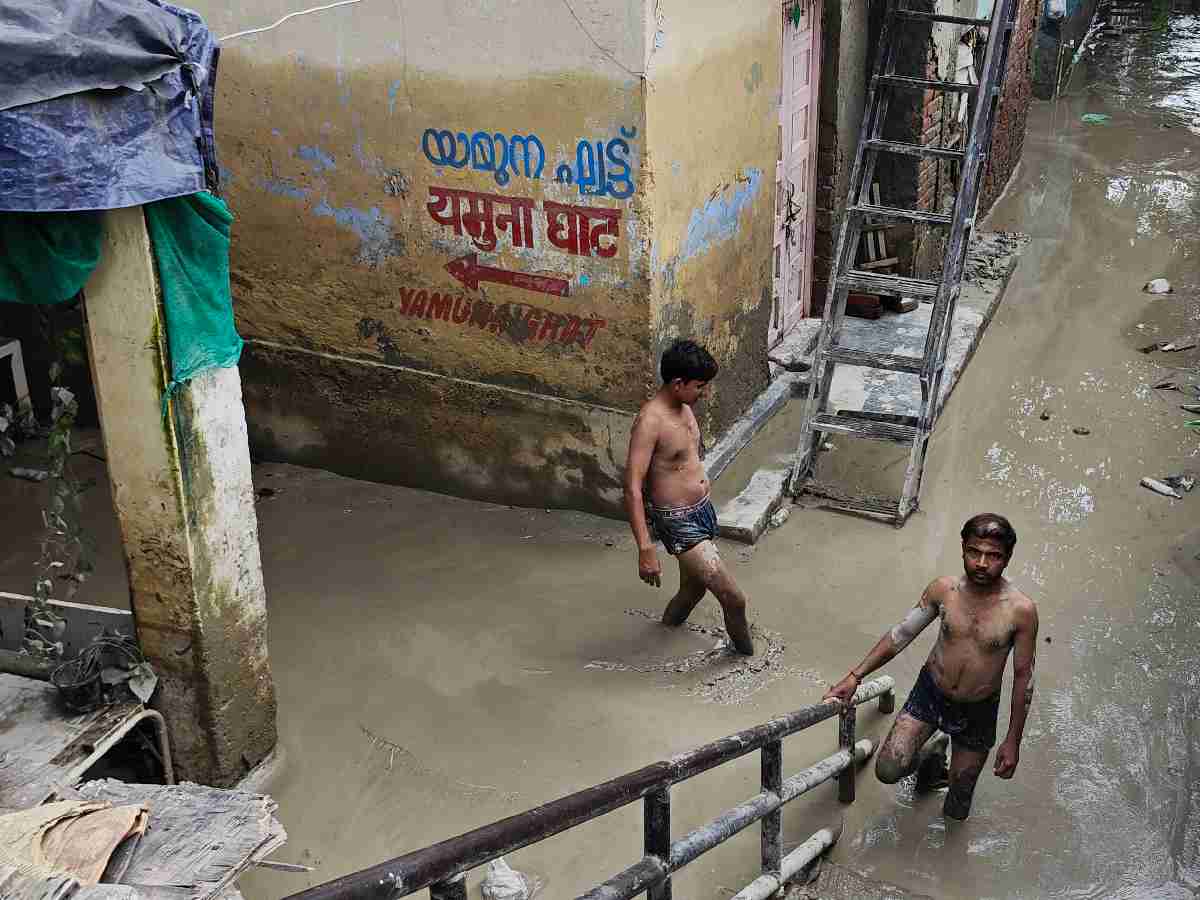
All 31 ghats at Yamuna Bazaar were submerged on September 2. Photo: Tahir Bhat
The Yamuna river level fell below the danger mark in the national capital on September 8, five days after it breached the safe limit. During these days, thousands of residents were forced to abandon their homes in low-lying areas for temporary shelters. As the river level returns to normal, the residents, whose houses were inundated, face mounting financial losses. On September 8, the river level was recorded at 205.21 meters.
Authorities claim to have evacuated nearly one lakh people from low-lying areas to relief camps. Those displaced are now grappling with the lack of electricity, unhygienic living conditions, and an acute shortage of basic facilities such as toilets, making survival increasingly difficult.
Huge financial losses
Speaking to Patriot, Gopal Jha, General Secretary of the Resident Welfare Association (RWA), Yamuna Bazaar, recalled the 2023 Delhi floods. He said that this year too, financial losses are skyrocketing as “everything which we had including refrigerator, washing machine and furniture were destroyed.”
According to Jha, each family has suffered a loss of at least Rs 2 lakh as flood water entered homes suddenly, leaving residents no time to salvage valuables.
On September 4, the Yamuna reached its highest level of the season at 207.48 metres. At 10 AM, the water level at the Old Railway Bridge was measured at 207.47 metres — nearly two metres above the danger mark and one metre above the evacuation threshold.
This surge marked the river’s third-highest level in the last six decades, since 1963, and only the fifth time it had breached the 207-metre mark.
All 31 ghats at Yamuna Bazaar were submerged on September 2, forcing residents to shift their families to evacuation camps.
“The residents are still waiting for the compensation announced by the authorities in 2023, but just five to six families received it for only Rs 10,000,” Jha said.
Squalid camps and lack of relief
Bharat Bhushan, 38, who was staying at the evacuation centre near Neeli Chatri Mandir, Yamuna Bazaar, sat waiting without even a fan for the waters to recede so he could return home to assess the damage.
“Since past three days, we are basically living under this temporary structure without electricity and the mosquitos have made it impossible to rest. We have raised a complaint with the Municipal Corporation of Delhi (MCD) but no action has been taken by them to date,” he said.
More than 70 people are living in the temporary structures at Neeli Chatri Mandir, while 312 others were shifted to Sarvodaya School Number 1, Mori Gate.
Bhushan added that his family has not been able to sleep for three days due to mosquitoes and the stench of garbage. “No sanitation officials have visited the camps to clean the space. Not only this, the authorities only provide the electricity during night – 6:30 PM to 5 AM,” he said.
For women residents, the conditions are even worse. Washroom facilities are located nearly 500 metres away from the camps and are in a miserable state.
No toilets for women
Kamla Devi, mother of Bharat Bhushan, lay inside the makeshift camp, gently waving a hand fan to battle the stifling heat. With folded hands and weary eyes, she prayed for the Yamuna to recede, whispering that life had become unbearable under the fragile shelter set up by authorities.
“The biggest struggle in this flood relief camp is the absence of toilets for women. The authorities must consider where women are supposed to go when they need a washroom. We have lived in Delhi for over 70 years, yet our voices, our demands, and even our losses are always ignored by the government,” she said.
Shanti Kumari, another resident of Yamuna Bazaar, said that in the absence of toilets, women were being forced to wait for hours in discomfort. “Many of us have lived in Delhi for decades, yet when floods come, we are pushed into these camps where even the most basic facilities are denied to us. It is humiliating and unsafe, especially for young girls and elderly women.”
She further said the government keeps talking about providing relief, but questioned, “What kind of relief ignores the most essential needs of half the population? We don’t just need food and shelter, we need dignity, we need toilets, and we need the authorities to finally understand that women cannot be made invisible in times of crisis.”
Residents rescue 500 cows
Residents also criticised the authorities for lack of preparation, saying they had to rescue stranded cattle themselves.
Bablu, 32, recounted how the water level rose suddenly, leaving cows tied and unable to move. “The authorities kept saying help was on the way, but no one came. For hours, in chest-deep water, we worked together — cutting ropes, pulling the animals out, and leading them to safer ground.”
He said they managed to rescue more than 500 cows. “It was an exhausting and dangerous task, but we could not just stand by and watch them die. Despite knowing the Yamuna floods every year, there is no plan, no system. If ordinary people like us had not acted, the loss would have been unimaginable.”
Another resident, Ravi, 22, said that every year authorities promise better arrangements, but when disaster strikes it is always residents who save one another. Along with protecting their children and homes, they had to rescue cows left stranded in floodwater.
“We tied ropes around them, calmed them down, and guided them towards higher ground. We don’t have equipment, we don’t have resources, but we have compassion, and that is what saved these animals. The government should feel ashamed that ordinary people had to risk their lives to do what officials should have done. Our lives, our animals, our belongings — we are protecting everything ourselves while those in power just make statements,” Ravi said.
Yamuna floods: a recurring crisis
The Yamuna has a long history of flooding that has repeatedly disrupted life in Delhi. Records show major floods in 1924, 1947, 1955, 1956, 1967, 1971, 1975, 1976 and 1978. Each time, vast stretches of the capital were inundated, paralysing normal life and leaving thousands of residents struggling to cope.
Government records note that in the last four decades alone, the river has witnessed “high flood” levels in 1967, 1971, 1975, 1976, 1978, 1988, 1995 and 1998, when water levels at the Old Railway Bridge crossed 206 metres.
Also Read: Delhi’s sludge crisis undermines Yamuna clean-up
The most devastating flood in recent history occurred in July 2023, when the Yamuna swelled to its highest-ever level of 208.66 metres, displacing more than 25,000 people. Before that, the record was 207.49 metres in September 1978, when 18 people died, thousands were left homeless, and damages reached nearly Rs 10 crore — a staggering figure for that time. More recently, the river touched 207.32 metres in 2013 and 207.11 metres in 2010, both of which triggered widespread displacement.
Understanding flood levels
Flooding in the Yamuna is classified as low, medium or high, depending on the water level. A low-intensity flood occurs when water remains below the warning level of 204.22 metres, generally posing no serious threat to life or property.
Medium floods are declared when levels rise between 204.22 metres and 205.44 metres, often leading to water spilling out of the river’s natural course and brushing the embankments.
Once the river crosses 205.44 metres, it is considered a high flood, demanding constant monitoring and protective measures. With heavy rainfall across Delhi-NCR, the Yamuna has once again submerged homes, displaced families, and halted businesses in low-lying areas, underlining the city’s continuing vulnerability to the river’s fury.
Protests against CEC Gyanesh Kumar over the SIR of electoral rolls started on October 10.…
Delhi Police books journalist under SC/ST Act for casteist remarks against ACP during a Jantar…
Hindu College staff protests against principal, demanding DU takeover over financial and admission irregularities and…
Delhi Cabinet approves Industrial Policy 2026 with Rs 1,000 crore for top sectors to turn…
Delhi launches DJB command centre with GPS tanker tracking and AI tools to manage water…
ABVP protests at JNU against Congress MP Akoijam over sexual harassment claims, demanding the party…

