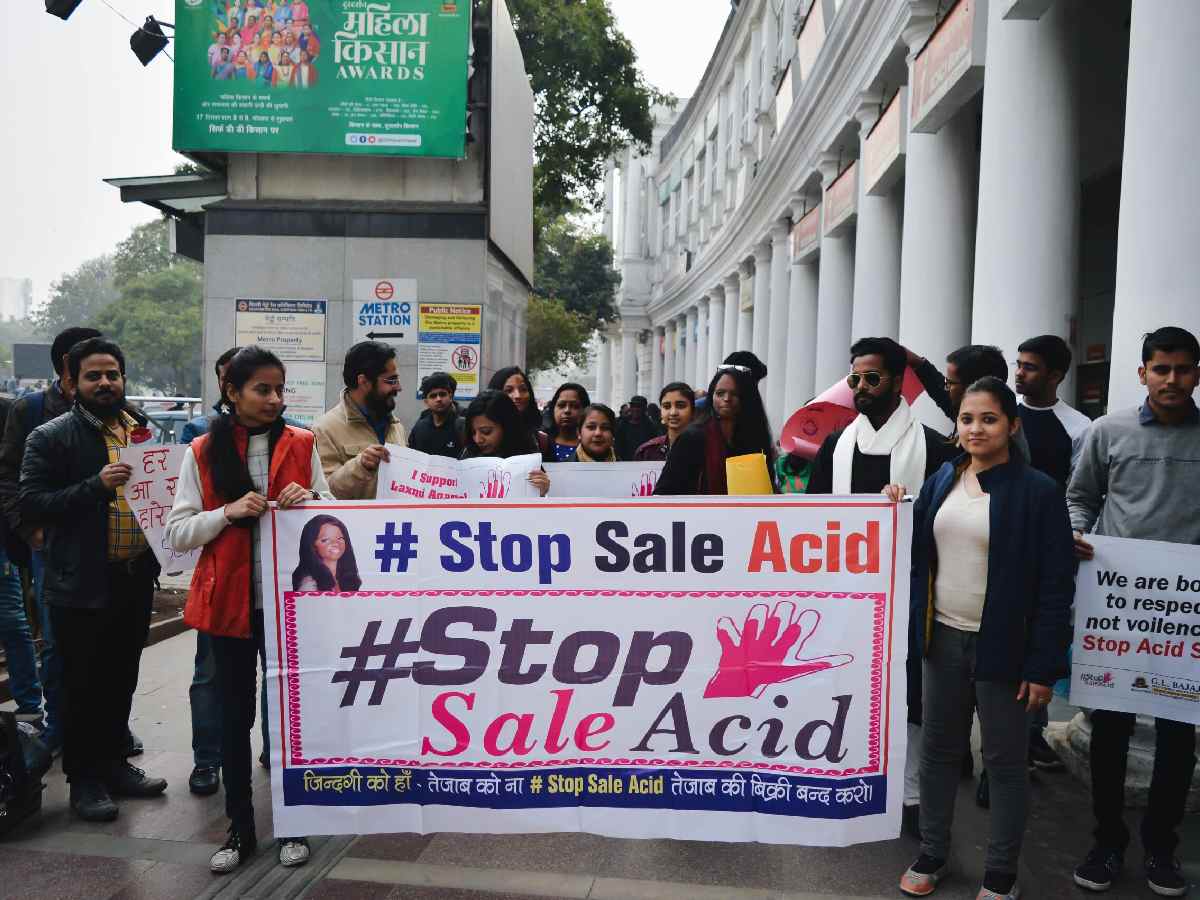
Markets across Delhi have become an easy spot for perpetrators to find the choicest weapons. Acid is one of the more easily accessed weapons. While checks and balances have been provided for, they are seldom implemented.
On October 6, a 24-year-old woman suffered serious burn injuries after a man allegedly threw a corrosive liquid at her near Ghonda Chowk in North East Delhi. Police arrested the 41-year-old accused, who investigators said had known the woman for around six months.
Days later, on October 9, the Supreme Court directed Sir Ganga Ram Hospital to continue providing an acid attack survivor with comprehensive treatment, including plastic surgery and medicines, until she was fit to be discharged, regardless of the cost. The intervention followed concerns raised over her continued medical care.
These incidents have once again brought into focus the vulnerabilities faced by acid attack survivors and the gaps in the systems intended to prevent such violence and support victims. One of the most persistent concerns is the ease with which corrosive substances can be obtained in the Capital, despite a decade-old regulatory framework designed to restrict their sale.
Also Read: The Ashok: seven decades of Indian hospitality
In 2013, the Supreme Court, in Laxmi vs Union of India, laid down stringent guidelines to regulate acid sales following a spate of attacks. The restrictions required sellers to maintain records of buyers, verify their identities and establish the purpose of purchase. The sale of acid to anyone below 18 was prohibited, while sellers were also required to declare their stocks to the area Sub-Divisional Magistrate.
The Delhi government subsequently introduced the Delhi Poisons Possession and Sales Rules, 2015, bringing 40 corrosive substances under a regulatory framework intended to tighten controls over their possession and sale.
However, a ground visit to several markets revealed that enforcement remains extremely lax across the city.
Citywide availability
In Govindpuri, at a busy local market, a small paint and hardware shop sold two bottles of yellow, unbranded liquid within minutes after being asked for a “strong floor cleaner”.
“You mean tezab [acid]?” the shopkeeper asked.
The chemical was poured into plastic bottles and sold for Rs 50 apiece. No register was maintained, and no details were recorded.
A similar transaction took place in Jangpura, where a shopkeeper readily handed over a bottle, describing its contents as an effective floor cleaner. He cautioned only that the substance was “very strong”. The bottle carried no label identifying its contents.
Also Read: Before the lights: two Diwalis Delhi can never forget
In Saket, two shops said acid could be obtained on pre-order. One shopkeeper said customers generally sought two to four bottles to clean bathrooms. Another eventually sold a brown glass bottle for Rs 80, claiming that the chemical had become harder to obtain because of the regulations.
“It’s tough to get now because of the laws. But this one is excellent — no leaks,” the shopkeeper said.
Neither demanded identification nor asked the buyer to disclose the intended use.
Bulk sale
In Mayur Vihar Phase I, a chemical shop stocked at least 10 unlabelled bottles and offered to sell in bulk. The shopkeeper asked for a name and telephone number to follow up on larger orders, but did not seek identification or establish the purpose of the purchase.
“We’ve been doing this for years,” he said.
The practice extended to Greater Kailash as well. In Zamrudpur village, a general store wrapped a bottle in a polythene bag and sold it for Rs 50.
“Everyone in GK buys from us,” the shopkeeper said. “What can we do? We just sell what people ask for.”
Across these neighbourhoods, the ease of purchase stood in stark contrast to the safeguards envisaged under the law. The absence of meaningful checks meant that a buyer could obtain a potentially dangerous chemical without establishing their identity or explaining its intended use.
Also Read: CPCB flags high pollution at Sahibabad, Shahdara drains
Restrictions on online commerce
The Central Consumer Protection Authority has separately warned against the sale of acid through e-commerce platforms. Citing Section 4(3) of the Consumer Protection (E-Commerce) Rules, 2020, the authority said platforms must not engage in unfair trade practices.
It directed e-commerce platforms to ensure that acid sales comply with applicable state regulations and the Union Home Ministry’s 2013 guidelines. These include verifying buyers’ government-issued identification, age and purpose of purchase, as well as obtaining undertakings from sellers confirming compliance with the relevant rules.
The findings raise questions about how effectively these requirements are being implemented, particularly when corrosive substances can be procured through informal retail networks and online suppliers with limited scrutiny.
Also Read: Where do we belong?’: Delhi tenants worry over SIR deletions
According to a Hindustan Times report, Delhi Police and National Crime Records Bureau data show that at least 35 acid-attack cases were reported in the national capital between 2020 and 2025. Survivors and activists, however, contend that official figures do not fully capture the scale of the problem, pointing to persistent gaps in enforcement and accountability.
The National Commission for Women took cognisance of one such case this year in Delhi.
According to the Delhi State Legal Services Authority, compensation disbursed to victims in such cases increased marginally. In 2025, Rs 80,50,000 was disbursed across 24 cases, while in 2024, data shows that Rs 79,51,050 was granted across 27 cases. As of September 30, Rs 77,00,000 has been disbursed as victim compensation across 22 cases.
The 2015 rules were introduced to ensure that corrosive substances could not be purchased as casually as ordinary household products. Yet the ability to obtain acid from shops across Delhi without identification, recorded details or disclosure of intent points to a significant gap between regulation and enforcement.
Delhi's Old RTR flyover reopens for light vehicles today after repair work following road cracks,…
Rescue teams recovered two bodies from the debris of a collapsed under-construction house in northeast…
Built on Jawaharlal Nehru’s vision, the Delhi landmark has witnessed the evolution of a young…
Delhi steps up NCR coordination to curb winter air pollution by enforcing strict border checks…
Police probe all angles, including a suspected breakup and CCTV footage, after a Class 12…
Two terror attacks, eight years apart, struck ordinary shoppers and changed festive celebrations in the…
