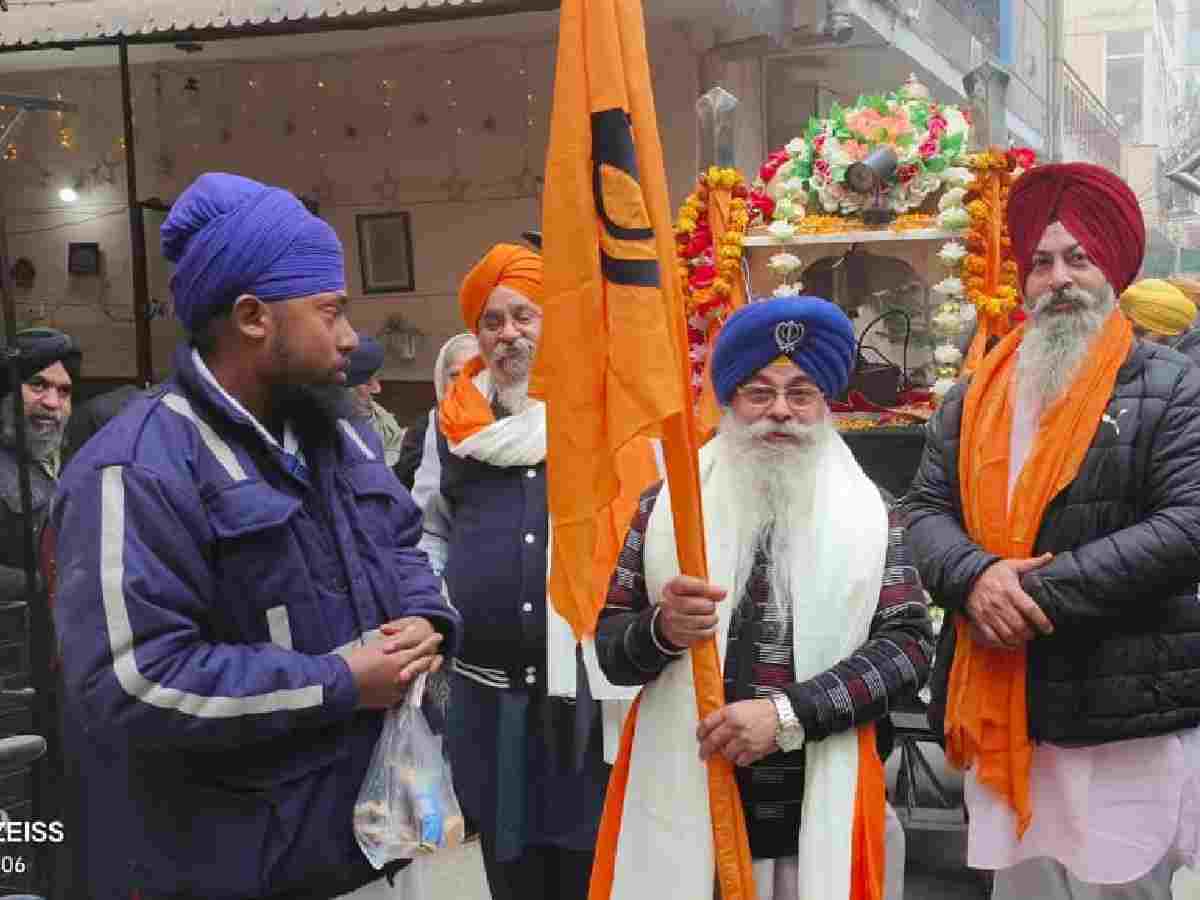
“Satnam, Satnam Wahe Guru Ji…” These words can be heard early in the morning these days, as groups of men and women head to gurdwaras at dawn. In colonies like Raja Garden, Geeta Colony, Tilak Nagar, Karol Bagh, Rajouri Garden, Vivek Vihar, Krishna Nagar, Greater Kailash and Model Town, where Sikh families live in sizeable numbers, these chants echo repeatedly — a sign that Guru Purab, the birth anniversary of Guru Nanak Dev Ji, is approaching.
Wherever there are even five Sikh or two Punjabi families, morning processions, or prabhat pheris (early-morning religious processions), are sure to take place. These processions feature shabad kirtan (devotional hymn singing), with some participants carrying manjira (cymbals) and dholkis (small hand drums). Men, women, children and the elderly all join in.
“The prabhat pheris begin at 6 am, with the congregation gathering outside gurdwaras as early as 5 am, reflecting their enthusiasm. As winter approaches, some participants wear shawls or sweaters. These processions typically circle the gurdwara’s neighbourhood,” informs Balbir Singh of Vivek Vihar, an active member of the Delhi Sikh Gurdwara Prabhandhak Committee.
Delhi-fication of a Punjabi tradition
The tradition of prabhat pheris originated in Punjab’s villages, but the custom of serving delicious breakfasts during these events is relatively new, emerging in recent years. The breakfast spread includes chole-kulche (chickpeas with flatbread), mathri (crispy snack), jalebi, tea and coffee — a distinct “Delhi-fication” of prabhat pheris.
Jatinder Singh Sahni, who has been joining prabhat pheris since his childhood, says the processions are held only on the birth anniversaries of Guru Nanak Dev Ji and Guru Gobind Singh Ji. “Their purpose is to prepare for Gurupurab and foster social bonding, as neighbours meet and interact early in the morning,” he explains.
In areas like Mayur Vihar and Gole Market, 30–35 people participate in prabhat pheris, while in Vivek Vihar, Greater Kailash and Rajouri Garden, the numbers can reach 250–300. In Kalkaji, the congregation is even larger, as it has emerged as a significant hub for Delhi’s Sikh community. Many families now hold their final prayers and bhog(concluding prayer ceremony) at the Pahariwala Gurdwara in Greater Kailash due to its excellent facilities.
Delhi’s first prabhat pheri
At 5:30 AM, before daylight breaks, a prabhat pheri starts from Paharganj’s Main Bazaar. About 50–55 people chant shabads as they move from Shora Kothi and Laddoo Ghati towards Ram Nagar, carrying drums and cymbals. They sing in sweet tones, “Kal taaran Guru Nanak aaya…” or “Nanak kahat jagat sab mithiya…” These processions signal that Guru Nanak Dev Ji’s birthday is near. The prabhat pheri in Paharganj begins at Shri Gurdwara Singh Sabha in Chuna Mandi.
Delhi’s older Sikhs believe this was likely the capital’s first prabhat pheri, which started in 1943 when the Paharganj gurdwara was established. Back then, few Sikhs lived in other parts of Delhi, though historical gurdwaras existed. Locals recall that two decades ago, up to 500 people, including children, participated in the Paharganj prabhat pheri.
Why participation has declined in Paharganj
Dr Harmit Singh, a Punjabi poet whose family has lived in Paharganj for many decades, explains that many Sikh and Punjabi Hindu families have left the area, leading to a decline in participation. “Paharganj has become increasingly commercialised, with residents moving to areas like Inderpuri, Naraina and Old Rajinder Nagar,” he says.
However, many Sikh families still visit the Chuna Mandi gurdwara for Gurupurab because of their deep connection with it. Meanwhile, prabhat pheris have started in areas like Lajpat Nagar, Vivek Vihar, Geeta Colony and Model Town, where participants sing shabads and are joined by Punjabi and Sindhi Hindus. Guru Nanak is revered by all.
Walking to gurdwaras while singing shabads
In these weeks leading up to GuruPurab, Sikh families are filled with enthusiasm. Early in the morning, groups from Patel Nagar, Geeta Colony, Lajpat Nagar and Model Town head towards Gurdwara Sis Ganj, Gurdwara Bangla Sahib and Gurdwara Nanak Piao.
If you happen to be around Patel Nagar Main Road at this time, you will see Sikh men and women walking with dholkiand chain (small metallic percussion instrument) in hand, singing in sweet melodies: “Kal taaran Guru Nanak aaya…” or “Nanak kahat jagat sab mithiya…”
Just like in previous years, this time too, many Sikhs are reaching the historic gurdwaras of the capital on foot while singing shabads. Joining them are Punjabi and Sindhi Hindus. “Baba Nanak belongs to everyone. He is the revered deity of all,” says Kulbir Singh Gill, who belongs to an old Sikh family of the capital.
The journey of faith and joy
“A spiritual glow shines on all their faces. They are in a state of supreme bliss. As they move towards their destination, several car drivers offer to drop them at the gurdwara, but they politely decline the offer with gestures,” says Gill.
After enjoying shabad kirtan for a while at Sis Ganj, Nanak Piao, Bangla Sahib or any other gurdwara, the congregation returns home — often in an Ola cab or three-wheeler. On the way back, conversations revolve around the nagar kirtan(city-wide religious procession) that proceeds from Gurdwara Sis Ganj to Gurdwara Nanak Piao on Gurpurab (Guru’s birth anniversary).
“When Baba Nanak came to Delhi in 1505, he stayed at the very spot where Gurdwara Nanak Piao now stands. It is considered Delhi’s first gurdwara. It is believed that when he arrived here, the area’s groundwater was saline, causing great distress to the people. Upon learning this, Baba Ji used his divine power to bring forth sweet water from the ground. Indeed, the water here is sweet,” informs Balbir Singh of Vivek Vihar.
Even today, even lakhs of devotees in the capital take part in prabhat pheris to Sis Ganj or Bangla Sahib before Gurpurab. The journey of eight or nine miles is completed while singing shabads. These prabhat pheris are distinct from those that start in neighbourhoods about a week before Gurpurab.
Families displaced by the Seemapuri building collapse spend another night on the streets as damaged…
Camera-based enforcement in Delhi generated around 40.6 lakh notices till September, but only about 2…
Delhi government to fast-track Rs 7,000-crore elevated Ring Road project, with two new Yamuna bridges…
Yamuna water quality deteriorated at three locations in Delhi in September, with BOD levels remaining…
Delhi liquor stores will remain shut on October 9 and 10 following police inputs to…
Strike began September 15; ESMA invoked by month-end has barred strikes for six months; drivers…



