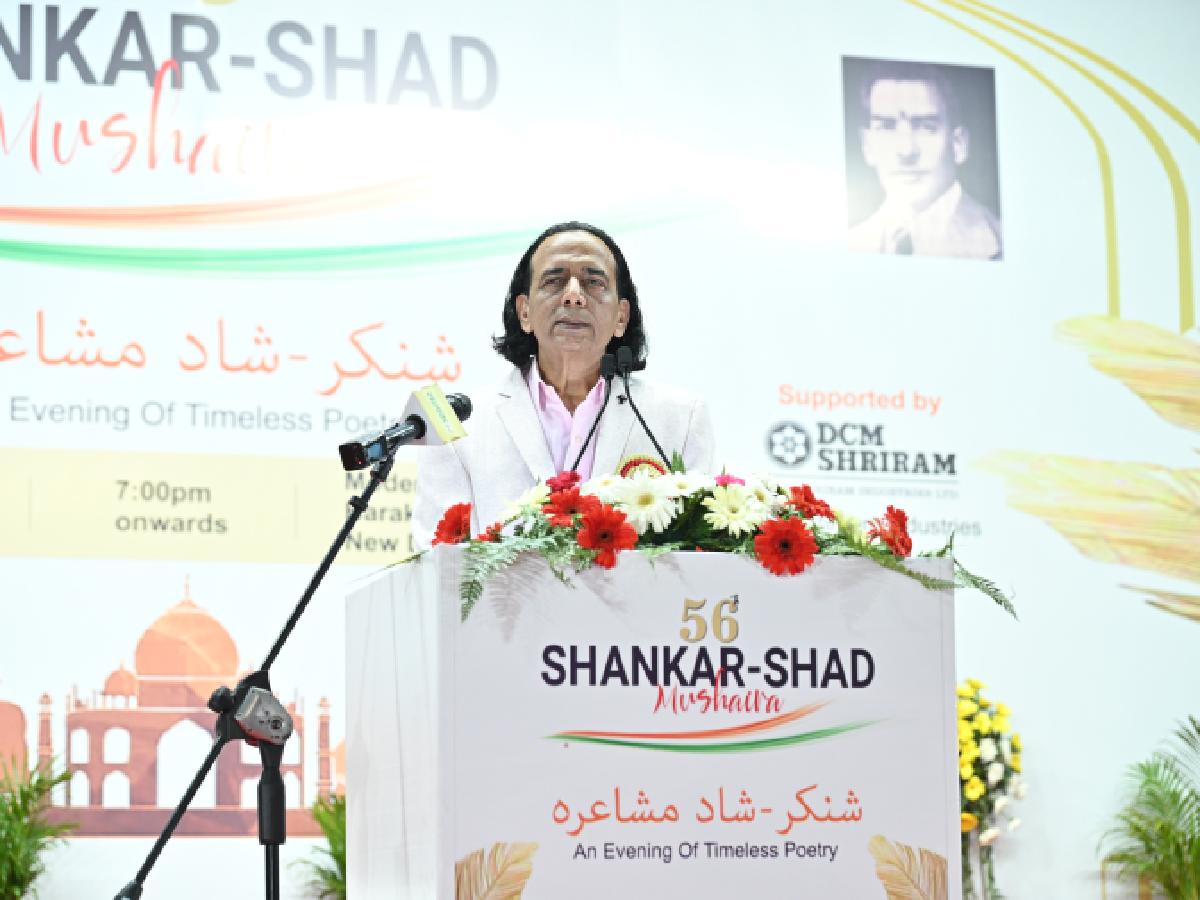
Iqbal Asshar
For Urdu poet Iqbal Ashhar, poetry did not begin in a classroom or a literary circle. It began in the streets, mosques, homes, and newspapers of Old Delhi—where Urdu was not merely a language but a way of life. Born in Kucha Chelan in Shahjahanabad, Ashhar grew up surrounded by Urdu in its most organic form, long before he became a recognised voice in mushairas across India and abroad.
“In those days, Urdu was everywhere,” he told Patriot. “It was in newspapers, on banners in markets, inside mosques, and in everyday conversations. Even advertisements painted on walls were written in Urdu because that was the language people read and understood.”
He recalled how Urdu newspapers and magazines regularly carried poetry, especially in Sunday editions, offering young readers early exposure to verse. Radio broadcasts, too, played a formative role, bringing recitations, interviews, and literary discussions into homes. “Programmes like Urdu Majlis introduced us to great poets. Listening to those voices shaped our understanding of poetry,” he said.
Language of culture and memory
Ashhar’s early education reflected this cultural landscape. At Shanta Nursery School in Old Delhi, Urdu was compulsory, rooted in the belief that the language refined pronunciation and expression. Even outside formal education, poetry lived within family and community traditions. His mother, who had connections to literary circles in Aligarh, often recited ghazals and folk songs at home.
“Poetry wasn’t something distant,” he said. “It was part of weddings, gatherings, and daily life. At weddings, poets would write verses that became part of the dowry, beautifully framed by calligraphers. I grew up seeing poetry honoured in this way.”
He described how entire neighbourhoods would celebrate weddings with decorated streets, music, and communal singing—experiences that nurtured his sensitivity to rhythm, language, and emotion.
The journey into mushairas
Despite this immersion, poetry was not his initial career ambition. Ashhar once aspired to become a chartered accountant and pursued his studies seriously. But his quiet habit of writing and reciting his own verses gradually brought him into literary circles. His association with senior poets and mentors opened doors to mushairas across the country.
“My elders encouraged me and told me that once you step into this world, you will realise how vast it is,” he said. “In the beginning, there were successes and failures. Sometimes audiences responded warmly, sometimes not. But over time, the journey shaped me.”
Also Read: Urdu poetry is not just a mode of expression, it’s an exploration, says Azhar Iqbal
For more than two decades, he has recited his poetry across India and internationally, performing in countries including the United States, Canada, Saudi Arabia, Oman, and the United Kingdom. These travels revealed a striking contrast between Urdu’s reception abroad and in India.
“In countries like Canada or Saudi Arabia, especially among people over 50 who studied Urdu in undivided India, there is deep respect for books. They buy them, read them, and preserve them. But in India, people praise poetry but rarely buy books,” he said.
A fading reading culture
Ashhar expressed concern about the declining readership of Urdu books in India. While appreciation for poetry remains strong, he said, the culture of purchasing and preserving literary works has weakened.
“People will tell you that you are a good poet, but they won’t spend money on a book,” he said. “Earlier, poetry collections would go through dozens of editions. Today, even selling a few hundred copies is difficult.”
He attributed part of this decline to changes in script usage, with Urdu increasingly written in Devanagari rather than its traditional script. This shift, he believes, has weakened the connection between readers and the language’s literary heritage.
Still, he remains hopeful, pointing to Urdu’s global presence. “Outside India, you see how alive Urdu still is. People value it deeply and see it as part of their identity,” he said.
The digital transformation of poetry
Ashhar sees the digital age as both an opportunity and a challenge. Platforms like Instagram and Facebook have created new avenues for poets to reach audiences, but they have also changed how poetry is evaluated and consumed.
“Today, organisers look at how many followers a poet has on social media,” he said. “Popularity online has become a factor. But the true strength of poetry cannot be measured by followers alone. Real appreciation comes from those who listen deeply.”
He believes social media has personalised the relationship between poets and audiences, making poetry more accessible. Yet he cautioned that digital popularity does not always reflect literary depth or enduring impact.
“Poetry is not just about visibility,” he said. “It is about experience, understanding, and emotional connection.”
Preserving tradition through mushairas
For Ashhar, traditional mushairas remain essential to Urdu’s survival. He spoke with particular reverence about the Shankar-Shad Mushaira, calling it a vital institution that has preserved poetic traditions for decades.
“This mushaira is the pride of our country,” he said. “It continues not for commercial gain but to preserve cultural heritage. That spirit is what keeps Urdu alive.”
He admired its organisers’ commitment to literature over numbers or popularity. “They believe literature cannot be ranked or measured. That is a powerful thought. It reminds us that poetry exists beyond competition.”
He also emphasised that such platforms nurture younger poets and ensure continuity. “Every generation must carry this legacy forward,” he said.
A lifelong bond with Urdu
Reflecting on his journey, Ashhar sees his poetry as inseparable from the world that shaped him—the streets of Old Delhi, the voices on radio, the gatherings of poets, and the lived experiences of language.
“Urdu is not just something I learned,” he said. “It is something I lived.”
Even as the language navigates modern challenges, he remains committed to writing, reciting, and preserving its beauty. For Ashhar, poetry is not merely an art form but a cultural inheritance—one that must be protected, shared, and carried forward.
Elected to the Delhi Golf Club general committee, Mansher Singh says he wants to build…
A $780 million market built on pavements, where the pleasure of reading meets the price…
Supreme Court advocate Abhishek Pawar alleges women were denied washroom access for seven to eight…
Each day of closure costs shops in Khan Market and Connaught Place between Rs 60,000…
Delhi generates nearly 15,000 tonnes of waste daily, prompting the government to deploy 1,000 mechanical…
Delhi Police has issued an NOC for the Congress rally at Ramlila Maidan on November…
