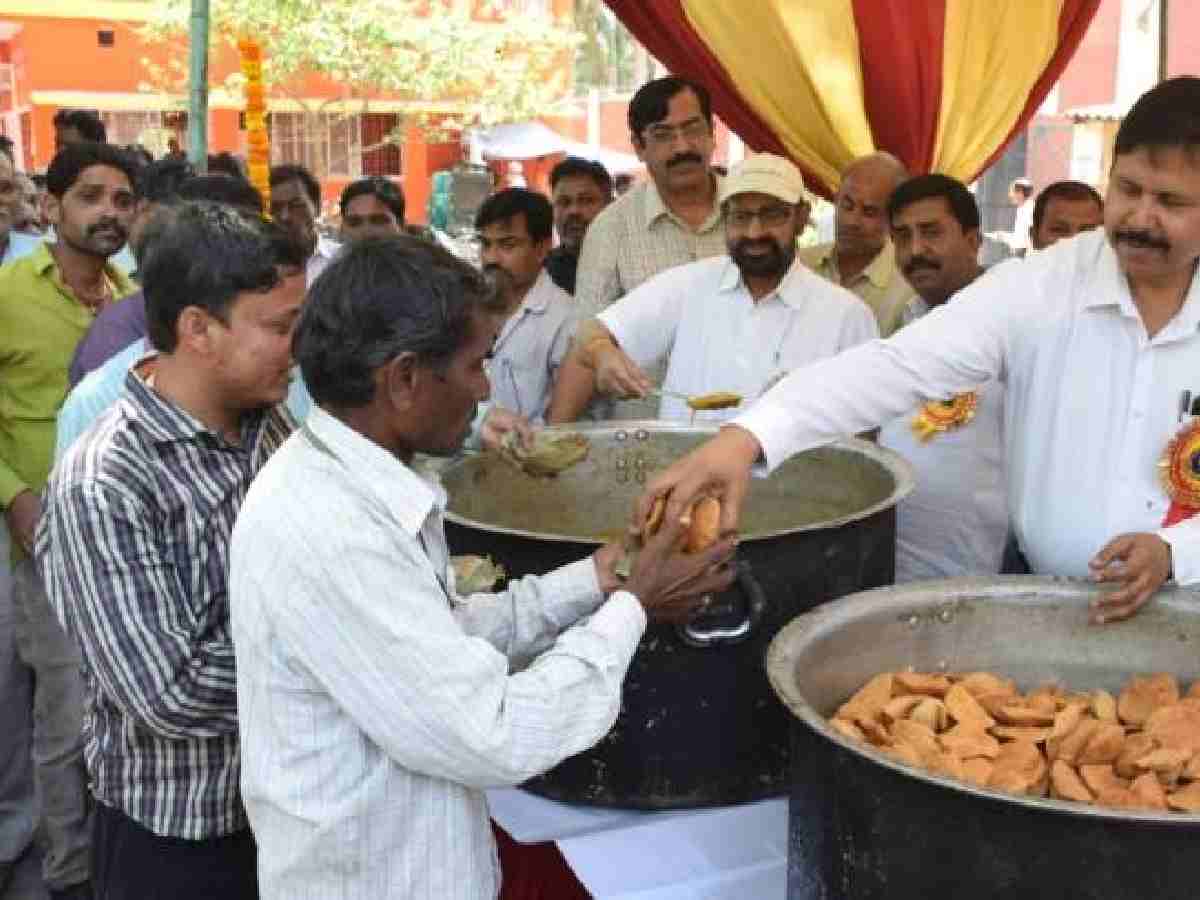
As in the past, the number of bhandaras has increased across Delhi-NCR during Navratras. In markets, residential neighbourhoods, near hospitals, and even along busy roadside stretches, scenes of people serving and sharing food have become common. Large vessels of puri, aloo ki sabzi, halwa, chhole, and chai are set up, and long queues of people patiently wait for their turn. There is a visible sense of participation and community in these gatherings, as people from all walks of life come together around something as simple yet meaningful as a shared meal.
The city has witnessed similar arrangements during Ramzan. In the evenings, especially near mosques and marketplaces, individuals and organisations distribute food to those observing fasts and to anyone in need. This overlap of traditions has made the past few weeks particularly rich in public acts of giving and service.
Bhandaras in CP
If you visit the area near the Connaught Place Police Station on Baba Kharak Singh Marg, you will notice continuous activity throughout the day. From early morning until around 7 or 8 in the evening, bhandaras operate almost without pause. Food such as puri-aloo, chai, and other simple dishes is served in large quantities. It is estimated that nearly 10,000 to 15,000 people are fed daily at this location. Some come just for tea, while others stay for a full meal, but everyone is welcomed equally. During Navratras, bhandaras are also organised at Janpath market and near the HT House.
Egalitarian aspect
The culture of bhandaras has long been a part of life in Delhi. What makes them truly special is the absence of social distinctions. “There is no divide between rich and poor, caste or religion. Everyone stands in the same line, eats the same food, and shares the same space. Even those who arrive in expensive cars often join the queue without hesitation. The experience is not just about eating; it is about equality, humility, and shared humanity,” says author Satyender Tripathi. Many people also believe that the taste of food served at bhandaras has a unique quality, perhaps enhanced by the spirit of generosity with which it is prepared and served.
Organisers usually arrange food either by sourcing it from vendors near temples, especially Hanuman temples, or by having it prepared separately in bulk. Due to the heavy footfall in central areas, food gets distributed quickly. In fact, one organiser noted that food meant for 75 people can be finished in just 30 minutes due to the constant movement of crowds.
Origins story
Some trace the widespread popularity of bhandaras to Gulshan Kumar, often called the “cassette king”. He is believed to have popularised large-scale food distribution at Vaishno Devi, where he sponsored meals for pilgrims. Originally from Delhi, he started his journey with a small juice shop before rising to success in the music industry. His efforts in organising such events are said to have inspired many others to follow suit.
“Gulshan Kumar was a pucca Punjabi Dilliwala. He was an alumnus of Deshbandhu College who started a juice shop in Daryaganj before entering the cassette business,” recalls Santokh Chawla, an old friend of Gulshan Kumar and director of the Fun and Food Village.
While bhandaras were largely associated with Navratras and a few other occasions, over time, they have come to be organised on occasions such as Independence Day, Republic Day, and Raksha Bandhan as well. If you step out between 11 am and 2 pm, you are likely to come across at least one such event somewhere in the city.
Areas like Rohini, Karampura, Moti Nagar, and Ramesh Nagar have become especially known for regularly hosting bhandaras. Together, these efforts reflect a living tradition of generosity that continues to evolve while holding onto its core values of equality and service.
Early days
During the COVID-19 pandemic, however, this culture came to a halt. With lockdowns and restrictions in place, public gatherings stopped, and so did bhandaras. But in the years since, they have returned with even greater frequency. Traditionally, more bhandaras were held on Tuesdays, Thursdays, and Saturdays, but now they take place almost every day. Common dishes include chhole kulche, halwa, puri aloo, bread pakora, and khichdi. Seasonal variations are also noticeable — mango drinks and milkshakes are served during summer, while tea and coffee are more common in winter.
Many neighbourhoods across Delhi, including Madhu Vihar, Vivek Vihar, Janakpuri, Rohini, Pitampura, and Punjabi Bagh, regularly host such events. In some places, sweet dishes such as kheer are also distributed, adding variety to the offerings.
Scene outside AIIMS
In South Delhi, near AIIMS and Safdarjung Hospital, a group of young volunteers from Pilanji village has been organising bhandaras for the past few years. Their goal is simple: to ensure that no one goes hungry. They hold these events every Tuesday and Saturday for those outside hospitals, as well as those in slums and spaces under flyovers. Each time, they serve around 200 people, offering items such as chhole kulche, halwa, and chai. The funds for these initiatives are usually collected from local residents, reflecting a shared sense of responsibility.
Delhi traffic police warn of major diversions and delays on Monday as opposition plans Supreme…
Fire broke out near Yamuna Vihar market in northeast Delhi, fire department is investigating the…
Delhi Police denotifies Jantar Mantar, naming Ramlila Maidan, Burari Ground, and CBD Ground as new…
Delhi HC gives police till Oct 13 to reply to IYC plea for Jantar Mantar…
CJP leaders set a 24-hour ultimatum for Delhi Police to approve a peaceful anti-CEC Jantar…
CJI-led bench to hear SCBA plea Tuesday on lawyer disruptions amid Delhi anti-CEC protests: "Democratic…

