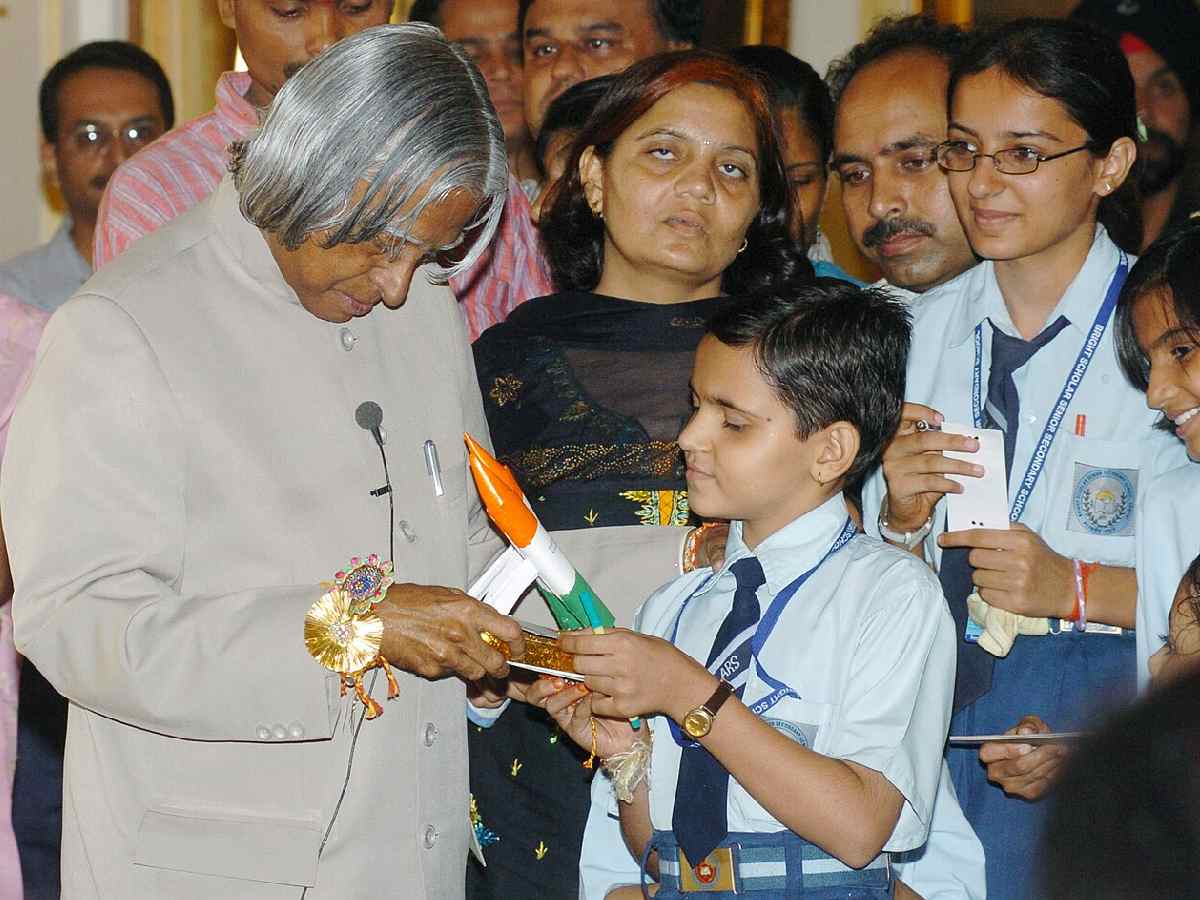
APJ Abdul Kalam was presented a memento by schoolchildren after they tied Rakhis on his wrist on the occasion of Raksha Bandhan in New Delhi on August 9, 2006
The tradition of celebrating Raksha Bandhan at Rashtrapati Bhavan dates back to the presidency of Rajendra Prasad, India’s first President. During his tenure, daughters of Rashtrapati Bhavan staff members would tie rakhis on the President’s wrist.
The early years
Now 104, social worker Subhadra Devi offered a glimpse of how Raksha Bandhan was celebrated at the President’s House:
“In the early 1950s, some women and school-going girls of Sarojini Nagar and Netaji Nagar visited the President’s house to tie rakhi to the President. There, we were welcomed by Rajvanshi Devi Prasad, the first lady, and other staff members of the Presidential Estate. Several girls of schools of the New Delhi area also came to celebrate [Raksha Bandhan] with the President,” Subhadra Devi recalled.
In return, Prasad would present the girls with gifts. After the ceremony, he would often leave, while his wife, Rajvanshi Devi Prasad, remained behind to speak with the girls and their guardians. The children affectionately called her “Maa Ji.”
Former staff at Rashtrapati Bhavan also recall that the daughters of Prasad’s family studied at Raghumal Kanya Vidyalaya near Connaught Place in Raja Bazaar. On Raksha Bandhan, some of their school friends would visit the Presidential residence to tie rakhis to the President.
The celebrations were simple. Traditional sweets from shops in Gole Market and Bengali Market were exchanged. “I know for sure since ages that the President house orders mithai from us for the rakhi. Once rakhi is nearing (sic), we prepare special boxes for the sacred festival,” says Girish Agarwal, owner of Bengali Sweets in Bengali Market.
Through the years
The practice continued under other Presidents, though the nature of the celebrations changed over time.
Sarvepalli Radhakrishnan continued the tradition, celebrating Raksha Bandhan with young girls in the Amrit Udyan, then known as the Mughal Gardens, of Rashtrapati Bhavan.
Zakir Hussain also celebrated the festival with schoolgirls and staff members of the President’s Estate. “Hussain was an extremely soft-spoken President. After the rakhi celebration, he used to sit with kids and listen to their stories,” recalls Anadi Barua, who lived in the President’s Estate for several decades.
Shankar Dayal Sharma, the ninth President of India, also spent time with his personal staff on Raksha Bandhan before meeting schoolchildren who visited the Presidential Estate.
“I have tied rakhi on his hand more than once. Not only on rakhi, he met President Estate kids on several occasions. His wife used to give us sweets and gifts,” says Rashida, who works in a Central government department.
APJ Abdul Kalam, President from 2002 to 2007, received rakhis from the daughters of Rashtrapati Bhavan staff members. After the ceremony and exchange of gifts, he would speak with the girls about their studies in school and college.
Changing times
In 2020, during the COVID-19 pandemic, President Ram Nath Kovind celebrated Raksha Bandhan with members of the nursing community at Rashtrapati Bhavan. Representatives of the Trained Nurses’ Association of India, the Military Nursing Service and the President’s Estate Clinic offered rakhis to the President and shared their experiences of working during the pandemic. Kovind felicitated the nurses, describing them as saviours who not only save lives but also risk their own in the line of duty.
Under President Droupadi Murmu, schoolchildren from across India have continued to be welcomed to Rashtrapati Bhavan. Students from government schools, Kendriya Vidyalayas, Jawahar Navodaya Vidyalayas and Kasturba Gandhi Balika Vidyalayas, as well as children with special needs, have participated in the celebrations.
Murmu has also spoken of Raksha Bandhan as a bond of love extending beyond siblings to elders, peers and the environment, encouraging students to plant and nurture trees as an act of protecting the earth.
Continuing tradition
For Ajit Dubey, President of the Bhojpuri Samaj of New Delhi, the tradition is also a childhood memory. He accompanied his mother, Subhadra Devi, and others to the President’s House for Raksha Bandhan.
“It began with the simplicity and sincerity of Prasad’s era and has grown into a symbol of inclusive celebration under successive Presidents. In the process, it has enriched the cultural life of the Presidential residence and offered a powerful reminder of the values that strengthen the social fabric of the nation,” he says.
Families displaced by the Seemapuri building collapse spend another night on the streets as damaged…
Camera-based enforcement in Delhi generated around 40.6 lakh notices till September, but only about 2…
Delhi government to fast-track Rs 7,000-crore elevated Ring Road project, with two new Yamuna bridges…
Yamuna water quality deteriorated at three locations in Delhi in September, with BOD levels remaining…
Delhi liquor stores will remain shut on October 9 and 10 following police inputs to…
Strike began September 15; ESMA invoked by month-end has barred strikes for six months; drivers…

