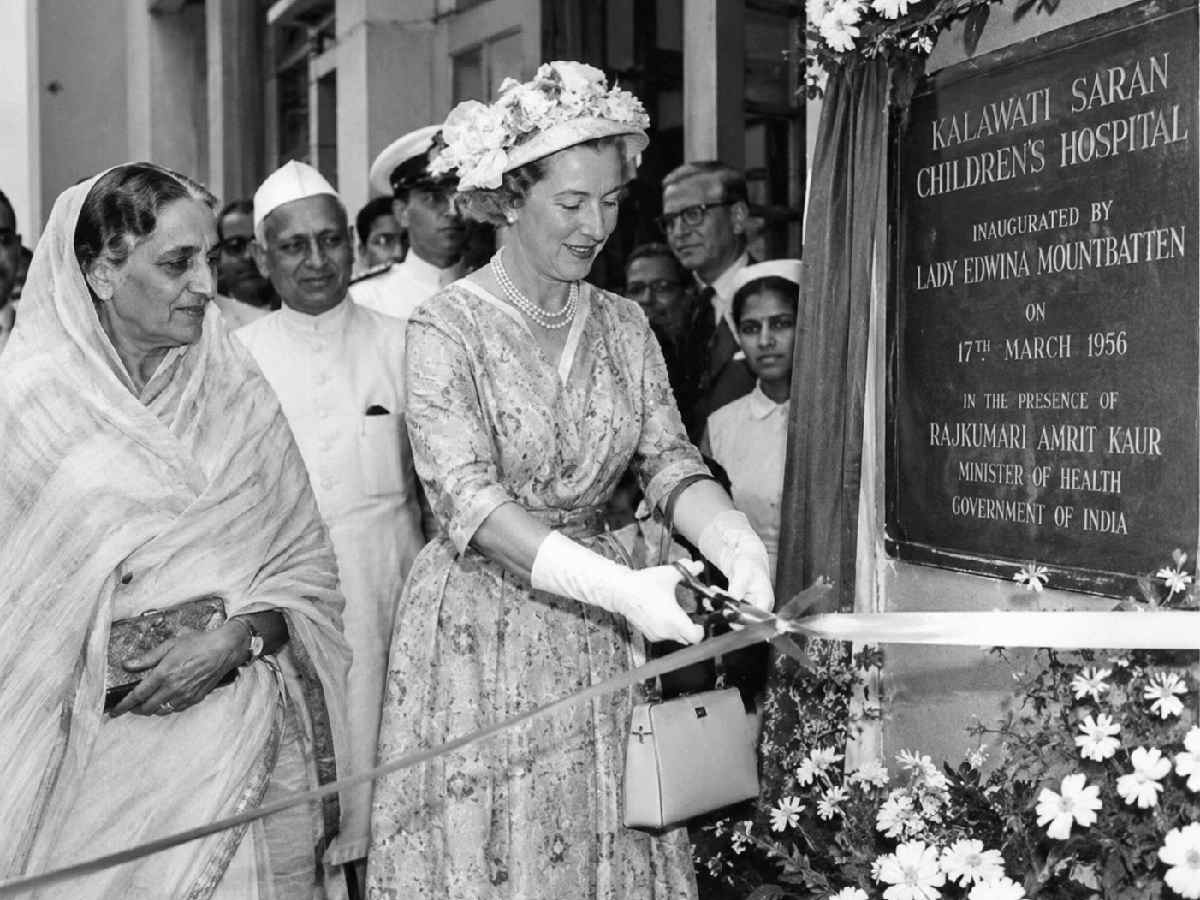
Imagine Delhi in 1956. The Capital was still recovering from the upheavals of Partition. Its population was growing, new residential colonies were coming up, and thousands of families were rebuilding their lives, but healthcare facilities remained limited, particularly for children. Dedicated paediatric hospitals were virtually unheard of.
Against this backdrop, Delhi got a hospital exclusively for children. On March 17, 1956, Kalawati Saran Children’s Hospital was inaugurated by Lady Edwina Mountbatten, wife of Lord Louis Mountbatten, the first Governor-General of independent India.
“Arguably, the hospital was a landmark initiative in the development of paediatric healthcare in the Capital. It was also Delhi’s first independent children’s hospital. Now all the hospitals have dedicated blocks for children, but it was unthinkable seven decades ago,” says Dr Vinay Agarwal, former President of the Indian Medical Association (IMA).
The story behind the name
The hospital was named after Kalawati Saran, wife of businessman and philanthropist Raghubir Saran. He and his younger brother, Raghunandan Saran, donated two properties to establish the institution. Valued at approximately Rs 8 lakh at the time, the properties represented a substantial contribution. The Saran family reportedly owned several properties in the Connaught Place area.
According to a reply by the then Union Health Minister, Rajkumari Amrit Kaur, in the Lok Sabha in April 1956, Rs 6.33 lakh represented the value of the two properties, while Rs 1.67 lakh was allocated for equipment. The Central Government undertook to meet the hospital’s maintenance expenses through grants-in-aid. Kaur, a freedom fighter, had played an instrumental role in its establishment.
A modest beginning
The hospital started on a modest scale, catering to a city where specialised healthcare for children was still scarce. Recalling its early days, Braham Prakash, a trade union leader at Lady Hardinge Medical College, says, “The hospital began its journey with just 50 beds. That might sound modest today, but it was an important beginning for a city that desperately needed specialised medical facilities for children.”
ALSO READ: Delhi: In Munirka, dust curbs get blown away by construction on the ground
Beyond patient care
Kalawati Saran Children’s Hospital is closely associated with Lady Hardinge Medical College, one of Delhi’s oldest medical institutions. The hospital is also headed by the college’s director.
“The addition of Kalawati Saran Children’s Hospital strengthened this medical campus by bringing specialised child healthcare into its fold. The hospital gradually developed into an important centre for paediatric treatment, teaching and research,” Prakash says.
Building an institution
Dr Sheila Singh Paul is remembered as the hospital’s founder-director. She was the first Indian woman entrusted with establishing and heading such a large, specialised institution. Her leadership helped shape the hospital during its formative years.
Over the following decades, the hospital expanded considerably. Its capacity grew from 50 beds to 350 by 1994. Its official website now lists 377 beds.
The institution also developed an important role in medical education. Its postgraduate programmes in paediatrics have trained specialists who go on to work in hospitals and medical institutions across the country.
“Kalawati Saran Children’s Hospital has also emerged as an important centre for training future paediatricians. Its postgraduate medical programmes have helped produce specialists who serve in hospitals and medical institutions across the country,” says Dr Agarwal.
ALSO READ: The Delhi Nehru helped shape
Rooted in the community
The hospital has also remained an important part of the local community’s healthcare network. “For the people of New Delhi and the walled city, Kalawati Saran Hospital is still the first choice when they have to treat their kids. I have helped dozens of families to treat their newborns here. Even when my son was unwell, the dedicated doctors and nurses of Kalawati Hospital worked tirelessly,” recalls Pritam Dhariwal, a social worker from the Gole Market area.
Seven decades of change
Delhi has changed considerably since 1956. The city has expanded, its population has multiplied, private hospitals have become more prominent, and advances in medical technology have transformed paediatric care.
Yet the need for affordable and accessible specialised healthcare for children remains. When the hospital opened, Delhi had nothing like the extensive network of public and private hospitals it has today. Establishing a dedicated institution for children was an important step in the development of the Capital’s healthcare infrastructure.
Over seven decades, generations of families have turned to the hospital for treatment, often during moments of anxiety and distress. Many of the children treated here in its early years would themselves be grandparents today.
Kalawati Saran Children’s Hospital is a reminder of a time when Delhi was building its public institutions with a sense of purpose. Its 70-year journey remains an important chapter in the medical and social history of the capital.
A man in his early 20s was killed in a truck hit-and-run near Mayapuri Chowk…
A fire broke out at a Burari godown storing electrical goods, prompting 10 fire tenders.…
Delhi recorded an average AQI of 278, while 25 monitoring stations reported ‘very poor’ air…
A man identified as Bishal Roy was killed near Mayapuri Chowk, with police searching for…
Delhi Metro will change Magenta Line timings between Deepali Chowk and Majlis Park from November…
Honey, ginger tea, salt-water gargles and saline sprays are among the simple household remedies that…

