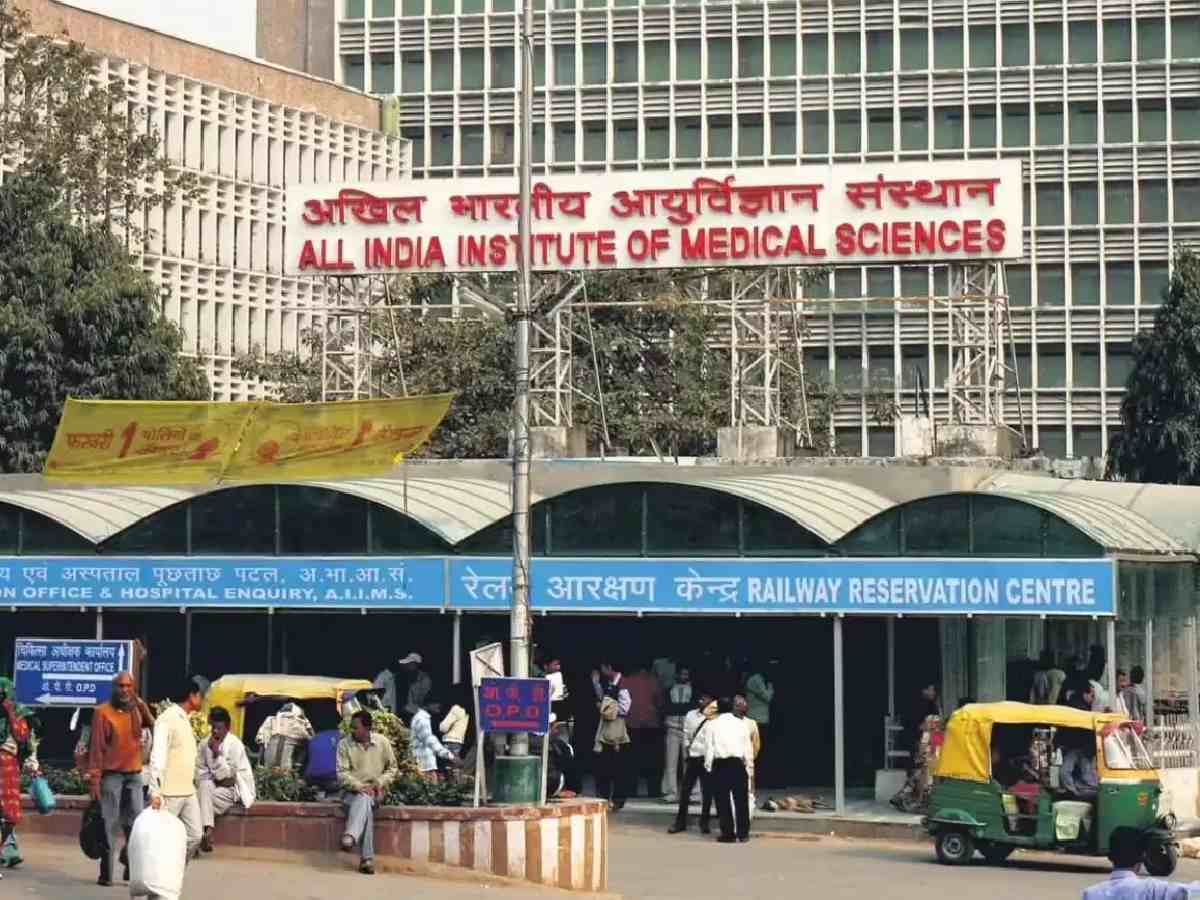
AIIMS Delhi
The noise of Prithviraj Road fades as one enters York cemetery, where a small, neglected grave among rows of graves outside the gate draws attention. The grave appears not to have received flowers for years, perhaps decades. Rajkumari Amrit Kaur, a close associate of Mahatma Gandhi, was laid to rest here. It was largely due to her efforts that the All India Institute of Medical Sciences (AIIMS) was established in 1956. She was then India’s Health Minister.
A proposal to establish AIIMS in Kolkata (then Calcutta) was initially made. The then Chief Minister of West Bengal, Dr BC Roy, however, did not find the proposal suitable, and AIIMS eventually found a home in Delhi.
When AIIMS came up, it could be seen even from Lajpat Nagar 4, as the entire area was barren. There was hardly a building or flat between AIIMS and Lajpat Nagar. There was no Ring Road,” recalls 68-year-old Anil Makhijani, a resident of Lajpat Nagar.
An institution built on trust
Seven decades later, AIIMS has become a place of trust for patients from across India. Every day, patients and their relatives arrive here seeking treatment.
“The spirit of AIIMS is one of service,” says Dr Prateek Sharma, an alumnus of AIIMS and a Delhi-based ENT specialist. Every year, students from across the country compete for admission to courses such as MBBS, MS and MD. The institute also places emphasis on research and patient care.
The first Director
If AIIMS was the result of Rajkumari Amrit Kaur’s vision, its first Director, Dr BB Dikshit, played a key role in shaping the institution. When he was offered the post, he is said to have accepted on the condition that there would be no interference from political leaders or senior government officials in appointments.
Dikshit had earlier been Principal of BJ Medical College in Pune and a professor of physiology. “During his tenure, Dr Dikshit brought professors and doctors to AIIMS. He made appointments strictly on the basis of merit and encouraged those engaged in research,” says Dr Vinay Aggarwal, past President of the Indian Medical Association.
A legacy of doctors
The influence of AIIMS can be seen in the careers of the doctors it has trained. Among its alumni are Dr Deepak Chopra, Professor Vinay Kumar of the University of Chicago, liver transplant surgeon Dr Arvinder Singh Soin, former AIIMS Director Dr Randeep Guleria and ENT specialist Dr Ramesh Deka. Many of its graduates have gone on to senior positions in India and abroad, while others have continued to serve at the institute.
Patients from across India
The reputation of AIIMS is perhaps best reflected in the patients who come here for treatment, Here, a person with little means and a senior government officer may find themselves standing in the same queue. Patients from Bihar, eastern Uttar Pradesh and Jharkhand appear to have particular faith in the institute. A senior officer of a security agency working at AIIMS said hundreds of patients from places such as Patna, Darbhanga, Kishanganj, Araria, Muzaffarpur and Ranchi come here for treatment.
The Rajendra Prasad Centre
In 1967, about a decade after AIIMS was founded, the Rajendra Prasad Centre for Ophthalmic Sciences was established at the institute and named after India’s first President, Dr Rajendra Prasad. Its motto is “Tamaso Ma Jyotirgamaya” — lead us from darkness to light.
The centre’s first Director was Dr LP Agarwal, who returned to India after higher studies at the Boston Retina Centre in the US and brought several eye specialists to AIIMS.
Dr Rajvardhan Azad was among the ophthalmologists who helped build the centre. He was associated with AIIMS for nearly four and a half decades, first as a student and later as its Director, and also taught there. He is now Professor Emeritus at AIIMS.
A specialist in retinal diseases and surgery, Azad has performed thousands of operations and published dozens of research papers in ophthalmology. During his outpatient clinics at AIIMS, he would examine about 30 to 40 patients a day.
A model for healthcare
Dr Vinay Agarwal says other government and private hospitals in the country could learn from the way AIIMS functions. He also argues that the government has a responsibility to improve the standard of hospitals in cities and villages across India. One priority, he says, should be to ensure that private hospitals do not subject patients to unnecessary tests.
Life around AIIMS
Three chemist shops operate in the AIIMS underpass. One remains open 24 hours a day, while the other two operate from 8am to 10pm. The shops are busy throughout the day, with staff attending to a steady flow of customers.
Each counter typically has at least three salesmen, a cashier and a supporting staff member. People undergoing treatment outside AIIMS also come here to buy medicines. According to those associated with the shops, their combined daily sales can reach Rs 4–5 lakh or more.
Food for patients and families
Bhandaras are a common sight around AIIMS. About 20 to 25 small and large bhandaras are organised here every day, offering free food to patients, relatives and others.
Bread pakoras, tea, samosas, kadhi rice, chhole rice and rajma rice are among the items served. A social worker, Dinesh Choudhary of Pilanji village in Sarojini Nagar, distributes food packets outside AIIMS with his friends three days a week.
“Here people stand in disciplined queues to receive the food; there is no disorder. Bhandaras are more frequent on Tuesdays, Thursdays and Saturdays. On these three days the number of community kitchens across Delhi also increases,” says Choudhary.
AIIMS has come to represent a combination of medical expertise, service and accessibility. From the grave of Rajkumari Amrit Kaur to the hospital’s busy corridors and the activity around its gates, its history is closely tied to the trust it has earned among patients and their families.
Coforge opened its first library in Noida in February 2024; it now claims a combined…
Of the 237 spa centres across 10 zones with valid MCD licences, the South East…
CTI chairman Brijesh Goyal said the Rahul Gandhi rally could affect wholesale and retail markets…
Established to mark the university’s 25 years, Jubilee Hall has witnessed generations of student life.…
Delhi inaugurates the 70th National School Games, hosting over 14,000 participants in 14 sports across…
Delhi High Court asked "Doosra" filmmakers to respond to Sourav Ganguly's plea over alleged violation…

