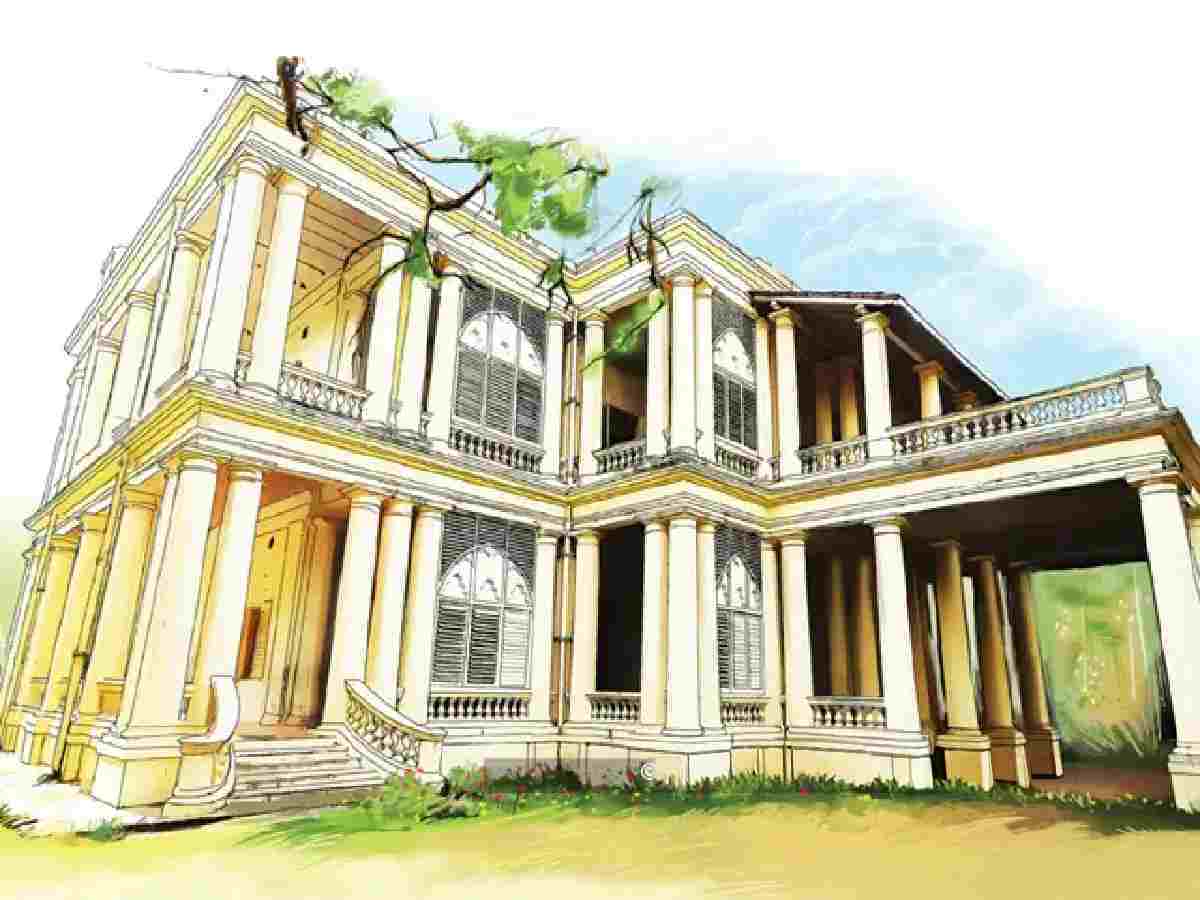
7 Jantar Mantar
It takes barely five minutes to reach Jantar Mantar from Janpath Metro Station. As you turn left, the first building you notice is filled with people dressed in dhoti-kurtas, moving in and out. This is 7 Jantar Mantar—a massive mansion that deserves immediate attention. Nearby, protesters often gather, voicing their demands, perhaps unaware that an 85-year-old woman was recently murdered here.
Consequently, police frequently visit the site to investigate the case. Yet beyond its present turmoil, 7 Jantar Mantar remains a remarkable place in its own right, having witnessed pivotal moments in Indian history—from the Partition to key decisions of the Congress Party.
A witness to history
“Well, this iconic place served as the headquarters of the Indian National Congress from 1947 to 1971. Stalwarts like Mahatma Gandhi, Jawaharlal Nehru, Sardar Patel, and Maulana Azad frequented this place. It was here, in 1959, that Indira Gandhi was elected Congress President,” says Vijay Shankar Chaturvedi, a veteran journalist.
Renowned writer Raj Khanna, in his acclaimed book Azadi Ke Pehle, Azadi ke Baad, elaborates on a meeting held at this Congress headquarters on June 15, 1947, to discuss the British government’s Partition plan. Quoting Dr Ram Manohar Lohia’s Guilty Men of India’s Partition, Khanna writes:
“During the two-day Congress meeting, with the hall packed with leaders, Maulana Azad sat silently in a corner, chain-smoking cigarettes without uttering a single word. Acharya Kripalani sat hunched over throughout.”
Who’s who at 7 Jantar Mantar
The building later served as the headquarters for Janata Dal (United) and the Akhil Bharatiya Seva Dal, founded by Morarji Desai. After a split in the Congress, the Congress (O) faction took control of the building, which later merged with the Janata Party. Even after Congress’s return to power in 1980, Indira Gandhi did not reclaim 7 Jantar Mantar.
“It’s unlikely that many current Congress leaders or workers are fully aware of the building’s historical ties to the party,” says Ashish Verma, whose father was a Congress Municipal Corporation member from Hauz Qazi in the past.
Meanwhile, the National Union of Journalists (NUJ) has operated its office here for a long time. NUJ leader Rakesh Thapliyal proudly notes, “7 Jantar Mantar has witnessed significant events of both British and independent India. We take pride in fighting for journalists’ rights from this historic location.”
A fading landmark
Currently, the building is in poor condition. Its walls have not been whitewashed in years, and damp patches are visible. Outside, protesters from across the country chant slogans in support of their causes. Delhiites, accustomed to such scenes, walk past with indifference.
Standing before 7 Jantar Mantar Road feels like stepping back into the freedom movement era. Elderly political workers clad in khadi often linger near the gate, discussing issues such as farmers, youth, unemployment, equality, and creativity. After a while, they head across the street to a South Indian eatery for a meal.
The dual identity of Jantar Mantar
The name Jantar Mantar evokes two distinct images: one of protesters staging demonstrations and another of the astronomical observatory built by Maharaja Jai Singh II in 1724. But Jantar Mantar is more than these associations.
This small street is lined with grand bungalows constructed by five prominent contractors who arrived in the capital in the early 20th century to build New Delhi’s iconic structures. Among them were Dharam Singh Sethi, Sobha Singh, Baisakha Singh, and Narayan Singh.
The house built by Dharam Singh later became the Congress headquarters. For a couple of years, it was owned by Nawab Abdul Hassan Khan, but it became an evacuee property after the 1947 Partition when the Nawab migrated to Pakistan. It is said that in 1959, the Central Government negotiated its sale to the All India Congress Committee (AICC) for Rs 6.10 lakh, plus additional premiums, converting it from a residence to an office. However, the absence of a final agreement left ownership ambiguous.
Also Read: From Metcalfe to Dholpur: 100 years of UPSC and the making of India’s civil services
Delhi historian RV Smith once said that Dharam Singh was tasked with supplying stones from Dholpur, Rajasthan, and Agra for the construction of Rashtrapati Bhavan, South Block, and North Block. Sobha Singh built his bungalow on the plot adjacent to Dharam Singh’s, which later became Kerala House.
From Jantar Mantar to North Block
Sobha Singh entrusted the design of his bungalow in Jantar Mantar to Walter George, who also designed Miranda House, St Stephen’s College, Delhi University’s oldest hostel Gwyer Hall, and Sujan Singh Park. George was part of Edwin Lutyens’ team, the chief architect of New Delhi.
Baisakha Singh, who came from Amritsar, was the main contractor for North Block and built several private buildings, including his own bungalow adjacent to Sobha Singh’s. It is said that the families of Sobha Singh and Baisakha Singh were close, so they created a passageway between their bungalows. When New Delhi’s wide, beautiful roads are mentioned, few recall Sardar Narayan Singh, who constructed them. His bungalow stood opposite those of Sobha Singh and Baisakha Singh.
Before 1911, the area where Jantar Mantar stands was a village called Madhoganj. Maharaja Jai Singh also contributed to the construction of the Hanuman Temple, Shiva Temple, and Bangla Sahib Gurudwara in the Connaught Place area.
At least 50 cases have already been reported this month; NCPCR guidelines mandate help desks,…
DMRC says zero reduction in train trips, attributes decline to security measures and public apprehension…
A Delhi court denied bail to a former DU professor accused of raping a student,…
Delhi Police charged seven dhaba workers in the fatal beating of a Manipuri musician who…
Seven Delhi STPs failed DPCC standards in September, dumping high levels of faecal coliform and…
AISA chief Neha Bora petitioned the Delhi HC against a police notice requiring a peace…

