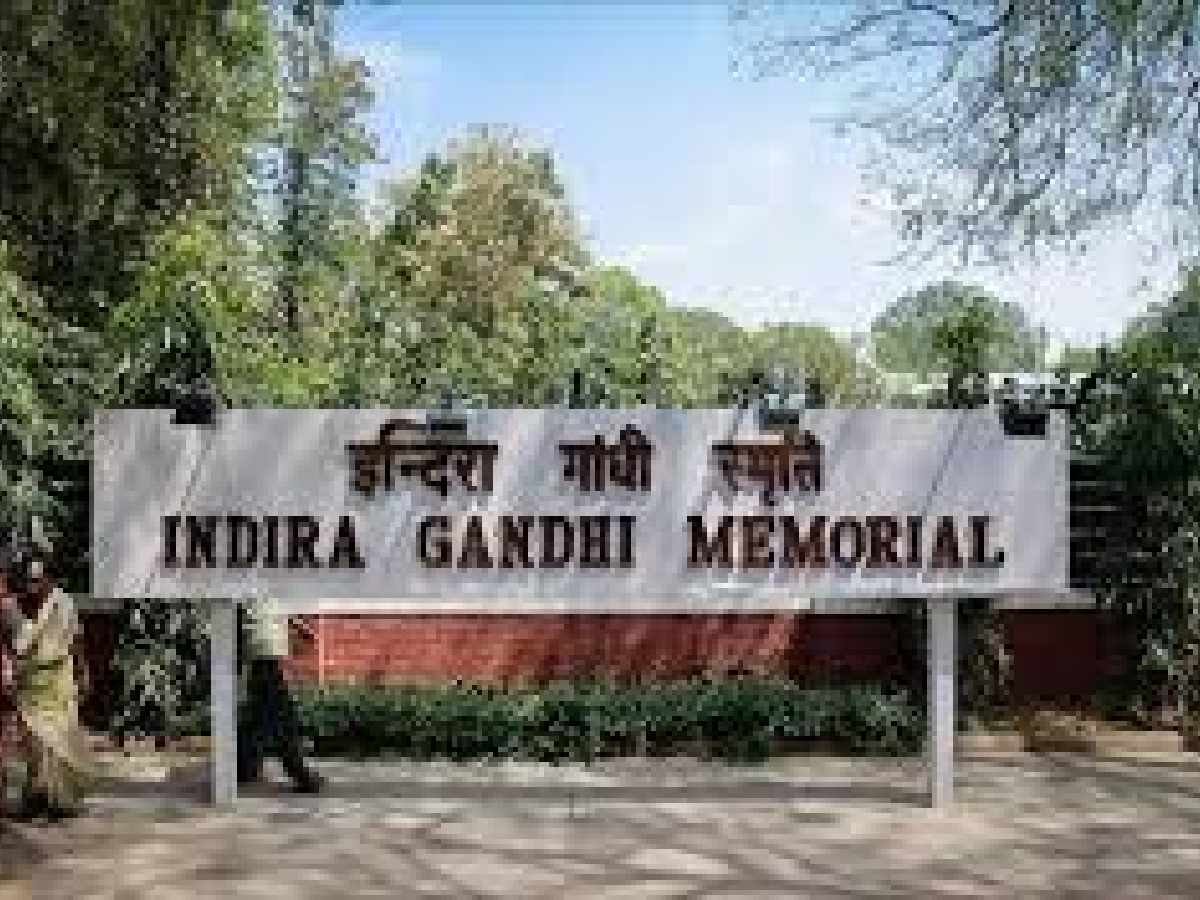
Indira Gandhi Memorial
Tucked away on Sardar Patel Marg, at the junction with Mother Teresa Crescent, stands a bungalow that witnessed a little-known chapter in the life of former Prime Minister Indira Gandhi. Numbered 12, the residence served as her home for nearly two-and-a-half years following the Congress’s defeat in the 1977 general election. It was here, amid a period of political uncertainty, that she began preparing for her return to power.
Whenever the Gandhi family’s official residences in Delhi are discussed, the names of 1 Safdarjung Road and 10 Janpath usually come up. However, Sonia Gandhi also turns her attention to 12 Willingdon Crescent in her recently published autobiography, Belonging: A Journey of Love. Though not a particularly grand bungalow, it played a significant role in the family’s life. In her memoir, Sonia fondly remembers their days at the residence, which the family called Baara Number.
Indira Gandhi moved into the four-bedroom house after losing the 1977 general election. Vacated by family friend Mohammad Yunus, it became home to the extended Gandhi family.
After stepping down as Prime Minister, Indira Gandhi had to vacate her official residence at 1 Safdarjung Road in 1977. She subsequently lived in this bungalow close to Rashtrapati Bhavan where she lived until her return to power in January 1980. The nearly two-and-a-half years she spent there marked a significant chapter in her personal and political life.
Behind the doors of Baara Number
Pupul Jayakar, a close friend and associate of the Gandhi family, offers a detailed account of this period in Indira Gandhi: A Biography. She describes how the four-bedroom residence gradually became a centre of political activity, even as Indira Gandhi adjusted to life outside the Prime Minister’s Office.
According to Jayakar, the former Prime Minister began laying the groundwork for her political comeback from here. Yet the house was also a place where she could spend time with her family. Jayakar saw this juxtaposition as reflective of the contrast between Indira Gandhi’s relatively simple personal life and the complexities of her personality.
Katherine Frank, in her book Indira: The Life of Indira Nehru Gandhi, also examines this phase. She recounts the circumstances of Indira Gandhi’s departure from the Prime Minister’s residence and her subsequent move to Willingdon Crescent. Frank regards these years as a turning point, marked by challenges on both the personal and political fronts.
The family behind the famous address
Who called 12 Willingdon Crescent home?
Indira Gandhi shared the bungalow with her two sons, Rajiv and Sanjay, and their wives, Sonia and Maneka. Her grandchildren, Rahul and Priyanka, also spent time there.
Situated in the heart of Lutyens’ Delhi, the property was considerably smaller than 1 Safdarjung Road. Former Chief Election Commissioner MS Gill was later allotted the same bungalow when he served as a Union Minister. On moving in, he was told by several people that Indira Gandhi had once lived there.
Among the corridors of power
Willingdon Crescent has traditionally housed senior government functionaries. Its residents have included Union Cabinet Ministers, Supreme Court judges, Secretaries to the Government of India, senior armed forces officers, the Chief Election Commissioner and the Comptroller and Auditor General (CAG).
The bungalows in the area fall under the Type VII and Type VIII categories, the highest grades of general government accommodation. Their allotment is governed by rules laid down by the Directorate of Estates under the Union Ministry of Housing and Urban Affairs.
A steady stream of Congress loyalists
Although Sonia Gandhi does not discuss the political visitors to the house, veteran Congress workers recall that Indira Gandhi’s trusted secretary, RK Dhawan, spent much of his day there. He would typically arrive around 8 AM and stay until 8 or 9 PM.
Delhi Congress leaders such as Arjun Das, Ramesh Dutta and Ram Babu Sharma were also frequent visitors. They helped look after the household’s requirements.
Arjun Das and Ramesh Dutta were prominent figures in the Delhi Congress, both known for their loyalty to Indira Gandhi. Das maintained an office near the post office at Lakshmi Bai Market and was considered close to Sanjay Gandhi. When INA Market was established, he was still a young man running a car and scooter repair workshop there. His business flourished, and he gradually became involved in local politics. As his influence within the Delhi Congress grew, he devoted increasingly less time to the workshop.
Following Indira Gandhi’s assassination in 1984, Das was accused of involvement in the anti-Sikh riots that followed. He was murdered on September 4, 1985, a killing that shocked his friends and associates in INA Market. He is still remembered by people in the area. His younger brother, Ashok Ahuja, subsequently became a member of the Delhi Legislative Assembly.
A man of the people
Ramesh Dutta was another notable figure in Delhi politics. First elected to the Municipal Corporation of Delhi from Minto Road in 1971, he went on to win from the same constituency in subsequent elections. He also served as Deputy Mayor, although his influence extended well beyond the office.
Dutta had admirers across the city. He remained unmarried and never accumulated personal wealth, earning a reputation for his commitment to public service and unassuming lifestyle. Cheerful and carefree by nature, he was remembered as someone who rarely complained.
A tale of three Delhi residences
In her autobiography, Sonia Gandhi also writes about 1 Safdarjung Road and her present official residence at 10 Janpath.
Indira Gandhi spent a substantial part of her political career at 1 Safdarjung Road. Located in Lutyens’ Delhi, the bungalow is close to Rashtrapati Bhavan, Parliament House and several other important government buildings.
She lived there during both her tenures as Prime Minister, from 1966 to 1977 and again from 1980 to 1984. The property served not merely as her home but also as a centre of political meetings, discussions and decision-making. Its garden was particularly well known, and she often went for walks there.
It was also at this residence that Indira Gandhi was assassinated on October 31, 1984. Following her death, the bungalow remained vacant for some time before being converted into a memorial museum under the Indira Gandhi Memorial Trust.
While 1 Safdarjung Road remains inextricably associated with Indira Gandhi’s years as Prime Minister and her assassination, 12 Willingdon Crescent represents a less familiar chapter. It was here that she navigated the uncertainties of life outside office, remained close to her family and began rebuilding her political fortunes. The unassuming bungalow thus occupies a distinctive place in the history of the Gandhi family and Indian politics.
10 Janpath, meanwhile, was allotted to Rajiv Gandhi in 1989, following the Congress’s defeat in the general election that year. After his death in 1991, the residence was allotted to Sonia Gandhi.
A 24-year-old tailor allegedly hurled a filled LPG cylinder from a third-floor balcony following a…
Delhi's minimum temperature rises to 10.6 degrees Celsius, while the AQI remains in the poor…
The exhibition brings together 28 artists to explore the diverse expressions, traditions and evolving visual…
Delhi HC seeks AAP leader Satyendar Jain's response to the ACB's challenge against his bail…
During rush hours, metro stations turn into marketplaces, with stalls offering festive jhumkas, crocheted flowers…
Four people, including three women, were arrested in Connaught Place after police recovered 63 packets…



