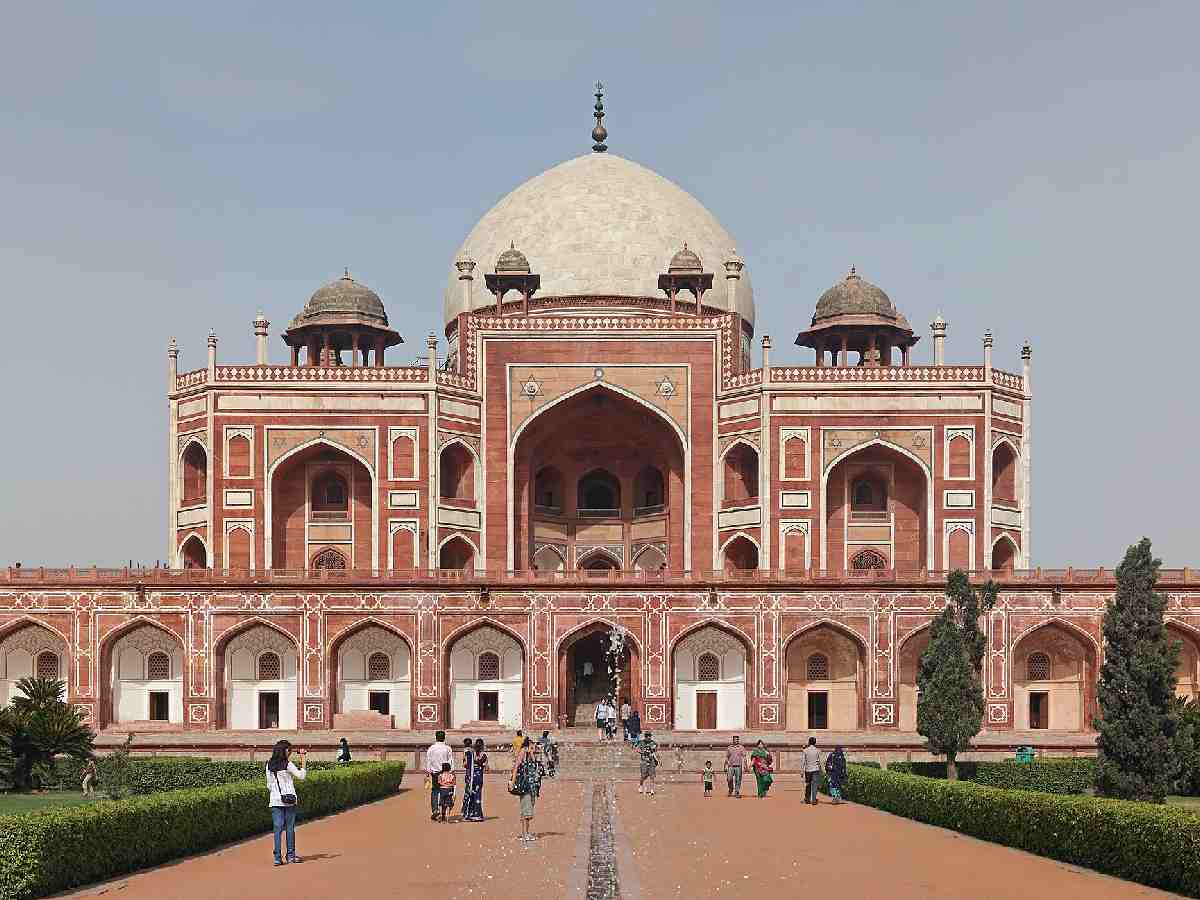
Mughal emperor, Bahadur Shah Zafar's sons and grandson had taken refuge at Humayun's Tomb from where they were captured
Khooni Darwaza stands just outside the main gate of Maulana Azad Medical College. On September 22, 1857, a Tuesday, Major William Hodson stopped a cart there. Inside were three Mughal princes—Bahadur Shah Zafar’s sons Mirza Mughal and Mirza Khizr Sultan, and his grandson Mirza Abu Bakr. Hodson ordered them to take off their upper clothes and then shot them.
Their bodies were later displayed in public at the Kotwali in Chandni Chowk. Even some British writers of the time described the act as cruel. In Delhi, the memory never faded, and the gateway came to be known as Khooni Darwaza, the Bloody Gate.
Old-timers in Delhi would say that blood still oozed from Khooni Darwaza during the rainy season. Mirza Mughal was about 30 and Khizr Sultan only about 18, and people said the bodies lay there for days without being buried. Hodson said the three had led the revolt and had to die. It is also said that he cut off their heads, although that detail is difficult to prove.
The shooting itself is not.
“Alas, we still have a road in the name of that bloodthirsty man in north Delhi’s Hudson Lane. It is a shame that we have not given a new name to Hudson Lane,” says Professor Rajkumar Jain, who taught at Delhi University for decades.
Professor Vinay Aggarwal, who joined Maulana Azad Medical College in the late 1960s, says he could never pass the gate without thinking of that day. Khooni Darwaza stands on Bahadur Shah Zafar Marg, with the medical college on one side and Feroz Shah Kotla on the other, while thousands of cars pass it every day.
The monument itself was built by Sher Shah Suri in the 1540s and was initially called Kabuli Darwaza. About 15.5 metres high and made of red sandstone, it is still regarded by some as a haunted spot. After Hodson’s act, people gave it the name by which it is known today.
The last ride
The princes had not been taken from the Red Fort. They had been seized a day earlier at Humayun’s Tomb, a few miles south of the walled city. On September 20, 1857, Hodson rode there with a small party of horsemen and took Bahadur Shah Zafar into custody, promising that the emperor’s life would be spared. The next day, he returned to the same tomb, forced the three princes to surrender, put them in a cart and started towards Delhi.
At Khooni Darwaza, he stopped and killed them. Humayun’s Tomb, built for the second Mughal emperor, thus became both the last shelter of the last Mughal court and the starting point of the journey that ended with the princes’ deaths.
The fall of Delhi
The chilling incident came at the end of the most important week in Delhi’s modern history. In September 1857, British troops, who had surrounded the city since June, finally broke in. The last major attack began around September 14, and after days of street fighting, the British took the city. For many Indians, this was not simply a battle but the decisive moment in what came to be remembered as the First War of Independence.
The revolt reached Delhi on May 11, 1857, when soldiers from Meerut came to the city and asked the old Mughal emperor, Bahadur Shah Zafar, to lead them. He was weak and old, but his name still carried weight. For three months, British forces remained on the Ridge north of the city, often outnumbered, until heavy guns arrived in early September. On September 8, the British began pounding the city walls, and on September 14, soldiers led by John Nicholson rushed through the breaches and entered through Kashmiri Gate.
Nicholson was shot in the chest during the assault and died on September 23, aged 35.
The final days
On the morning of September 18, a solar eclipse darkened the sky, unsettling people on both sides. Some British soldiers later wrote that the sudden darkness frightened the rebel troops and made them believe that God was against them. That same day, Bahadur Shah Zafar and his court left the Red Fort as the British closed in.
By September 19, British troops had taken the Jama Masjid and the empty palace, and had also occupied positions near the Lahore Gate. On September 21, they declared the city fully captured.
The soldier who fell
John Nicholson’s story also lives on in the city. Near the crowded Kashmiri Gate area, next to ISBT, is Agrasen Park, and just beyond it lies Nicholson Cemetery, one of Delhi’s oldest Christian graveyards. It was opened in 1857 because so many people had died in the fighting.
Nicholson is buried there, his grave marked by a white marble stone from the Red Fort.
“Until 1952, a life-size statue of Nicholson stood in what is now Agrasen Park. After Independence, it was taken down and later sent to Ireland. In 2007, when India marked 150 years of 1857, some of Nicholson’s family members came from Ireland and other countries,” says veteran journalist Anil Sharma, who spent his childhood on Nicholson Road in Kashmiri Gate.
Nicholson was the son of an Irish doctor. He came to India young and joined the East India Company, and in 1857 was sent from Peshawar to crush the revolt in Delhi. People said he walked around with a drawn sword. Indian soldiers shot him on September 14, and he died 10 days later.
The British praised him as the man who had saved their rule. Many Indians, however, remember him as a harsh officer who helped bring the uprising in the capital to an end.
Traces of 1857
Noted historian RV Smith would write that people believed ghosts walked in Nicholson Cemetery at night. No one ever proved it. The famous priest and Hindi scholar Father Camille Bulcke was also buried there in 1982, though his remains were later moved to Ranchi.
These places are the living signs of 1857 in Delhi.
Khooni Darwaza still stands, locked but easy to see from the road, while Nicholson Cemetery remains quiet beside the noise of Kashmiri Gate. Hudson Lane still carries Hodson’s name, and Kashmiri Gate still shows marks of the September 14 attack.
The Ridge, Flagstaff Tower, the old city walls, the Red Fort, Jama Masjid and Humayun’s Tomb are all still part of daily Delhi.
More than a battle
After the city fell, British troops looted homes and killed many people, leaving whole neighbourhoods empty. Bahadur Shah Zafar was put on trial, but because Hodson had promised to spare his life, he was not hanged. Instead, he was sent to Rangoon, now Yangon, where he died in 1862. That was the end of the Mughal court in Delhi.
What happened in those few days in September was more than a battle. It was the end of an old world in the city. Three young princes left Humayun’s Tomb as prisoners and were shot at a gate that traffic now rushes past. An Irish officer who led the storming of Delhi was buried a short walk from today’s bus terminal, while an English officer who killed the princes still has a lane named after him.
You can walk the story in a few kilometres.
Start at Kashmiri Gate. Cross to Nicholson Cemetery, then go down Bahadur Shah Zafar Marg to Khooni Darwaza. From there, go south to Humayun’s Tomb, where the last emperor gave himself up and his sons began their last ride. The First War of Independence is not only in books. It is in these stones, these names and the old stories people still tell when the rains come.
Delhi kept the blood and kept the addresses. That is why this week still matters.
Over 130 volunteers, doctors and lawyers mobilised legal, medical and mental health aid for CJP…
Delhi Police released a video claiming Dipke was informed of his grandmother’s death in custody…
MCD acted against 1,046 properties over illegal construction and unsafe buildings in Delhi between September…
AAP accused Delhi Police of using force against protesters and vowed to continue the CEC…
Saffron-clad groups allegedly attacked Delhi protesters, with Hindu Raksha Dal chief claiming responsibility for the…
Delhi Police issued fresh notices to CJP leaders in a case involving allegedly morphed objectionable…

