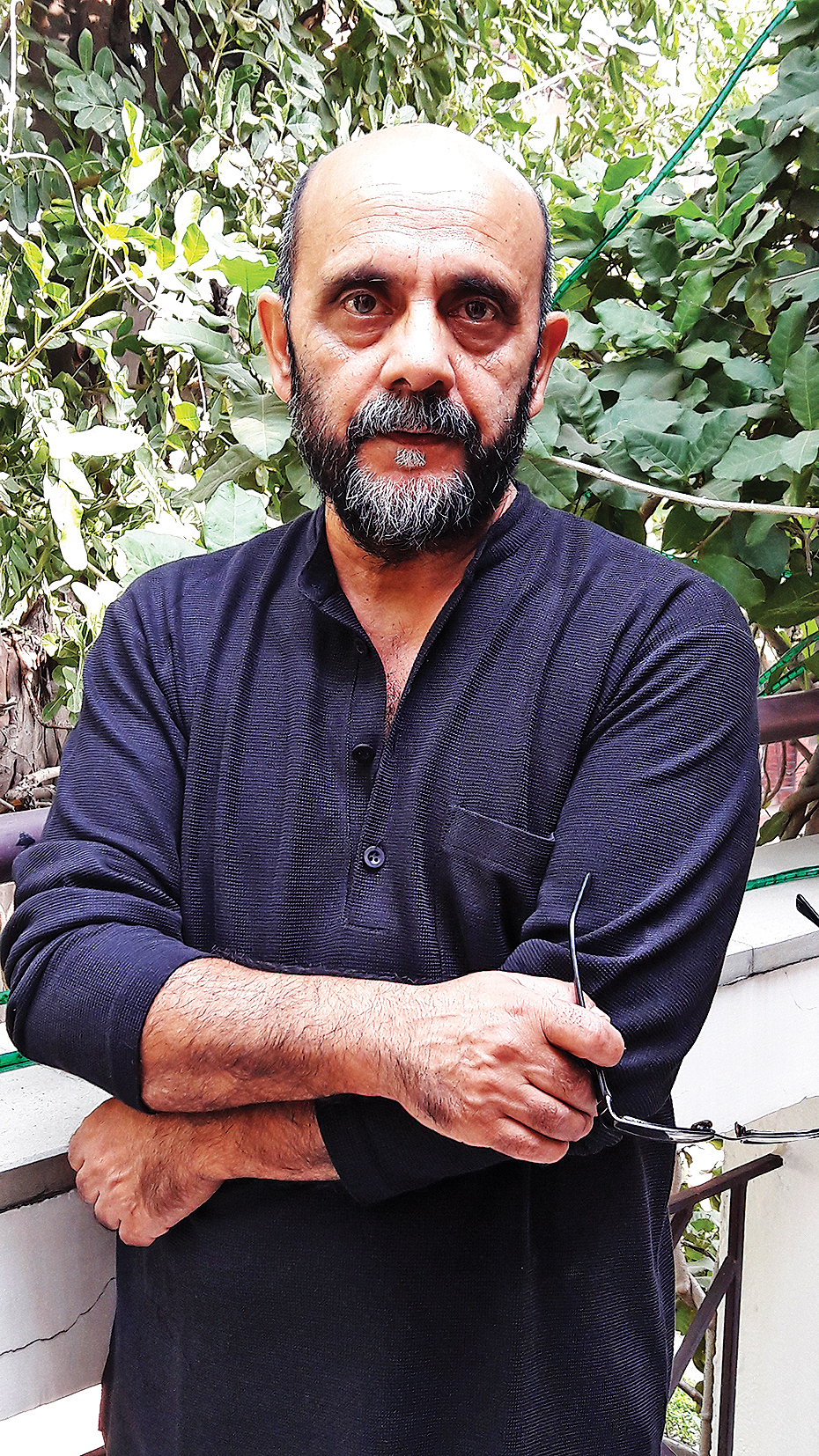
For artist Veer Munshi, Kashmir holds a special place in his heart. Born and brought up in the Valley, he was forced to migrate to Delhi in 1990. Depicting the fear and anguish of Kashmir in its true colours, Munshi does not shy away to bring forth the real Kashmir in front of the rest of the world. In conversation with Patriot, he shares his journey and how the art scene of the Valley is faring.
Your work is very personal, concerning the turmoil in Kashmir. Has this always been the subject that interested you as an artist or was it only after the migration to Delhi?
It was definitely after I migrated. Before that, conflict was not my subject at all. Earlier, when I was in Kashmir, before I went to Baroda to study art, I would paint landscapes on spot — pretty pictures of beautiful Kashmir. In Baroda I learned different idioms of art. But when I moved after the exodus happened, it changed my language. It was more therapeutic for me. I tried to release my anger and tension through my artwork. It was a chaotic situation that I thought I will never face in life. I would paint every experience of mine — what I saw and what was happening there. I remember wanting to paint a very pretty picture in order to sell something but I couldn’t, because my mind was not working in that order.Then after more than 10 years I visited Kashmir and after a few years I visited my home in Srinagar which I knew was burnt down. This emotionality inspired me to do a photography project of abandoned houses of Kashmiri Pandits. I wanted to protect the culture, architecture, habitat of a civilization — of what was there then.
It’s been over two decades now since you have moved to Delhi. Is there still that urgency in your work or has it evolved over time?
When I started off it was my personal reaction, how I experienced it myself. Then I started analysing and reacting to how others are perceiving the situation. I have always wanted to come out of this. But whenever I visit Kashmir, something emerges out of it, because the situation there is not settled, so my mind is also not ready to move on. So far it has always been continuous.
I am very connected to the place since I keep going there. I like engaging with the youngsters. I work more to protect their indigenous culture, because the next generation does not know what Kashmir was before. It is very important to have a solution for Kashmir, but for that one has to know the Valley very well.
Since you visit Kashmir often, what changes have you witnessed over the period of time?
I am an outsider insider. I do visit the Valley but I don’t live there anymore. When I visit now I stay in hotels which is a very different experience for me. If anyone visits a place after 20 years they will feel lost. But if you keep engaging with the place you might find your foothold. After all, it’s your roots. The urge of being there is always present. Whenever I get an excuse to visit I always go.
I returned from Kashmir on August 5. I witnessed the curfew first hand and saw how everything has been shut and there’s no communication. Four days before we did not know what was going to happen. We were confused with so many troupes coming in. And suddenly one night there was no communication and the next morning we woke up to curfew. I somehow reached the airport where I learned about the news of Article 370.
Coming to the crafts of the Valley, do you think it is doing well now in Kashmir?
No, the crafts are actually in a very bad shape there. I am concerned that the next generation is not doing it at all. It will finish with the older generation and it will become antique. There is no hard hand practice because when the children of these artists get education they find better ways to make a livelihood. Handmade products have the biggest industry here. It concerned me so I thought I should adopt one of this and try to push it through my work. I got engaged with craftsmen and brought the craft of papier-mâché into my work, to make it more interesting and Kashmir centric. You can relate it to the Valley very easily.
Being an artist from a conflict zone, do you think enough is being done in the sphere of art to make the audience aware of the situation in such areas?
No, I don’t think much has been done. When you live in a conflict zone it is quite difficult to do so. When you witness that, and then come out of the place — it is possible. Not much has been done but photographers and writers have still done quite a lot.
I feel a change in the younger generation. Perhaps because they are born into it, so they are more vivid in trying to express what they are going through. It is however not easy to sustain if you are an artist in Kashmir. It is not easy to sustain on the ideas you have, since there are not many galleries or collectors. It’s like if you are writing a novel you need to have readers.
At least 50 cases have already been reported this month; NCPCR guidelines mandate help desks,…
DMRC says zero reduction in train trips, attributes decline to security measures and public apprehension…
A Delhi court denied bail to a former DU professor accused of raping a student,…
Delhi Police charged seven dhaba workers in the fatal beating of a Manipuri musician who…
Seven Delhi STPs failed DPCC standards in September, dumping high levels of faecal coliform and…
AISA chief Neha Bora petitioned the Delhi HC against a police notice requiring a peace…


