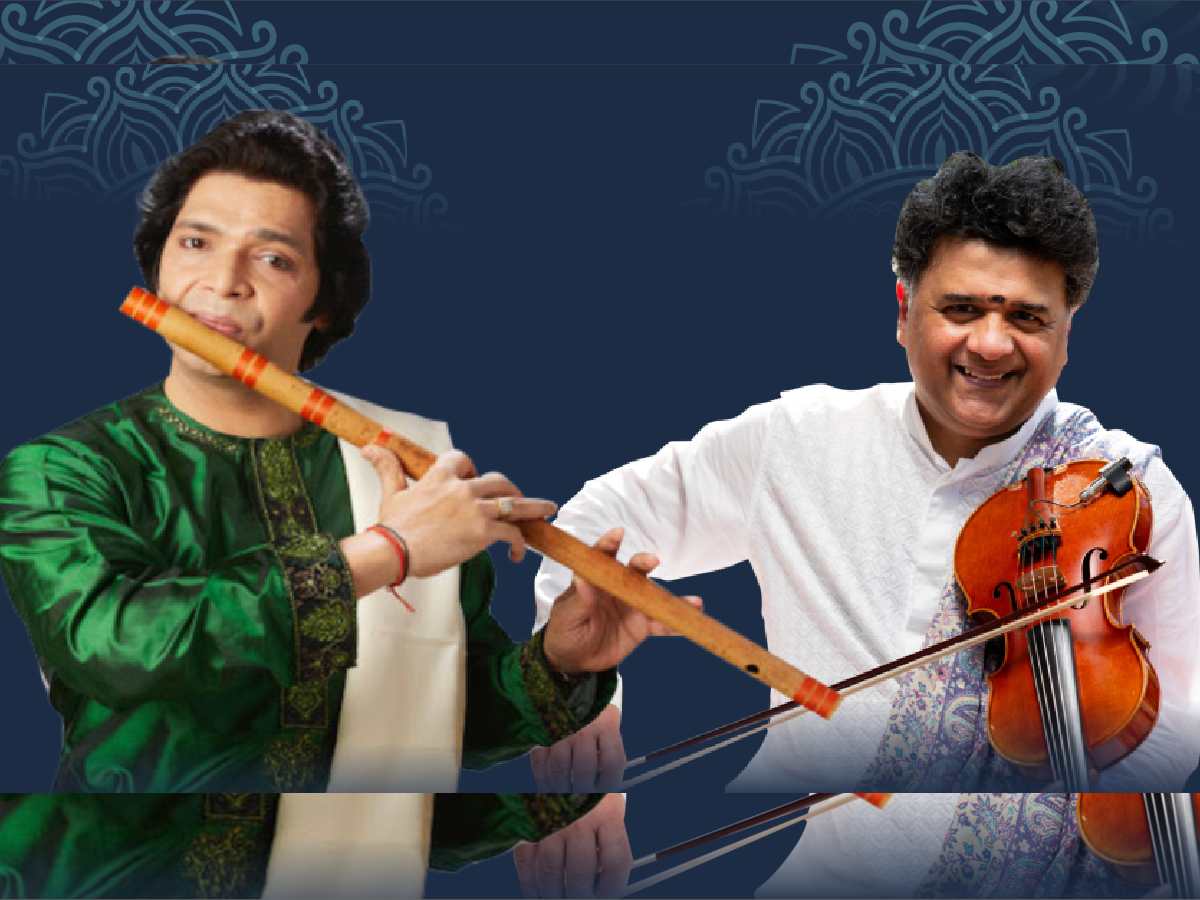
The New Year brings to Delhi an inclusive musical idea that seeks to bring together the classical traditions of North and South India. Often described as Hindustani and Carnatic music, the two systems share deep historical roots but evolved along different paths over centuries.
With Mughal invasions beginning around the 12th century CE, the country’s shared musical tradition underwent significant changes. In North India, music gradually moved out of temples and into royal courts, developing a more elaborate instrumental tradition. In the South, a distinct idiom and presentation style took shape. New ragas emerged in both systems, while the taal system of the North diverged sharply from the rhythmic structures of the South.
A tradition of rare collaborations
In the 20th century, a handful of innovative musicians attempted North–South duets, treating them as creative challenges rather than formal experiments. These included Pandit Ravi Shankar with Carnatic veena player Vidwan Emami Sankara Sastry, Ustad Ali Akbar Khan with violinist Dr L Subramaniam, Ustad Amjad Ali Khan with Vidwan Lalgudi G Jayaraman, and vocalists Vidwan Balamuralikrishna with Vidushi Kishori Amonkar. Such collaborations, however, remained rare.
V Narhari, an accomplished percussionist, has long believed that the distance between the two traditions is a relatively recent phenomenon. Exposed to both systems, he argues that until about 100–150 years ago, there was far greater exchange of musical ideas across regions.
“Uttar Dakshin began as a simple idea to let the music speak across traditions,” Narhari said. “Having witnessed legends like Pandit Hariprasad Chaurasia to today’s inspiring young maestros share the same stage has been deeply humbling. This journey reaffirms our belief that classical music is not bound by geography or generation. It is a living, breathing legacy that continues to evolve, connect, and inspire audiences everywhere.”
Fifteen years of dialogue on stage
Started 15 years ago, the Uttar Dakshin concert series has been held in six cities across India. According to Narhari, the process is rarely easy.
“It’s a challenge, as many mainstream musicians are simply not open to collaborating on stage with another musician, and that too from a different tradition,” he said. “We have had to convince musicians, then they rehearse together, which is again a challenge as the artistes are almost never from the same city, and commonality is found.”
At times, he added, the series has presented solo concerts from both traditions back-to-back, simply to bring audiences of the two streams together. Recent pairings have included Begum Parween Sultana followed by Carnatic vocalists Ranjani and Gayatri, and Rahul Sharma on santoor followed by veena exponent Rajhesh Vaidhya.
Bridging musical differences
The challenges are not merely logistical. The ragas differ, presentation styles vary, and even laya structures and pitch systems are not the same. Restricting one’s on-stage creativity to accommodate another tradition is often difficult. Despite this, the concerts have consistently drawn full houses, with audiences keen to experience the unexpected.
Over the years, Uttar Dakshin has featured combinations such as vocal music with modified Indian slide guitar, Saraswati veena with flute, mandolin with flute, flute with sitar, and sarod with violin, bringing together musicians from Chennai, Kolkata, Bengaluru and Mumbai.
A Grammy-winning evening in Delhi
The concert on January 2, 2026, at Kamani Auditorium is especially notable, as both principal artistes are Grammy winners.
Flute maestro Rakesh Chaurasia won two Grammys in 2024. The first was in the Best Contemporary Instrumental Album category for As We Speak, alongside tabla maestro Zakir Hussain, banjo player Bela Fleck and double bass player Edgar Meyer. The second Grammy was for Best Global Music Performance for the haunting track Pashto from the same album.
Violinist Ganesh Rajagopalan, a child prodigy who gave his first public concert at the age of seven, won a Grammy in 2024 for This Moment, the first studio album in over 45 years by the band Shakti, of which he has been a member since 2019. Based in Seattle and Chennai, Rajagopalan said he was looking forward to returning to Delhi to begin the New Year.
“I am so happy to come back to Delhi to start the New Year. I will have the honour of playing with my dear friend Rakesh ji,” he said. Speaking about jugalbandis, he added, “It’s best to take the friendship off stage onto the stage, and bring about a connection with the audience. That’s what you will witness at the January 2 concert. Rakesh and I have played together very often, with Zakir bhai too, and I don’t think there is a difference between our two systems of music. Even if there is, our playing will make any difference vanish.”
The concert will feature Rakesh Chaurasia and Ganesh Rajagopalan, accompanied by mridangist Patri Satish Kumar and tabla player Satyajit Talwalkar. It begins at 6 PM at Kamani Auditorium. Tickets are available on BookMyShow.
A $780 million market built on pavements, where the pleasure of reading meets the price…
Supreme Court advocate Abhishek Pawar alleges women were denied washroom access for seven to eight…
Each day of closure costs shops in Khan Market and Connaught Place between Rs 60,000…
Delhi generates nearly 15,000 tonnes of waste daily, prompting the government to deploy 1,000 mechanical…
Delhi Police has issued an NOC for the Congress rally at Ramlila Maidan on November…
CJP chief Abhijeet Dipke received conditional bail following his arrest for participating in a Connaught…
