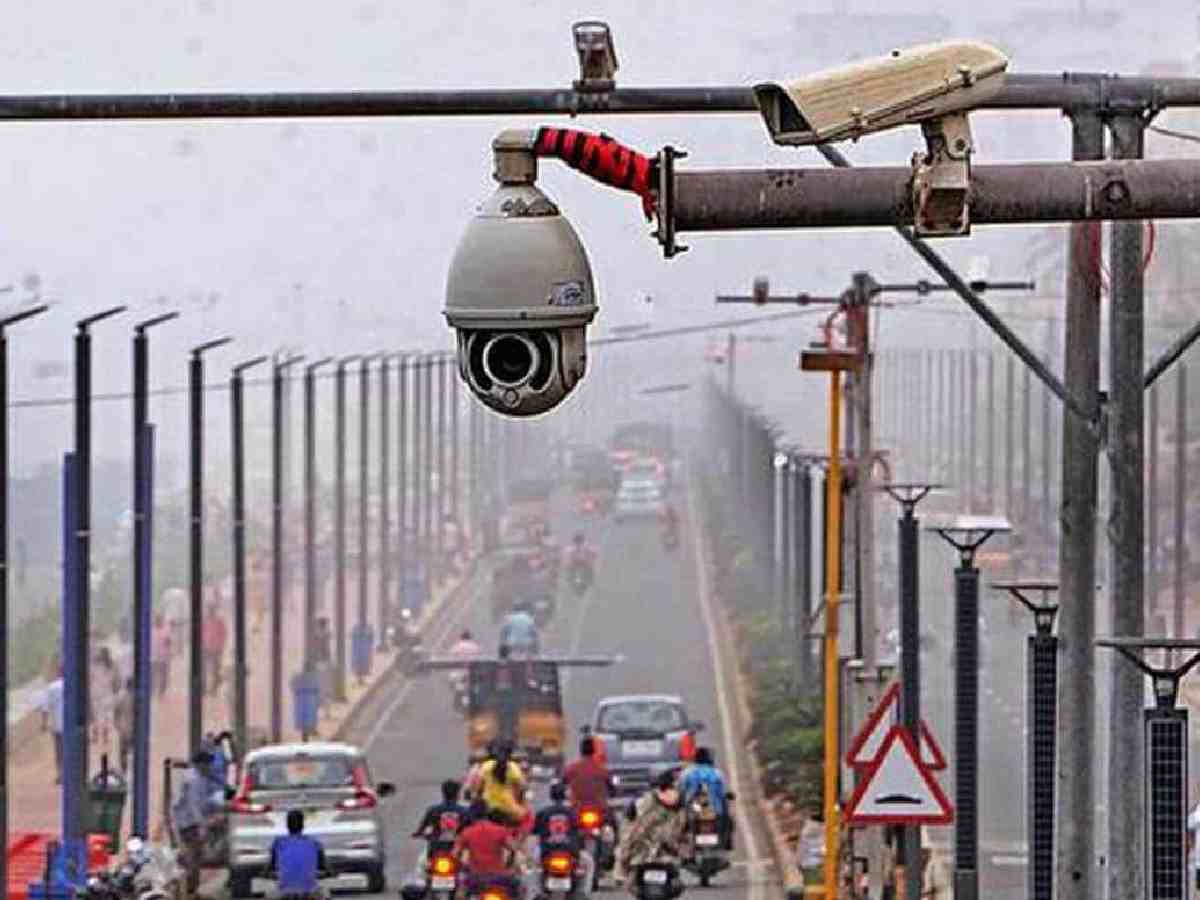
Come October 1, Delhi’s streets will have over 3,500 activated Artificial Intelligence (AI)-enabled cameras, gunshot sensors and alert systems under the first phase of the ‘Safe City’ project aimed at transforming the functioning of police in the national capital, an official said on Saturday.
Equipped with Artificial Intelligence Video Analytics (AIVA), the system will issue real-time alerts on incidents like shootings, crimes against women, stolen vehicles and abandoned objects.
The move comes nearly two years after the horrific Kanjhawala incident on the night of December 31, 2022, when a 20-year-old woman was dragged for over 12 km by a car in outer Delhi. The incident shocked the nation and prompted a massive review of surveillance gaps in the city.
“After the Kanjhawala case, the Ministry of Home Affairs directed us to audit vulnerable areas. We found that around 10,000 additional cameras were needed. This project is being implemented in phases and will cover high-risk and densely populated zones first,” a senior police officer said.
In the first phase, a total of 3,500 cameras will go live, drawn from a larger pool of 6,121 bullet cameras, 1,622 Automatic Number Plate Recognition (ANPR) cameras, 370 Facial Recognition System (FRS) cameras, and 1,876 Pan-Tilt-Zoom (PTZ) cameras.
Additionally, the project includes 200 gunshot detection systems — each comprising three acoustic sensors — and 300 public address systems (speakers). These will be strategically installed to provide real-time alerts and enable public communication during emergencies.
“These are not just passive CCTV cameras. They are intelligent systems with AI-based video analytics. The system will instantly alert our Integrated Command, Control, Communication and Computer Centre (C4i) at police headquarters when it detects any abnormal activity,” the officer added.
The alerts will also be forwarded simultaneously to the Deputy Commissioner of Police (DCP) offices and local police stations. This tiered structure will ensure faster response and accountability.
At the heart of the Safe City project is the goal of strengthening women’s safety. The AI software in these cameras is programmed to flag high-risk scenarios such as a woman being isolated and surrounded by a group of men, or a woman waving her hands seeking help.
“Both scenarios will automatically trigger high-priority alerts. A nearby PCR unit will be dispatched without waiting for a formal complaint. This is proactive policing,” the official said.
Areas with high concentrations of women residents, such as hostels, PG accommodations, college campuses and workplaces, are being prioritised for deployment. Locations known for frequent cases of harassment, snatching and eve-teasing are also being mapped and covered under this surveillance net.
The system will also monitor crowd gatherings and alert authorities to potential flashpoints. If more than 50 individuals are detected congregating at a location not designated for public assembly, a high-priority alert will be generated.
A gathering of fewer than 50 people will be flagged as a low-priority event.
In addition, the technology will track abandoned objects, detect gunfire, and scan for hotlisted vehicles or persons.
The ANPR cameras will be able to identify stolen, suspicious, or blacklisted vehicles in real time, while FRS cameras will match faces against a police database of over 20,000 known criminals.
Also Read: Delhi | Only 32 CCTVs in Shahdara functional: RTI
In case of a gunshot, the acoustic sensor will immediately relay the direction of the sound, prompting a PTZ camera to pan and zoom toward the source, offering investigators a real-time visual.
“Once an alert is received, the operator at C4i will verify its authenticity. If genuine, it is assigned a priority level, and the nearest patrol unit is mobilised. If the alert is found to be false, it is dismissed with proper reasoning,” the officer explained.
The system is also designed to serve as a force multiplier for the Delhi Police. By capturing high-definition, time-stamped visuals of incidents, the footage will offer evidentiary support in court and help in post-incident analysis.
Supervisory officers will be able to review how on-ground personnel responded to situations, helping improve accountability and operational effectiveness.
“It’s a training tool as well. Officers’ performance in crisis situations can be reviewed to improve responses in future. This is not just about technology, but also about transforming the way we police the city,” the officer said.
Also Read: Delhi’s ‘Safe City’ drive: Thousands of CCTV cameras defunct
The first phase is expected to dramatically change how Delhi Police monitors and responds to crimes in public spaces.
The remaining two phases of the project are expected to be completed by the end of 2026, eventually bringing the entire capital under the lens of AI-backed surveillance.
Elected to the Delhi Golf Club general committee, Mansher Singh says he wants to build…
A $780 million market built on pavements, where the pleasure of reading meets the price…
Supreme Court advocate Abhishek Pawar alleges women were denied washroom access for seven to eight…
Each day of closure costs shops in Khan Market and Connaught Place between Rs 60,000…
Delhi generates nearly 15,000 tonnes of waste daily, prompting the government to deploy 1,000 mechanical…
Delhi Police has issued an NOC for the Congress rally at Ramlila Maidan on November…
