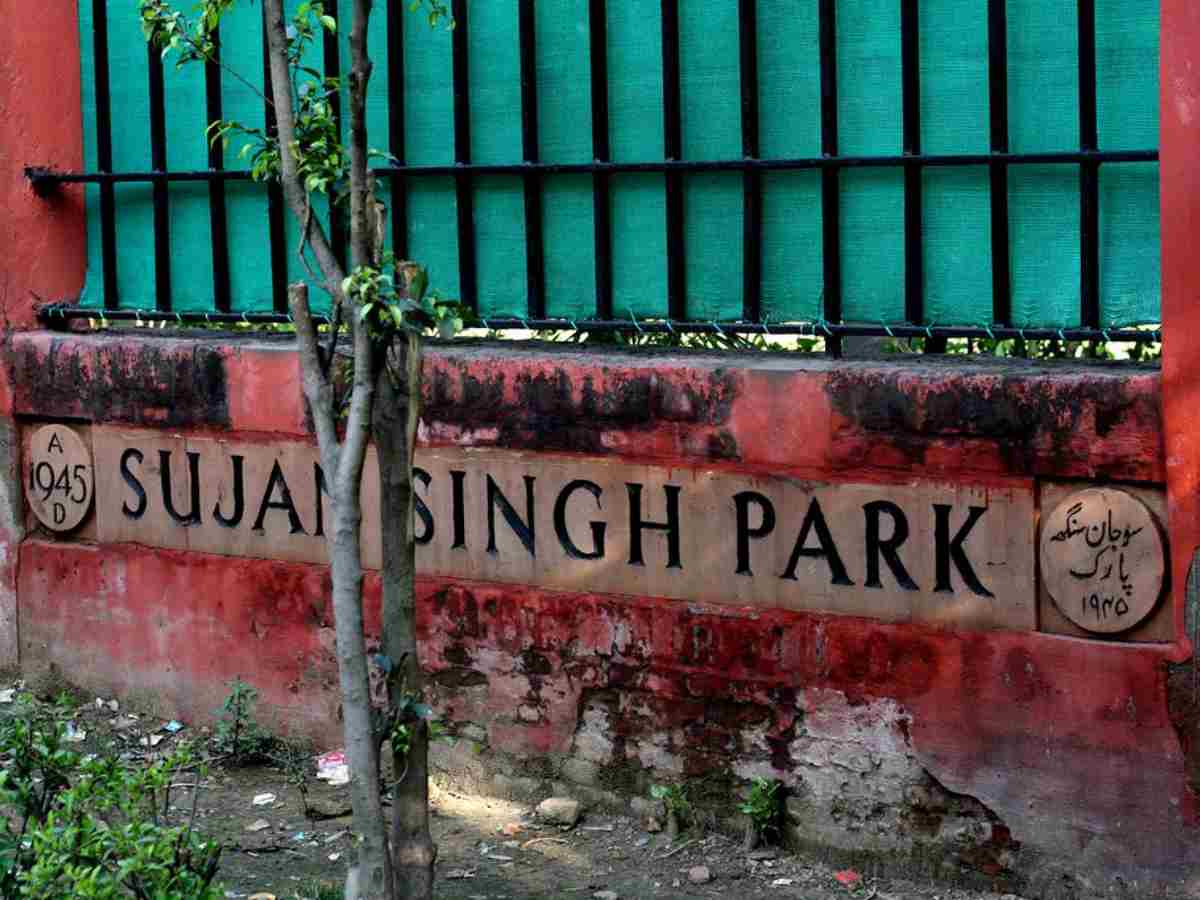
Sujan Singh Park
Circa 1947. Sardar Sobha Singh was a shattered man as he listened to the heartrending accounts of refugees arriving in Delhi after Partition. They came in millions, without shelter, food or any idea of what lay ahead. Deeply moved by the devastation, Sobha Singh opened the doors of Sujan Singh Park, built in 1945, so that at least some of them could find temporary refuge. Among those who sought shelter was his own son, Khushwant Singh, who had also been forced to abandon Lahore. Khushwant lived in the same A Block apartment until his death in 2014; over the decades, his home became a quiet shrine for writers, journalists and admirers who came seeking conversation and stories.
For more than eight decades, Sujan Singh Park has been much more than a residential complex. It stands as a living chronicle of Delhi’s transformation—from a colonial administrative outpost to the bustling capital of independent India.
Named after Sobha Singh’s father, Sujan Singh, the complex was originally leased for 99 years, with the lease set to expire in 2045. Conceived in 1943 by the Central Government as emergency accommodation for British military and civil officers arriving during the war years, the project bypassed the slow-moving Delhi Improvement Trust. It was fast-tracked under direct central oversight. Sir Sobha Singh—already the undisputed figurehead of Delhi’s construction world and the man behind India Gate, South Block, parts of Connaught Place and much of Lutyens’ Delhi—was enlisted by Chief Engineer Khan Bahadur Mohammad Suleman to construct the blocks at remarkable speed.
The British architect Walter Sykes George was entrusted with the design. By 1945, Sujan Singh Park was ready—Delhi’s first-ever apartment complex. The next one, Sagar Apartments on Tilak Lane, appeared only in the early 1970s.
Built with red brick and white accents, and framed by rows of golden amaltas trees, the seven elegant blocks—each containing twelve flats—still seem to belong to a gentler era. From almost every window, one can glimpse a lush garden brimming with roses and seasonal flowers. Right across the road lies Khan Market, today one of Delhi’s most exclusive shopping districts.
Also Read: Delhi Police arrests 16 gangsters with multiple bulletproof vehicles in separate raids across city
A world apart
The moment you step inside Sujan Singh Park, the clamour of Delhi seems to dissolve. A serene, almost otherworldly calm takes over. Over the years, its apartments have housed celebrated residents—writers, diplomats, actors and public figures. Among them were Dilshad Khan (actress and sister of Sanjay Khan), Gujarati writer Bhai Chand Patel, foreign diplomats and several generations of the Khushwant Singh family.
Altaf Hussain, the legendary editor of Dawn (founded by M.A. Jinnah), also lived here; his flat was attacked by rioters in 1947. In the earlier years, most residents were British officers; after Independence, Indian families and senior government officers moved in. For decades, the Government of India itself rented multiple flats.
Among its distinguished residents was Badruddin Tyabji, a 1936 batch Punjab-cadre ICS officer, who was allotted a flat in the complex. Recalling those days during a 1996 interaction with this writer at his South Delhi home, he said: “I was entrusted with the responsibility of the first Republic Day function held at the Dhyan Chand National Stadium. As I lived at Sujan Singh Park, I used to visit the venue even at night as my home was so close.” Tyabji later served as Vice-Chancellor of Aligarh Muslim University.
Abode of a wordsmith
The moment one enters Khushwant Singh’s flat, it becomes clear that this was the sanctuary of a man utterly devoted to words. Even today, hundreds of books remain neatly arranged on shelves—on Punjab, Punjabiyat, Urdu poetry, politics, society and more. He must have read every single one of them. But he himself is missing now.
Khushwant once told this writer that he never allowed anyone to take even a single book from his home. On arrival, visitors were often led straight to his study, where he would be seated in his favourite armchair, immersed in a book. He welcomed everyone with genuine warmth.
The ceilings in the flat are remarkably high—an architectural reminder that Sujan Singh Park was built more than 75 years ago. No modern construction offers such soaring proportions. From every room in the four-bedroom flat, one can look out onto gardens bursting with flowers. Natural light pours into every corner. The architecture of these apartments is unmatched today; it is nearly impossible to find flats built with such grace and generosity.
Behind the main blocks lie the modest quarters of the original staff and support workers—many of whom have lived there continuously since 1945, forming a parallel community with its own history.
Also read: Electric Double-Decker buses set to comeback on Delhi’s roads
A British PM connection
A curious international connection also links Sujan Singh Park to the United Kingdom. Boris Johnson, former British Prime Minister, has often referred to himself—playfully—as a “son-in-law of India”. The reference stems from his second wife (now divorced), Marina Wheeler, daughter of Dip Singh Kaur (known widely as Deep Kaur), a Sikh woman who once lived in Sujan Singh Park.
Deep Kaur’s first marriage was to Daljeet Singh, younger brother of Khushwant Singh. In an indirect way, Boris Johnson is therefore distantly connected to the Khushwant Singh family. After 25 years together and four children, Boris and Marina separated, but Johnson has visited Delhi several times and is known to have stopped by G-74, Sujan Singh Park—the Daljeet Singh family flat.
Walking through Sujan Singh Park today, one senses the many layers of history embedded in its pathways: the echo of British officers’ boots, the hurried footsteps of Partition refugees, the soft clatter of Khushwant’s typewriter and the hum of evening addas. Sujan Singh Park remains a class apart. Those who have lived—or still live—here are, unquestionably, among Delhi’s most fortunate.
A Delhi court denied bail to a former DU professor accused of raping a student,…
Delhi Police charged seven dhaba workers in the fatal beating of a Manipuri musician who…
Seven Delhi STPs failed DPCC standards in September, dumping high levels of faecal coliform and…
AISA chief Neha Bora petitioned the Delhi HC against a police notice requiring a peace…
Average AQI of 171 in the first week of this month; falling temperatures and stubble…
Delhi Police dismissed claims of disrupting CR Park Durga Puja, stating actions strictly enforced court-mandated…

