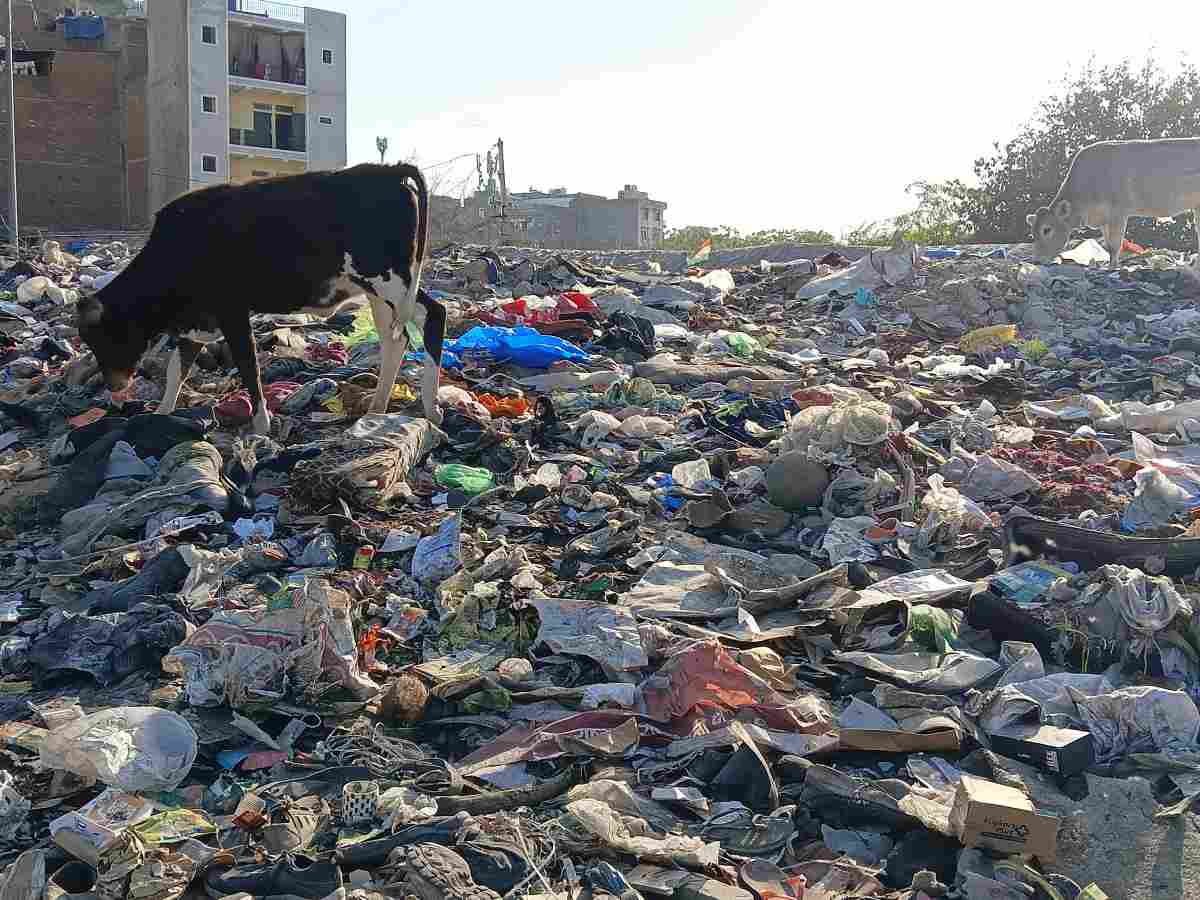
Mounds of garbage await sale at the South East Delhi locality
Water bottles, empty canisters, and jute bags packed with discarded waste litter an unremarkable patch of land in South East Delhi. A heap of golden-hued jerry cans mark this settlement just beyond Kalindi Kunj, which several families working as ragpickers have made their home.
Many of them said they moved to the national capital over the past decade and lived peacefully, but, of late, have been facing discrimination, with the accusation of being “illegal immigrants from Bangladesh” often hurled at them. In recent months, surveys by the Delhi Police and other government agencies have sought to remove all those living in Delhi without valid documents.
Housing over 250 families and a population of roughly 1,200 individuals, Kanchan Kunj is largely isolated from the rest of Delhi. The settlement can only be accessed through a narrow alleyway, flanked by towering heaps of garbage and rows of makeshift houses with tin and thatched roofs, most of which house families of four.
A life built on waste
For the residents, sifting through garbage heaps is the primary source of livelihood. While some work with the Municipal Corporation of Delhi (MCD), their role remains the same—rag picking, albeit in a more formalised capacity.
On March 22, Delhi Police dismantled a network that facilitated the illegal settlement of Bangladeshi immigrants, arresting eight individuals, deporting six, and placing four under investigation. The operation uncovered a widespread identity fraud scheme, with illegal immigrants securing counterfeit Aadhaar cards, PAN cards, voter IDs, and even Indian passports.
Authorities seized 23 voter cards, 19 PAN cards, 17 Aadhaar cards, 11 birth certificates, six blank voter ID cards, and a computer system used for forgery. The prime accused, Mohd Moinuddin, operated a computer shop in Delhi, specialising in fabricating fake documents.
“Moinuddin and his accomplices created fraudulent paperwork that allowed illegal immigrants to integrate into Indian society undetected. Corrupt Aadhaar agents played a key role in securing their official registration,” a senior police official revealed.
Further investigations exposed a complex money laundering network where illegal immigrants transferred funds to Bangladesh through digital platforms such as Google Pay, Paytm, and PhonePe in a hawala-like setup.
“The financial trail points to an intricate system where cash from illegal workers in Delhi was sent to their families in Bangladesh via UPI apps. Licensed forex agents and hawala operators played a critical role in these transfers,” the official explained.
Key figures in the scheme included Manwar Hussain, who collected cash from immigrants, and forex agents Nimai Karmakar and Gouranga Dutta, who facilitated cross-border transactions. The arrested individuals had infiltrated low-wage industries, including waste management, delivery services, and housekeeping, often using fake identities. Some had even enrolled their children in Indian schools, police noted.
More than 1,100 Bangladeshi nationals have been deported from Delhi since January 2025, with nearly one-third of them removed in the past two weeks, according to senior police officials.
Struggling for daily survival
However, for the residents, who claim to be Assamese Bengalis, at Kanchan Kunj, these crackdowns are not the biggest worry. Their primary struggle is ensuring they have food on the table each day.
Mofisul Alam, a resident, earns between Rs 400 and Rs 700 a day. However, survival remains uncertain. “I have two sons and a daughter. My wife stays here with me. I think I earn enough to get by, but I have no savings. Each day, I spend at least Rs 200 to Rs 300 on food and other necessities. My expenses depend on how much garbage I can sell,” he said.
For the residents, police patrols are a common sight. While some remain unfazed, others fear potential deportation. Many carry their Aadhaar cards at all times, yet anxiety persists. “It’s terrifying that I could be deported just because my name’s spelling doesn’t match exactly. But beyond that, every police visit disrupts our livelihood for the day,” said Hashim Islam, another resident.
The battle for water
Life at Kanchan Kunj means contending with structural neglect, garbage, and periodic crackdowns. None of the residents receive water from the Delhi Jal Board (DJB). A mix of government apathy and residents’ distrust keeps them from seeking assistance.
“We know that if we call them, they will send emergency water tankers. But we do not want to live on handouts. We buy jerry cans of water for our families,” Alam explained. The mound of jerry cans they accumulate is a testament to years of self-sufficiency. At Rs 20 per can, families purchase at least five each day, choosing dignity over dependency.
Women bear the brunt
Women in the settlement have been hit hardest by the special drives. According to Shabana Begum, one of the oldest residents, these operations are not new, but their intensity has increased.
“There is nothing new about this. However, the intensity of the drives has increased. Last time, they [the police] took a few people away, and later we heard they had been deported,” she said.
Also Read: Total recall: The forgotten victims of the 1972 JAL crash in Delhi
Begum’s family consists of two sons and two daughters. The latter were married off early to reduce the financial burden on the family. One son works in Assam and sends money at the end of each month, which helps sustain her. Her other son works in CR Park, but the struggle remains hand-to-mouth. She has not seen her daughters in years.
“Shob dhormo ek (All religions are equal). It is tragic that we are being deported based on our names. Discrimination is constant in this city—some call us Assamese, others call us Bangladeshis,” she said.
According to DCP South East, Ravi Kumar Singh, over 30 people have been suspected of being illegal immigrants in the district.
“We are also investigating whether there are agents helping them come in groups and forge their documents,” Singh said.
Ranjay Atrishya, ACP (PRO), clarified that the drive is not intended to target Indian citizens. “Only if there is suspicion that a person is a foreign national—in this case, Bangladeshi—can they be deported,” he said.
CTI chairman Brijesh Goyal said the Rahul Gandhi rally could affect wholesale and retail markets…
Established to mark the university’s 25 years, Jubilee Hall has witnessed generations of student life.…
Delhi inaugurates the 70th National School Games, hosting over 14,000 participants in 14 sports across…
Delhi High Court asked "Doosra" filmmakers to respond to Sourav Ganguly's plea over alleged violation…
Delhi L-G appointed Paralympian Suvarna Raj as State Commissioner for PwDs following her gold win…
DDA is planning Delhi's longest 24-km cycling track along the Yamuna floodplain, linking key eco-projects…

