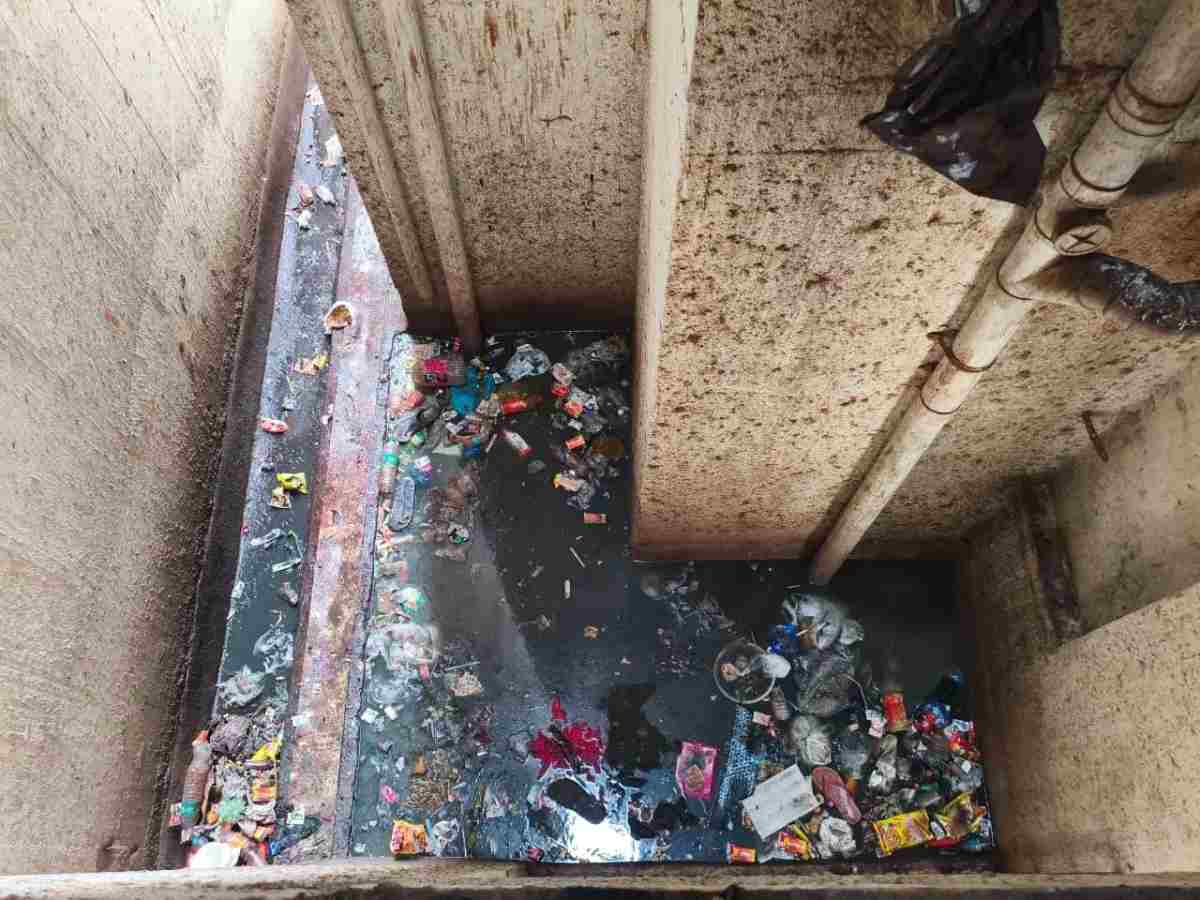
Garbage lay strewn across Ashok Vihar's Swabhiman Apartments
In north-west Delhi’s Ashok Vihar, the Swabhiman Apartments—part of an in situ slum rehabilitation project under the Centre’s Jahan Jhuggi Wahan Makaan scheme—were meant to transform the lives of former slum dwellers.
Inaugurated by Prime Minister Narendra Modi on January 3, 2025, ahead of the Delhi Assembly polls, the flats were constructed by the Delhi Development Authority (DDA) to house 1,675 families, primarily from the razed Jailorwala Bagh slum cluster. Within weeks, however, the complex fell into disrepair, leaving residents grappling with severe challenges, especially during the rains.
Phoolchand, a 64-year-old migrant worker from Uttar Pradesh, began suffering from itchiness and rashes after moving in. “A doctor suggested it could be due to the hard water supplied here,” he said.
After switching to bottled water for drinking and sourcing water for bathing from a pipeline near his former slum, his symptoms subsided. Many residents echo his concerns, avoiding the hard water supply they believe is unfit for use.
Families like that of Rampreet Jha, a 43-year-old worker from the Wazirpur industrial area, are forced to purchase 20-litre jars daily, adding financial strain.
Heavy rains have worsened conditions. The ground floors flood frequently due to a lack of drainage, leaving stagnant water in corridors and outside gates. Residents say sewer pipelines in several buildings remain unconnected to the main drainage system, creating unhygienic conditions. Of the 14 lifts, only a few work.
A security guard, speaking anonymously, said: “Flooded ground floors make it risky for electricians to repair lifts due to the fear of electrocution.” For families like Jha’s, this means carrying heavy water jars up multiple flights of stairs, far from the convenience promised.
The project, aimed at uplifting families displaced from illegal slum clusters like Jailorwala Bagh, has left many feeling worse off. “I had hoped moving here would transform our lives, but it feels like a curse. Life in the slum was better,” said Jha.
Narela: empty flats and rising crime
On a stifling August afternoon in Narela’s Pocket 4 and 5, Ulaganathan sits in his one-bedroom flat with over 40 keys tied with sticky notes, each belonging to families who abandoned their homes.
In June 2025, 370 shanties in Madrasi Camp near Jangpura were demolished on Delhi High Court orders to clear the Barapullah drain. Around 215 families were allotted flats in Narela, while the rest were deemed ineligible. Two months later, however, barely five families remain, says Ulaganathan.
“Since we were allocated these flats, there have been multiple burglaries. Expensive electrical wires have been stolen, sometimes in broad daylight. We suspect insiders are involved,” he said. Many residents, unwilling to risk thefts or disrupt livelihoods, have returned to rented accommodation near their old camp, entrusting their keys to him.
Krishna Murthy, a cleaner at Rashtrapati Bhavan, said his flat was burgled before he could settle in. “I work at Rashtrapati Bhavan and must report by 7 AM. Travelling from Narela every day is impossible. So, I’ve rented a place in Ashram. I earn Rs 18,000 a month and pay Rs 9,000 in rent. It’s tough, but better than the commute,” he said.
Veerappan Kumar, a rickshaw driver, also left after repeated sewage flooding and theft. He said his children’s schooling was another concern: “We were promised a bus service from Narela to the Delhi Tamil Education Association School in Lodhi Estate, but nothing materialised. This isn’t the life we were promised. My son is in Class 10, and until he finishes his education, we’ll stay in Ashram. I’ll do whatever it takes to educate him. I’m a rickshaw driver, but my son won’t be.”
Kalkaji: unsafe structures and poor upkeep
At the Asha Kiran Apartments in Kalkaji Extension, older residents have adjusted, but new arrivals from Bhoomiheen Camp face major challenges. Exposed wires near damp walls, broken lifts, stolen earthing wires, and unsafe structures are commonplace.
Seema Saxena, an unemployed single mother, said: “The drainage system is poor. We’re on the 13th floor, and one lift is constantly broken. Water tank lids are left open, contaminating our supply. Any repairs require private hiring and payment. I haven’t found work since moving here.”
Another resident, who requested anonymity, reported structural problems: his flat had windows without panes, which led to flooding during heavy rain. “Earthing wire worth Rs 7,500 was stolen. There are also seepage issues,” he said.
The wider picture
On July 22, during Parliament’s monsoon session, Union Minister of State for Housing and Urban Affairs Tokhan Sahu told the Rajya Sabha that the DDA had demolished 5,185 homes in the past three years, rehabilitating only 3,043 households in Ashok Vihar, Kalkaji Extension, and Narela.
Also Read: Heavy rain causes worry among residents near Delhi’s landfills
Chief Minister Rekha Gupta announced on August 1 that demolitions would be paused and the slum policy reviewed, echoing an earlier statement in June. Yet, thousands remain in limbo.
Among the most vulnerable are those left out of allotments altogether. Ravi Kumar, a former resident of Jailorwala Bagh, found himself homeless after being excluded. With no savings, he now stays at a night shelter. “This is how they snatch our houses and render us homeless. I had mostly been staying near the railway tracks earlier, since my workplace is closer from there. It is because of the rains that I am staying here (night shelter),” he said.
A dream deferred
For many families, the promise of dignified housing under the Jahan Jhuggi Wahan Makaan scheme has soured into disillusionment. From waterlogging and theft to long commutes and broken lifts, the gap between policy promises and lived reality remains wide.
As Ulaganathan, preparing to leave Narela by September, put it: “When I arrived, I had Rs 50,000 in savings; now, I have Rs 12,000. I haven’t found work, and my son hasn’t attended school for two months. We’ve got a decent flat with water, electricity, and tiling, despite other issues. But without livelihoods and our children’s education, what use are these beautified structures?”
Two terror attacks, eight years apart, struck ordinary shoppers and changed festive celebrations in the…
NDMC to build a larger tulip garden with parking at Nehru Park, featuring seasonal blooms,…
A 17-year-old student was found burnt at an east Delhi school, with police probing a…
Delhi's temperature fell to 17°C following overnight rain and thunderstorms, with an AQI of 167…
Coforge opened its first library in Noida in February 2024; it now claims a combined…
Of the 237 spa centres across 10 zones with valid MCD licences, the South East…
