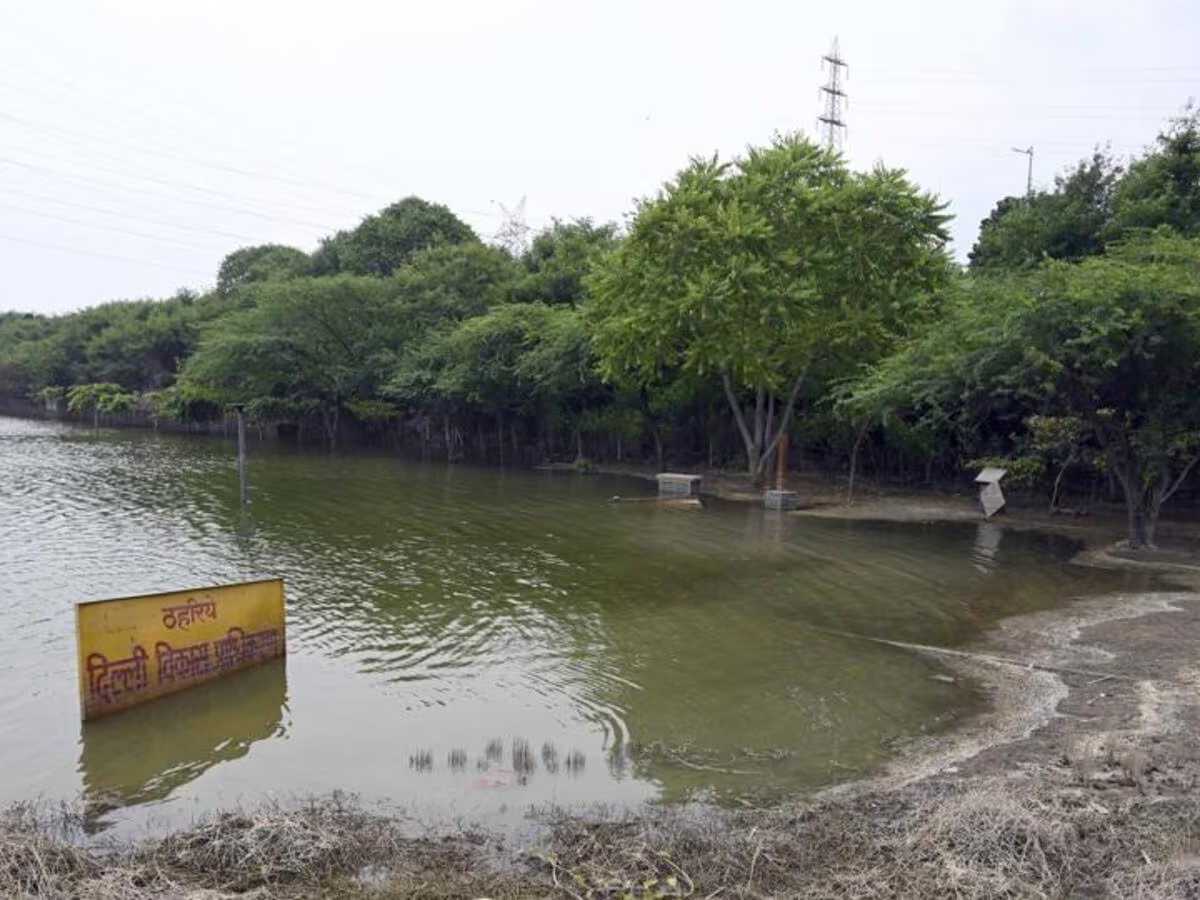
Floodplain: The Centre has circulated with states a nationwide framework for regulating development in flood-prone areas, introducing a three-tier classification of floodplains, prohibiting high-risk activities in vulnerable zones, and setting uniform standards for demarcation, monitoring, and environmental safeguards.
The move aims to curb flood damage, improve climate resilience, and ensure that human activity in floodplains is subject to strict regulation.
The Ministry of Jal Shakti’s Technical Guidelines on Flood Plain Zoning, finalised with the approval of Minister C R Paatil last month, have been circulated to all states and Union Territories for implementation, a senior official said.
Under the new norms, floodplains will be classified into protected, regulatory and, warning zones based on flood frequency, with stringent restrictions on activities in each category.
Also read: Hindu temple desecrated in US; Indian consulate calls act ‘reprehensible’
Permanent construction, waste dumping, and storage of hazardous materials will be banned in ‘protected zones’, except for essential public infrastructure such as bridges, embankments, and flood protection works.
“The protected zone is the active flood zone and subjected to most frequent flooding. This corresponds to the area covered by floods with 1 in 5-year return period. No activities/ construction will be allowed in this zone except those specified,” the guidelines said.
Until floodplain mapping is completed, a nationwide 100-m no-development zone from a river’s edge will be enforced.
States and Union territories must designate a nodal agency to map flood-prone areas using satellite data, hydrological modelling, and climate change projections, and integrate these maps into land-use planning and revenue records, as per the new guidelines.
In the regulatory zone, The area of flood plain covered by floods between 1 in 5-year return period and 1 in 25-year return period will be termed as Regulatory Zone. The activities in this zone will be regulated. The severity of flood in this area will be lesser than that of the Protected zone.
The warning zone is the outermost zone in which most of the activities can be permitted by mapping their vulnerability so that that risk flooding hazards remain minimal. This part of flood plain corresponds to the area covered by floods between 1 in 25-year return period and 1 in 100-year return period.
Special provisions address hilly and Himalayan regions, factoring in slope stability, cloudburst threats, and glacial lake outburst floods. The guidelines also recommend phased removal of encroachments, relocation of vulnerable communities, and regular public alerts for those living in high-risk areas.
Environmental safeguards include a ban on landfill sites within 500 metres of rivers, a prohibition on dumping municipal and industrial waste in floodplains, and mandatory effluent monitoring under the Water (Prevention and Control of Pollution) Act, 1974.
“This document represent a strategic reimagining of how we can coexist with our rivers. Prepared through robust consultations and grounded in national and international best practices, this document seeks to equip state governments, urban planners, and decision-makers with a standardized yet adaptable framework for delineating, regulating, and restoring the floodplain zones,” said Debashree Mukherjee, Secretary of Water Resources, in the guidelines.
Drawing on global best practices from the US, UK, New Zealand, and Bangladesh, the framework will be periodically reviewed to address emerging threats.
Also read: 9 Tihar jail officials suspended over extortion row, HC told
India, the second most flood-affected country after Bangladesh, loses an average of 1,654 human lives, over six lakh cattle, and 75 lakh hectares of land to floods every year.
The Central Water Commission (CWC), which prepared the guidelines, stressed that traditional measures like embankments and reservoirs cannot provide absolute protection and must be supplemented with non-structural interventions.
The floodplain zoning legislation has seen poor implementation with only four states of Manipur, Rajasthan, Uttarakhand, and the erstwhile Jammu & Kashmir complying despite repeated reminders.
Delhi HC will rule Oct 23 on AISA chief Neha Bora’s plea against a police…
A CREA analysis shows Delhi's winter AQI has seen no steady gain since 2022, with…
DMRC will plant over 28,000 saplings across 991 MCD parks in 3 months to offset…
Delhi HC quashed an FIR against an SSC aspirant, ruling mere presence at a protest…
CJP leaders Saurav Das and Ashutosh Ranka sought more time to join the Delhi Police…
Delhi Police held 3 more people, including a couple using a minor to sell heroin…
