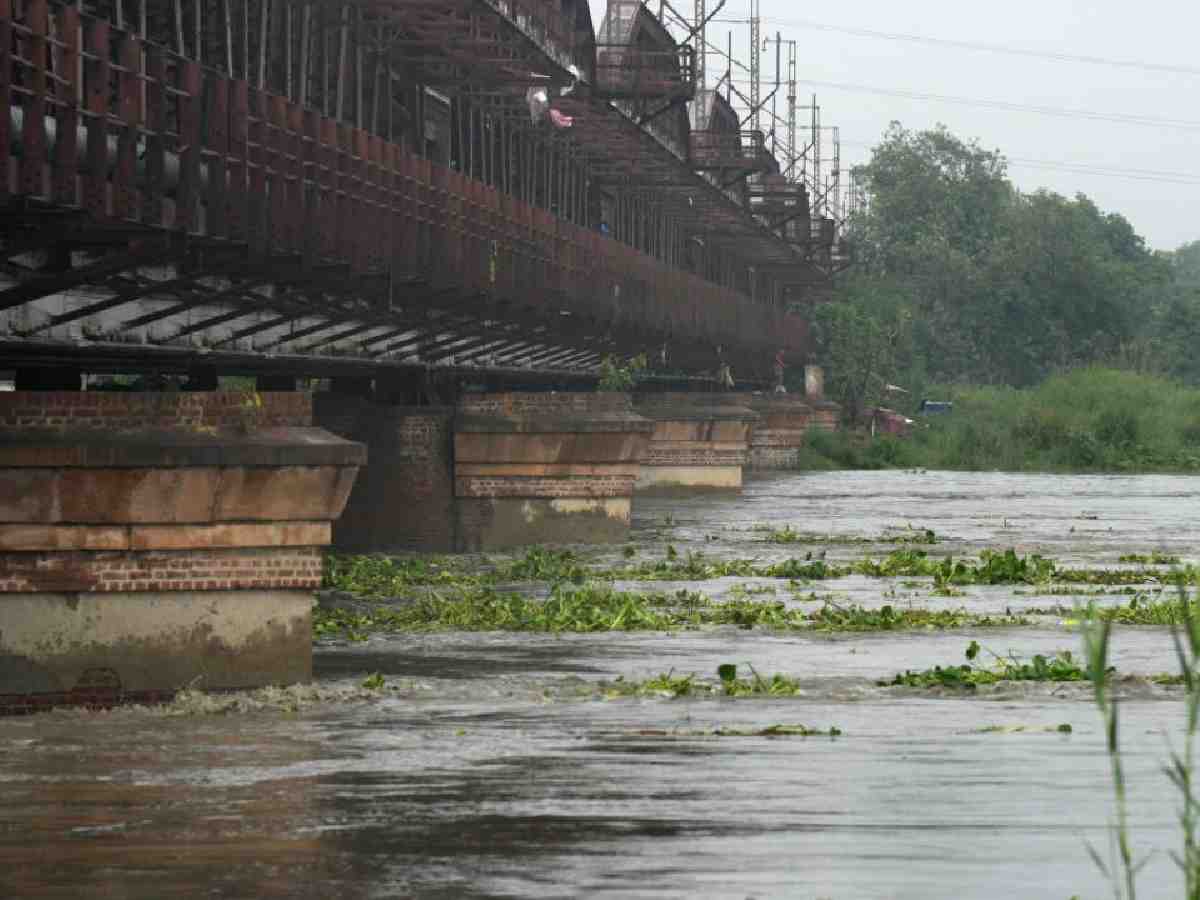
A major discrepancy has surfaced between the Central Pollution Control Board (CPCB) and the Delhi Pollution Control Committee (DPCC) regarding the performance of sewage treatment plants (STPs) in the national capital. While the CPCB’s water quality report for June 2025 revealed that none of Delhi’s 37 operational STPs met prescribed discharge standards, the DPCC’s report for the same month claimed that 23 of them were compliant, raising questions about the Yamuna’s water quality.
Stark discrepancies
An RTI reply accessed by Patriot from the CPCB exposed vast inconsistencies between the two agencies’ findings. For instance, the CPCB reported that the Yamuna Vihar Phase-II STP had an alarming faecal coliform level of 22,000,000 MPN/100 ml, total suspended solids (TSS) at 52 mg/l, and ammoniacal nitrogen at 13 mg/l. However, the DPCC’s report for the same month recorded drastically lower values — faecal coliform 140 MPN/100 ml, TSS 7 mg/l, and ammoniacal nitrogen 0.6 mg/l — suggesting the plant was well within permissible limits.
The prescribed discharge standards for treated wastewater are as follows: faecal coliform ≤230 MPN/100 ml, TSS ≤10 mg/l, biological oxygen demand (BOD) ≤10 mg/l, chemical oxygen demand (COD) ≤50 mg/l, pH 6.5–9.0, and ammoniacal nitrogen ≤5 mg/l.
A similar mismatch appeared at several other facilities. The Rohini STP, for example, reported 26,00,000 MPN/100 ml faecal coliform and 8 mg/l ammoniacal nitrogen according to CPCB, but the DPCC claimed the plant met standards with faecal coliform at 170 MPN/100 ml and ammoniacal nitrogen at 1.1 mg/l.
At variance
The Coronation Pillar STP (Phases I and II) had a faecal coliform count of 3,500 MPN/100 ml in the CPCB report, whereas the DPCC recorded 110 MPN/100 ml. The same facility’s Phase III showed 460 MPN/100 ml and TSS 12 mg/l as per CPCB, but the DPCC’s version listed 220 MPN/100 ml and TSS 6 mg/l.
Even more concerning was the case of SEN Nursing Home STP, where CPCB’s findings revealed faecal coliform at a staggering 4.7 billion MPN/100 ml, COD 63 mg/l, BOD 12 mg/l, and ammoniacal nitrogen 18 mg/l. Yet, the DPCC asserted that the same unit met standards, reporting faecal coliform at 110 MPN/100 ml, COD 36 mg/l, BOD 8 mg/l, and ammoniacal nitrogen at 0.8 mg/l.
Likewise, Chilla STP showed faecal coliform at 24,000 MPN/100 ml and TSS at 12 mg/l in the CPCB report. However, the DPCC data claimed compliance with values of 130 MPN/100 ml and TSS 8 mg/l, respectively.
Other plants flagged by CPCB as non-compliant include Kondli STPs (Phases I & IV), Narela, Keshopur (Phases I–III), Nitholi (Phases I & II), Okhla (Phases V, VI, and New), and Kapashera. The DPCC, however, has maintained that these facilities are performing within norms — a contradiction that undermines the credibility of the city’s wastewater management records.
‘Poor oversight’
Environmental activist Pankaj Kumar, popularly known as the Oxygen Man, criticised the authorities for failing to maintain operational efficiency at the STPs.
“This is deeply disappointing. The authorities are not even managing the existing sewage treatment infrastructure properly,” Kumar said. “The CPCB’s findings show that STPs are not adequately disinfecting the faecal coliform received, allowing untreated or partially treated sewage to flow directly into the Yamuna.”
He stressed that the CPCB report should serve as an eye-opener for both the DPCC and the Delhi government, which have repeatedly promised to clean the Yamuna. “The focus should be on improving STP functioning instead of publishing misleading reports,” he said.
Kumar added that parameters like TSS, BOD, COD, and ammoniacal nitrogen levels further indicate serious performance lapses. “If these systems continue discharging below-standard water, the Yamuna will only get more toxic,” he warned.
Timing and effluent flow
A senior DPCC official defended the agency’s data, citing timing differences and variable discharge patterns as possible reasons for the mismatch.
“There can be multiple factors behind the variation between CPCB and DPCC data — including the timing of sample collection and the discharge of industrial effluents,” the official said.
“For instance, if samples are taken in the morning, faecal coliform levels may rise because more people are using household sanitation systems. Industrial effluent discharges tend to increase in the afternoon, which can alter water quality readings,” the official explained.
However, experts argue that such explanations cannot justify the enormous discrepancies between the two datasets, especially when the gap runs into millions of MPN units in faecal coliform counts.
‘Persistent failure’
The Yamuna has long been at the centre of Delhi’s pollution crisis. Despite decades of clean-up campaigns, court interventions, and government promises, the river continues to receive over 70% of the city’s untreated sewage. Environmentalists say the failure to ensure functional STPs remains the single biggest obstacle to restoring the river’s health.
Repeated contradictions between CPCB and DPCC data, experts say, not only erode public trust but also make it impossible to assess progress accurately. Without transparency and independent monitoring, Delhi’s “clean Yamuna” mission risks remaining little more than rhetoric.
Bhim Singh Rawat, associate coordinator, South Asia Network on Dams, Rivers and People (SANDRP), said, “The glaring contradictions in CPCB and DPCC June data on 35 STPs’ compliance in Delhi are self-explanatory and highlight the abysmal status of river governance in the national capital. This is a very concerning issue undermining the critical efforts required to improve the functioning of defaulting STPs, which are ultimately resulting in continual degradation of river water quality in Delhi.”
“The DPCC in its first report in October 2025 flagged the alarming level of pollution in Yamuna’s water quality and then published a second report showing a sharp decline in pollution levels without any credible basis,” he said.
“STPs are being promoted and built as a silver bullet solution to cleaning the river. But each and every aspect of the STP — planning, building and monitoring — has been mired by poor performance, opaque monitoring and an unaccountable operation system. There is an urgent need to overhaul the way the STPs are built, run and monitored. The government must take penal action against the companies and contractors running the defaulting STPs,” he said.
Also Read: Experts warn MCD’s move to send firecracker waste to WtE plants may worsen Delhi’s pollution
“This incident only reinforces the long-pending demand of making STP monitoring a participatory process. Involving RWAs, ULBs, independent experts, and civil society members from the area is a must-take measure by the government,” Rawat concluded.
Way forward
Experts insist that immediate measures are needed to bridge institutional gaps and establish a unified monitoring framework between CPCB and DPCC. Random sampling, third-party audits, and real-time online monitoring of effluent discharge could ensure accountability.
As Delhi continues to grapple with water pollution and dwindling river health, the CPCB’s June report stands as a grim reminder: even the most ambitious rejuvenation plans will fail unless data integrity and operational efficiency become non-negotiable.
Until then, the Yamuna — once Delhi’s lifeline — remains a mirror reflecting environmental neglect and bureaucratic discord.
What is TSS?
TSS, or total suspended solids, refers to the small solid particles suspended in water that are not dissolved, such as silt, sewage, and industrial waste. High TSS levels indicate poor water quality, as they block sunlight, harm aquatic life, and often carry harmful pollutants. In treated wastewater, TSS should ideally remain below 10 mg/l, as per CPCB standards, to ensure safe discharge into rivers like the Yamuna.
What is faecal coliform?
Faecal coliform refers to a group of bacteria found in the intestines and faeces of humans and warm-blooded animals. Its presence in water indicates contamination by sewage or animal waste, which can carry harmful pathogens causing diseases such as diarrhoea, typhoid, and cholera. High faecal coliform levels indicate that the water is unsafe for human use and aquatic life. It is a key indicator of water pollution and treatment efficiency.
What is BOD?
BOD, or biochemical oxygen demand, measures the amount of oxygen that microorganisms need to break down organic matter in water. A high BOD indicates a large amount of organic pollution — often from sewage, industrial waste, or decaying plants — which can deplete oxygen levels and harm aquatic life. It is a key indicator of water quality, indicating how effectively wastewater is treated before discharge.
What is ammoniacal nitrogen?
Ammoniacal nitrogen refers to the amount of ammonia (NH₃) and ammonium ions (NH₄⁺) present in water. It is a key indicator of pollution, often originating from sewage, agricultural runoff, or industrial waste. High levels of ammoniacal nitrogen suggest the presence of untreated organic waste and can be toxic to aquatic life, as it reduces oxygen levels and disrupts the ecosystem’s balance.
At least 50 cases have already been reported this month; NCPCR guidelines mandate help desks,…
DMRC says zero reduction in train trips, attributes decline to security measures and public apprehension…
A Delhi court denied bail to a former DU professor accused of raping a student,…
Delhi Police charged seven dhaba workers in the fatal beating of a Manipuri musician who…
Seven Delhi STPs failed DPCC standards in September, dumping high levels of faecal coliform and…
AISA chief Neha Bora petitioned the Delhi HC against a police notice requiring a peace…
