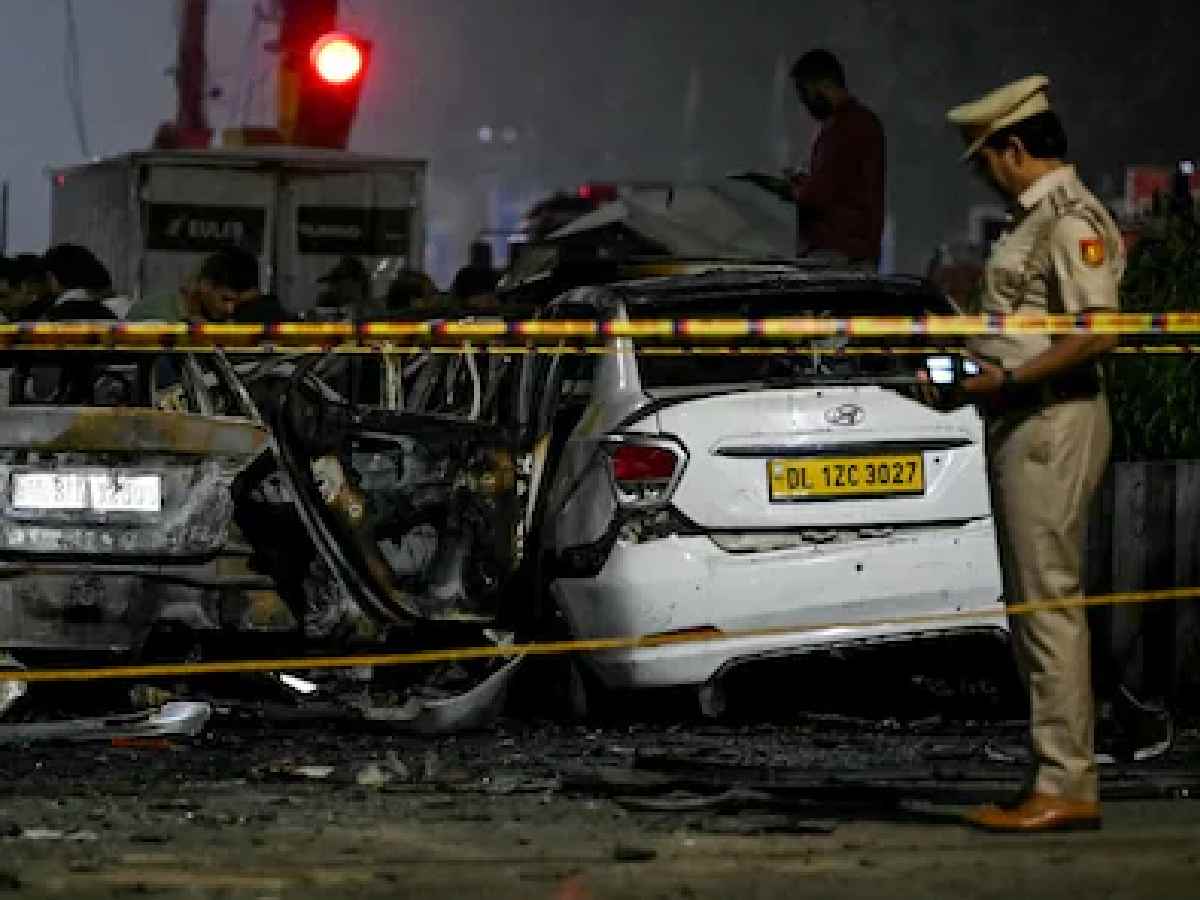
Delhi: The national capital is in a state of shock and mourning. A day after the car bomb blast near the Red Fort on November 10, 2025, a deep sadness has settled across the city. Over the last four decades, Delhi has witnessed dozens of bomb blasts that have claimed hundreds of lives and left thousands injured.
The nightmare began with the transistor bomb blasts of 1985, followed by the 1996 Lajpat Nagar explosion, the serial attacks just before Diwali in 2005, the multiple blasts of 2008, the 2011 High Court bombing, and now, yet again, a deadly car bomb near the Red Fort — which killed 13 people and injured dozens. Each of these attacks not only caused immense human tragedy but also rekindled long-standing fears about safety in the capital.
While security systems have grown increasingly sophisticated over the years, the recurrence of such attacks continues to raise concerns over the effectiveness of preventive measures.
Recurring pattern
The history of bomb blasts in Delhi can be traced back to the 1980s. On May 10, 1985, transistor bombs — explosives hidden inside transistor radio-like devices — detonated in buses and public places, killing 49 people in Delhi alone and injuring 127. (The total death toll, including neighbouring states, was 69.) The investigation was marred by loopholes; in 2020, a court acquitted all 30 accused for want of evidence, making it a case study in investigative lapses.
Also Read: Delhi Red Fort blast: eyewitnesses recount scene of horror
On May 21, 1996, a car bomb ripped through Lajpat Nagar’s central market, killing 13 people and injuring 39. The attack was linked to the Jammu and Kashmir Islamic Front and Pakistan’s ISI. Then, on October 29, 2005, just two days before Diwali, three simultaneous blasts struck Paharganj, Sarojini Nagar and Govindpuri, claiming 67 lives and injuring over 200. Lashkar-e-Taiba and Indian Mujahideen were later found to be involved.
A series of five coordinated blasts on September 13, 2008, hit Connaught Place, Greater Kailash, Karol Bagh and other areas, killing 30 and injuring more than 100. Indian Mujahideen claimed responsibility. On September 7, 2011, a briefcase bomb outside the Delhi High Court killed 15 people.
Smaller explosions have also occurred in Karol Bagh (1997), near the Red Fort (2000), Jama Masjid (2006) and other locations — underlining the city’s long, painful relationship with such violence.
Complex urban realities
Delhi’s size and density have always made it difficult to secure completely. With over 3 crore residents and millions entering daily, crowded markets like Sarojini Nagar, Connaught Place and Chandni Chowk, and tourist landmarks such as the Red Fort and India Gate, remain vulnerable soft targets.
“Checking every person or vehicle in such crowds is practically impossible. Terrorists deliberately choose festivals or peak hours to maximise casualties. Open borders with Uttar Pradesh, Haryana and Rajasthan allow easy infiltration,” says senior journalist Lalit Vats, who has reported on several blast incidents over the past two decades.
Persisting loopholes
In many cases, specific warnings were received but not adequately followed up. The lack of real-time coordination between Delhi Police, the NIA, the IB, RAW and state police forces has long been a concern. “Weak preservation of evidence, poor witness protection, and inadequate forensic capacity have often allowed the accused to go free even years later,” said an official from the Home Ministry who did not wish to be named.
From Khalistani militants in the 1980s to Kashmiri separatist groups and, more recently, home-grown modules of Indian Mujahideen and Jaish-e-Mohammed, the nature of the threat has evolved. According to investigators, Pakistan’s ISI continues to provide logistical and financial support, while a newer concern is the rise of “white-collar terrorism” — educated professionals, including engineers and doctors, being drawn into radical networks.
Limits of tech, manpower
Inadequate technological and human resources remain key challenges. CCTV coverage is still patchy in several parts of the city, drone and AI-based surveillance are limited, the police-to-population ratio remains low, and training infrastructure has not kept pace with changing threats.
Also Read: Experts warn MCD’s move to send firecracker waste to WtE plants may worsen Delhi’s pollution
Despite these gaps, major attacks declined significantly after 2011 — a sign that preventive mechanisms and inter-agency coordination have improved, even if not uniformly.
According to former Delhi Police officer JS Joon, “Complete control over bomb attacks in Delhi may not be possible, but significant prevention is achievable if intelligence systems are strengthened, borders monitored more effectively, explosives tightly regulated, and coordination between agencies made seamless.”
The Red Fort blast, he added, is a stark reminder that the city’s vigilance can never afford to lapse.
Families displaced by the Seemapuri building collapse spend another night on the streets as damaged…
Camera-based enforcement in Delhi generated around 40.6 lakh notices till September, but only about 2…
Delhi government to fast-track Rs 7,000-crore elevated Ring Road project, with two new Yamuna bridges…
Yamuna water quality deteriorated at three locations in Delhi in September, with BOD levels remaining…
Delhi liquor stores will remain shut on October 9 and 10 following police inputs to…
Strike began September 15; ESMA invoked by month-end has barred strikes for six months; drivers…
