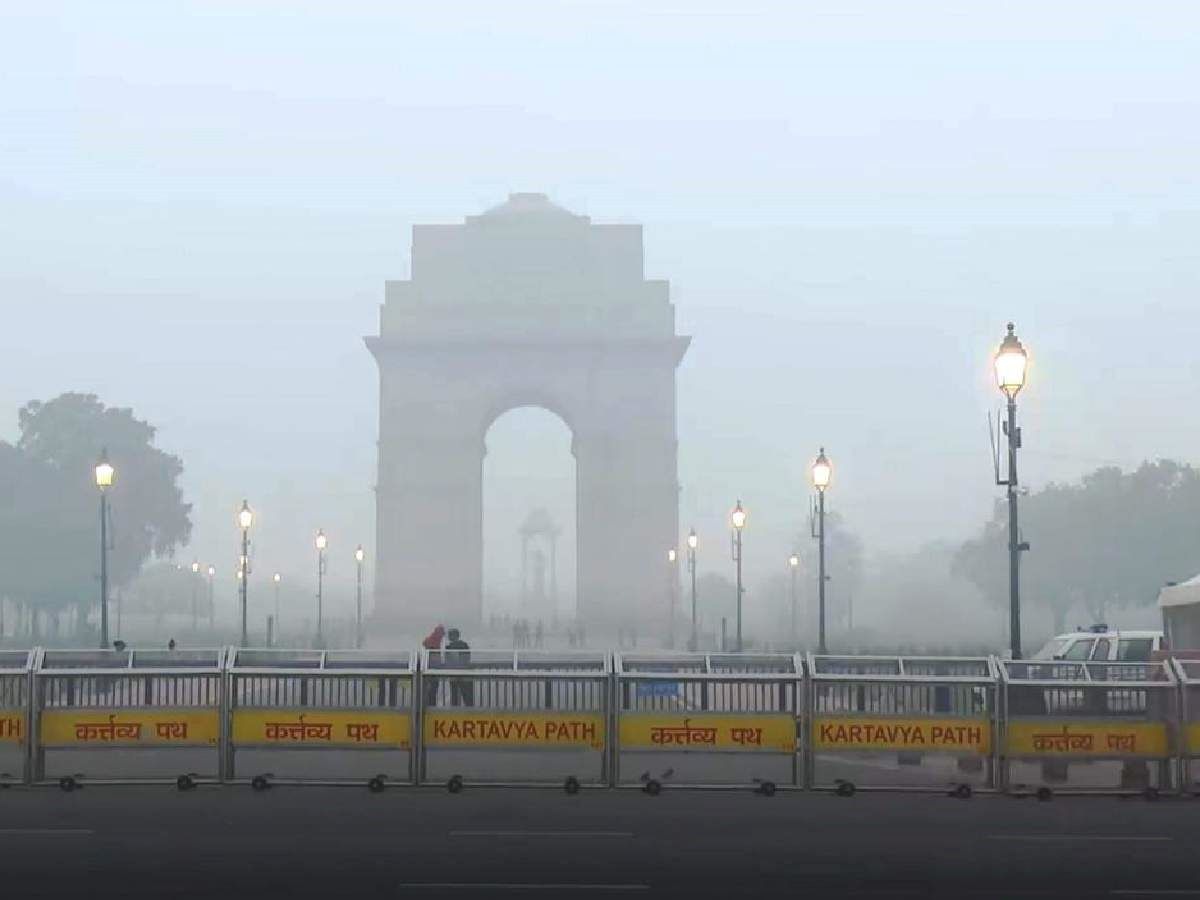
Delhi’s air quality saw a slight improvement on Friday, moving to the ‘poor’ category despite a thick layer of smog still covering the Delhi in the early hours.
At 9:00 AM, the Air Quality Index (AQI) in the capital was recorded at 281, as reported by the Central Pollution Control Board (CPCB).
In localities like Mundka, Punjabi Bagh, Rohini, Bawana, Jahangirpuri, Anand Vihar, Alipur, Ashok Vihar, Burari, Sonia Vihar, and Mandir Marg, the AQI remained in the ‘very poor’ range.
The AQI scale categorizes levels from zero to 50 as ‘good,’ 51 to 100 as ‘satisfactory,’ 101 to 200 as ‘moderate,’ 201 to 300 as ‘poor,’ 301 to 400 as ‘very poor,’ and 401 to 500 as ‘severe.’
Meanwhile, the city’s minimum temperature was recorded at 19.2 degrees Celsius, two degrees above normal.
At 8:30 AM, humidity levels stood at 76 percent, according to data from the India Meteorological Department.
Also Read: Delhi: Authorities intensify efforts as air quality dips into “very poor” category
The weather office has forecast clear skies for the day, with a maximum temperature likely around 34 degrees Celsius.
On Thursday, Delhi’s Lieutenant Governor V K Saxena chaired a Delhi Disaster Management Authority meeting with relevant department officials.
The focus was set on dust control and mitigation, with multiple agencies tasked with implementing anti-pollution measures.
After the meeting, Delhi Environment Minister Gopal Rai indicated the possibility of adjusting government office hours to reduce pollution.
“Discussions were held regarding altering the timings of both central and state government offices in Delhi to decrease the number of vehicles on the roads simultaneously,” he stated.
The Delhi government has requested that the LG discuss with the Centre a pilot project for artificial rain to address emergency pollution levels, Rai added.
Delhi faces high pollution levels during the winter, largely due to low wind speeds, dropping temperatures, increased moisture, and pollutants that act as condensation surfaces.
Also Read: Foam and fear: Are officials distorting Yamuna pollution data?
In related news, the Municipal Corporation of Delhi (MCD) has allocated Rs 20 lakh per zone to improve air quality management.
The funds will enhance equipment and manpower for dust control, specifically for operating sprinklers and hiring drivers based on manpower assessments at the zonal level.
Due to rising pollution, anti-pollution measures under GRAP-II were activated earlier this week.
Experts predict that as temperatures continue to fall, smog will thicken, leading to higher pollution levels.
(With inputs from PTI)
Rescue teams recovered two bodies from the debris of a collapsed under-construction house in northeast…
Built on Jawaharlal Nehru’s vision, the Delhi landmark has witnessed the evolution of a young…
Delhi steps up NCR coordination to curb winter air pollution by enforcing strict border checks…
Police probe all angles, including a suspected breakup and CCTV footage, after a Class 12…
Two terror attacks, eight years apart, struck ordinary shoppers and changed festive celebrations in the…
NDMC to build a larger tulip garden with parking at Nehru Park, featuring seasonal blooms,…
