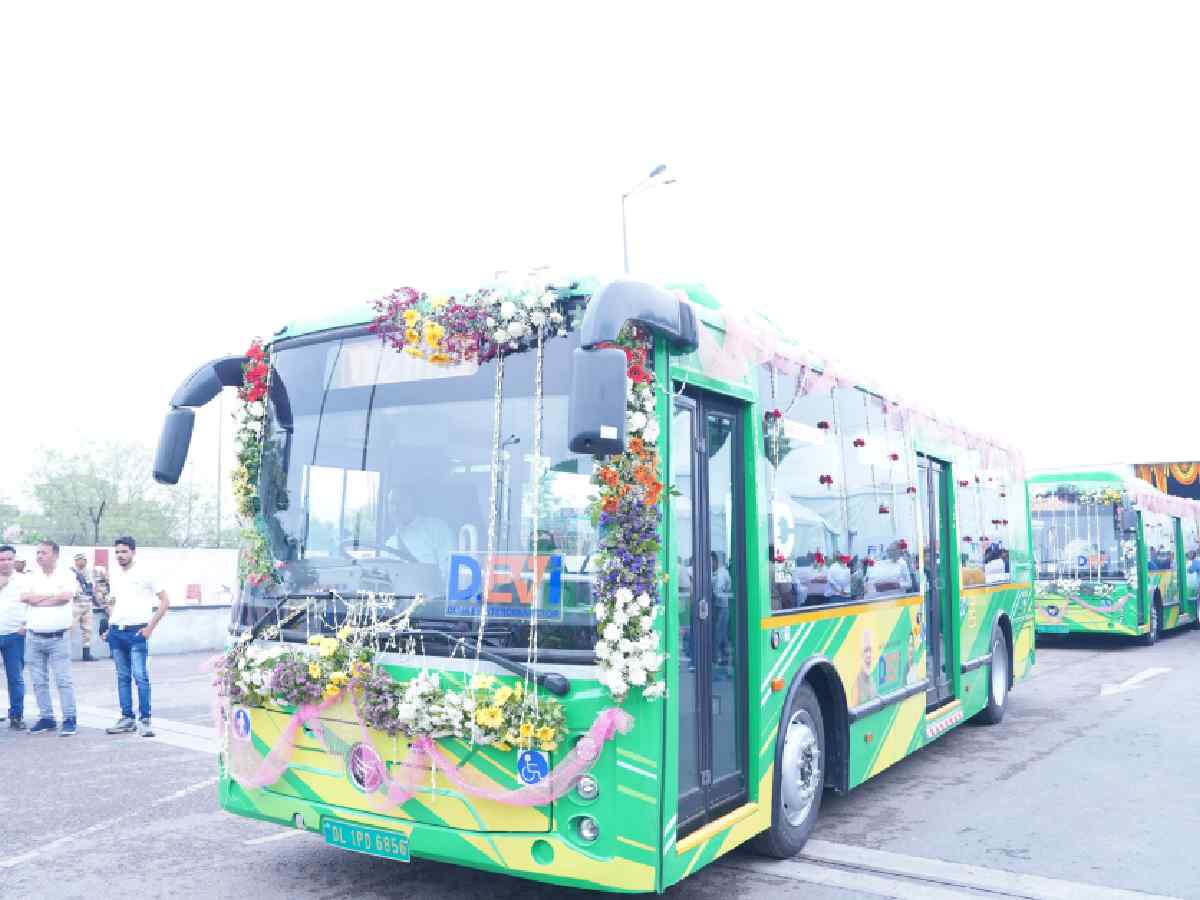
The Delhi government’s procurement strategy for electric buses is tilting towards nine-metre ones instead of the 12-metre ones owing to the congested roads in the national capital, manoeuvrability concerns and cost efficiency, officials said.
According to a senior transport department official, the nine-metre buses introduced during the tenure of the Rekha Gupta government under its Delhi Electric Vehicle Interconnector (DEVI) scheme are better suited for negotiating narrow stretches, sharp turns and densely populated neighbourhoods.
Barring the Outer Ring Road, the 12-metre buses often struggle to operate smoothly in other areas.
“Traffic congestion is a persistent challenge across the city, especially in older areas. The move is aimed at improving operational efficiency and service reliability,” the official added.
The official said that buses are procured through CESL, which floats the tender.
“We have requested 2,800 buses. Out of these, 1,400 will be nine-metre ones and the remaining will be 12-metre ones. For the next request for procurement of 1,200 buses, we plan to seek 800 nine-metre buses and the remaining will be the 12-metre buses,” he shared.
Explaining further, the official said Delhi’s road geometry in several pockets is not ideal for 12-metre buses, which occupy a larger space.
Nine-metre buses are easier to manoeuvre and also low on cost. The cost of a 12 metre bus is Rs 1.5 crore, whereas a smaller bus costs around a crore, the official added.
At a time the government is focused on fleet modernisation and the transition to electric mobility, the move is a sustainable one, the official said.
Passenger load patterns are also a reason for the shift.
According to the official, buses are fully occupied only during peak hours in the morning and evening. During non-peak hours, larger buses often operate with empty seats.
“This move in the longer run will also reduce commuter waiting time and better last-mile connectivity,” he added.
The official stressed that 12-metre buses will continue to be deployed on high-demand corridors and also on the inter-state bus routes that have recently been started.
The department is in the process of induction of 5,780 electric buses, including 2,840 DTC and 2,940 cluster ones.
In addition, 2,442 CNG Buses, including 692 DTC ones, are in operation, which would gradually go off-road by December this year. The 1,750 CNG Cluster buses will go off the roads by 2030-31.
BNSS caps custody at 24 hours and requires production before a Magistrate; force permitted only…
An SEM court reserved its order on extending the judicial custody of CJP leaders Saurav…
Delhi recorded its first 'poor' air day of the season on Wednesday as AQI hit…
Stage I of GRAP was invoked later this year in Delhi due to govt's preventive…
DDA plans to resume tethered hot air balloon rides at Baanseera park from Nov 14,…
NDMC is consulting RWAs and traders on draft 2026 property tax bye-laws, seeking feedback on…
