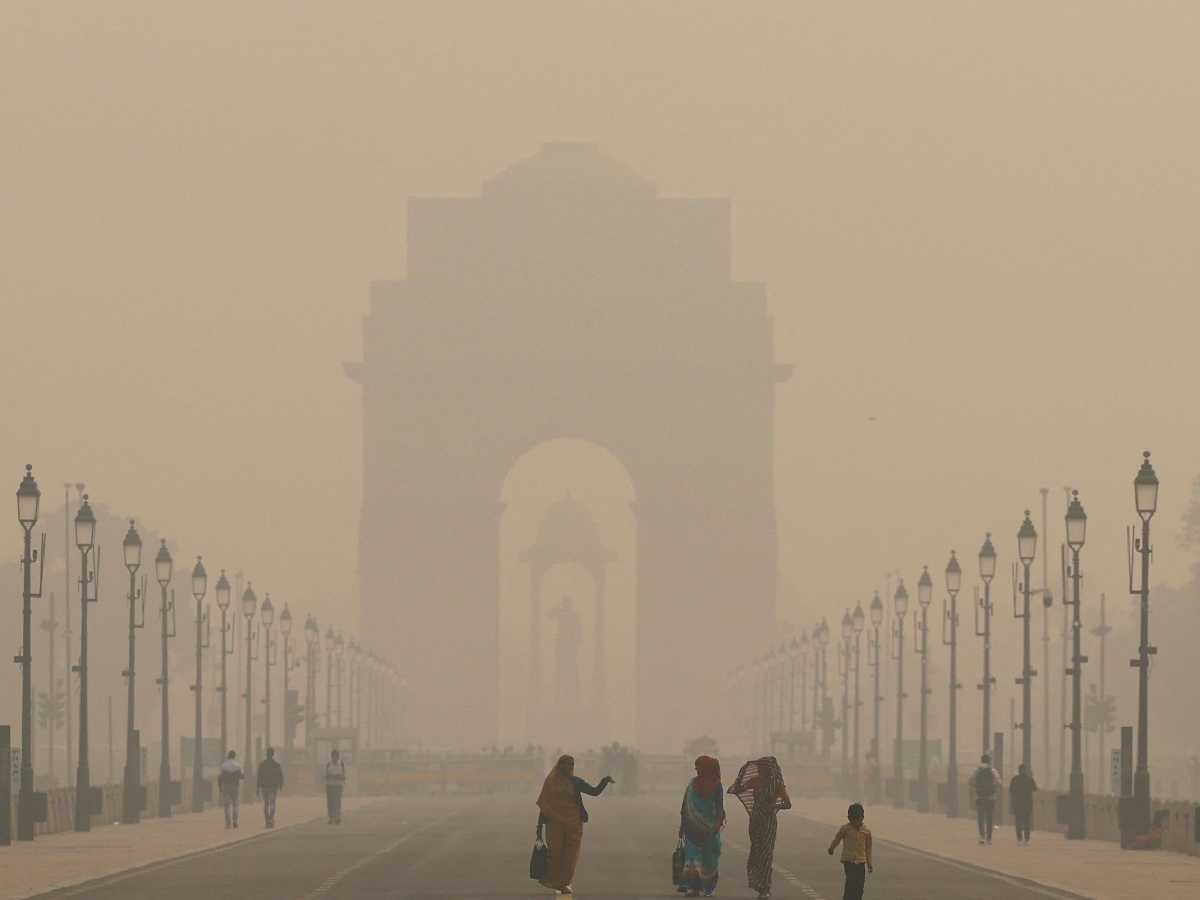
Delhi residents woke up once again to a city blanketed in smog, the familiar haze settling stubbornly over roads, markets and neighbourhoods. Although official bulletins on November 16 suggested a slight improvement in air quality due to favourable winds, an on-ground investigation by Patriot painted a more troubling picture. What emerged was a consistent gap between official AQI numbers and the air residents said they were breathing, prompting fresh questions about the reliability of Delhi’s monitoring infrastructure.
Govt data vs ground reality
By mid-day on November 16, government dashboards indicated that Delhi’s Air Quality Index (AQI) had dipped to 377, placing it in the “Very Poor” category but showing improvement from preceding days. Yet across several locations, Patriot reporters recorded significantly higher readings. The investigation found malfunctioning machines, incomplete data displays and monitoring stations that were either inaccessible or visibly inactive.
The situation was particularly striking at Anand Vihar, repeatedly identified as one of the capital’s worst pollution hotspots. When Patriot reached the East Delhi transport hub, it witnessed Municipal Corporation of Delhi (MCD) water tankers spraying the area around the monitoring station. Officials claim such measures help settle dust particles, but critics argue that targeted spraying near sensors can “mask” pollution levels and produce deceptively lower readings. The timing and placement of the spraying only intensified suspicions of data manipulation.
Raju Kumar, a tea seller, said, “Bhaiya, yeh paani waale truck toh roz yahin monitor ke aas-paas hi chakkar laga rahe hain (Brother, these water-sprinkling trucks circle only around the monitoring station every day).”
Meena Devi, a fruit vendor, added, “Do-teen din se lagataar wahi ho raha hai (for the last two or three days, the same thing has been happening repeatedly).”
Infrastructure in disrepair
The discrepancies extended beyond Anand Vihar. At ITO, one of central Delhi’s busiest junctions, the government’s AQI reading was 417 (“Severe”). However, handheld equipment used by the Patriot team registered levels above 500. The display board here was showing only PM10 and PM2.5, omitting the overall AQI — the figure most relevant for public health advisories.
A similar issue surfaced at Lodhi Road, where the outdoor AQI board was completely non-functional. Several locations across Delhi had broken or partially functioning display boards. In a city where millions rely on real-time readings to gauge exposure risks, such gaps have profound implications.
At India Gate, despite its open surroundings, a visible grey smog hung over the lawns and the monument even in the afternoon sun. Many visitors were seen covering their faces as they walked through the lawns.
At Dilshad Garden, readings were comparatively better, though still in the “Poor” range. The monitoring station here is situated inside a tree-lined medical institute campus, far from dust and road traffic — a placement that environmental experts say often yields more optimistic readings than stations located along arterial corridors.
Missing stations, inaccessible locations
The problems were not limited to malfunctioning devices. At Siri Fort, the team could not access the monitoring station because it lies inside a restricted-entry sports complex. At Jawaharlal Nehru Stadium — a large public facility — the situation was baffling: none of the employees at the sports complex, including security personnel, knew the AQI monitor’s location. Besides, there was no signage to indicate its presence. For a crucial public-health instrument to be effectively “lost” within a major stadium raises serious concerns about oversight.
‘Technical failures’
Several display boards not only malfunctioned but also showed suspiciously low readings compared to independent measurements.
At the National Institute of Tuberculosis and Respiratory Diseases on Aurobindo Marg, the display board appeared active but was barely legible — and its numbers were notably low. The Patriot team recorded a PM2.5 concentration of 300 µg/m³ on their device, more than double the board’s 250 µg/m³.
Also Read: Delhi’s air pollution may be 20% worse than recorded: Study
At ITO, the board fluctuated erratically through the day, showing PM2.5 levels of around 248 µg/m³ while the team’s handheld meter consistently measured around 269 µg/m³.
At Anand Vihar, even as water sprinkling continued, the official board reported PM2.5 levels of 312 µg/m³, while the handheld device measured around 402 µg/m³ — a disparity significant enough to alter public perception.
Hazardous air across Delhi-NCR
Despite some official claims of “improvement,” the broader picture remained grim. According to the Central Pollution Control Board’s (CPCB) daily bulletin, Delhi’s 24-hour average AQI stood at 418 on November 11 — firmly in the “Severe” category, though marginally lower than Tuesday’s reading of 428. For context, AQI values between 401 and 500 are classified as “Severe,” a range that can affect even healthy individuals and severely harm those with respiratory or cardiac conditions.
The government’s Air Quality Early Warning System predicted that air quality would remain in the “Very Poor” category from November 13 to 15. The subsequent six-day outlook also indicated persistent “Very Poor” levels.
Delhi’s seasonal pollution pattern is well-documented. Every winter, low wind speeds and dropping temperatures trap pollutants near the ground. Vehicle emissions, industrial activity, construction dust and road dust form the baseline pollution load, while stubble burning in Punjab and Haryana during late October and November pushes levels into hazardous territory. Firecrackers during the festival season exacerbate the crisis.
Political blame game
As pollution levels rose, political tensions escalated. The Aam Aadmi Party (AAP) accused the Bharatiya Janata Party (BJP), which controls the MCD, of manipulating pollution data. Delhi AAP chief Saurabh Bharadwaj released a video showing MCD water tankers spraying roads near the Anand Vihar monitoring unit, alleging the move was aimed at influencing AQI readings rather than improving air quality.
Delhi’s Environment Minister Manjinder Singh Sirsa countered that the AQI had begun to show a “declining trend” due to coordinated pollution-control measures. He cited challans issued to polluting vehicles, truck diversions and widespread water sprinkling as evidence of a “data-backed, disciplined campaign” to curb pollution.
Under scrutiny
The contradictions documented by Patriot point to a critical issue: residents rely on official AQI data to make informed decisions about daily activities, health precautions and outdoor exposure. When monitoring systems malfunction or data is unreliable, public safety is compromised. The presence of non-functional monitors, inaccessible stations and unexplained discrepancies suggests that Delhi’s air-quality monitoring network — a crucial early-warning system — may not be functioning with the transparency and accuracy the crisis demands.
AQI measurements
According to the CPCB’s classification system, an AQI of 0–50 is “Good,” 51–100 “Satisfactory,” 101–200 “Moderate,” 201–300 “Poor,” 301–400 “Very Poor,” and 401–500 “Severe.” These categories reflect escalating health risks, ranging from mild discomfort among sensitive groups to serious impacts on even healthy individuals at the “Severe” level.
Families displaced by the Seemapuri building collapse spend another night on the streets as damaged…
Camera-based enforcement in Delhi generated around 40.6 lakh notices till September, but only about 2…
Delhi government to fast-track Rs 7,000-crore elevated Ring Road project, with two new Yamuna bridges…
Yamuna water quality deteriorated at three locations in Delhi in September, with BOD levels remaining…
Delhi liquor stores will remain shut on October 9 and 10 following police inputs to…
Strike began September 15; ESMA invoked by month-end has barred strikes for six months; drivers…
