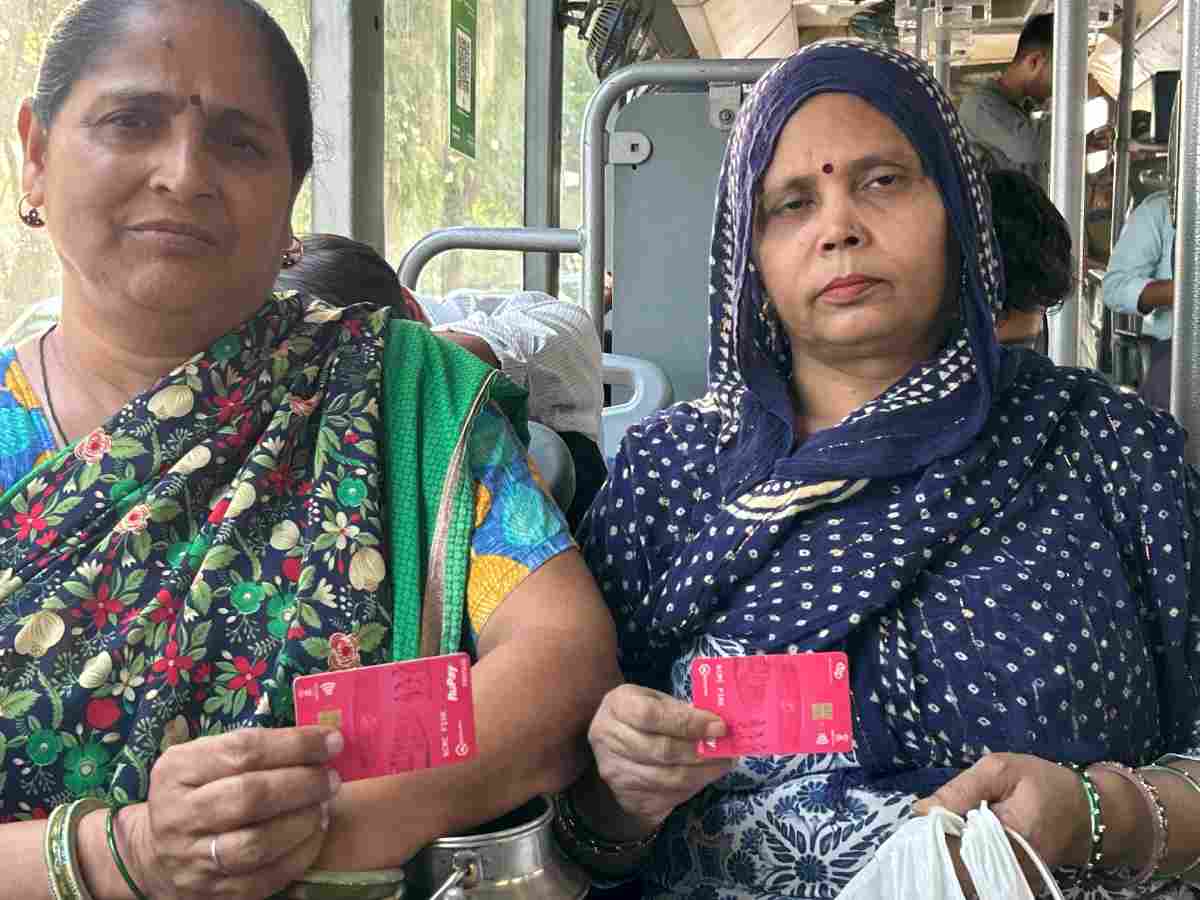
Women display their Pink Saheli Smart Cards
For Savitri Prajapati, a sari shop worker in Chandni Chowk, the search for a better livelihood in Delhi has come with a new hurdle: obtaining the Pink Saheli Smart Card required for free bus travel.
Originally from Chanpura in Bihar, Prajapati migrated to Delhi with her husband in 2017 to seek a better life. She now works at a sari shop in Chandni Chowk but has struggled to apply for the card because her Aadhaar is registered in Bihar, not Delhi.
Prajapati’s experience highlights a concern emerging with the transition from pink paper tickets to the smart card system: women who have depended on free bus travel may struggle to establish their eligibility or complete the application process.
From domestic workers and shop employees to women travelling between residential neighbourhoods and Metro stations, the change has exposed different barriers. Some women have been unable to obtain the card despite repeated attempts, while others who possess it say their problems begin when they board a bus.
The Pink Saheli Smart Card was introduced on March 2 to replace the paper-based pink ticket system. The transition to the smart card system was extended to give women more time to obtain the new cards, with October 10 set as the final deadline for the transition. From October 10, the smart will be mandatory for availing the free-travel benefit. The first Pink Saheli Smart Card is issued free of cost, while a replacement card costs Rs 49.
Caught in transition
At Kartar Nagar 4 Pusta, where she was waiting for a bus, Prajapati described the difficulty of applying for the new card. Although she has lived and worked in Delhi for years, her Bihar-linked Aadhaar has complicated the process.
Her experience raises questions about how women who have migrated to Delhi for employment can establish their eligibility for the benefit, especially when their identity documents still list addresses in their home states.
Nisha Sharma, who hails from Gorakhpur in Uttar Pradesh, faces a similar concern. She works at a garment shop in Karol Bagh and travels to work from Baraf Khana. Sharma says the cost of daily bus tickets has become more difficult to manage amid rising household expenses.
“Earlier, spending money on bus tickets did not hurt as much as it does now because everything has become so expensive. Paying for tickets every day hits our pockets. We used to save money; even a penny matters to people like us. Now, because I do not have a Delhi address, I cannot avail myself of the Saheli Smart Card,” Sharma said.
For women like Sharma, free bus travel offered an opportunity to save small amounts from their daily earnings. The end of the paper-ticket arrangement has raised concerns about whether migrant women who lack Delhi address documents can access the replacement benefit.
Yet, conversations with women at major bus terminals suggest that the transition is not proving equally difficult for everyone. At Dhaula Kuan, several women said they got their Pink Saheli Smart Cards from the SDM office with no major problems.
The SDM office in Dwarka Sector 2, however, was crowded, and some women said the rush made it difficult to get the cards made.
One worker at Lady Hardinge Medical College alleged that she was charged for a journey despite having an active card. She was travelling from Palam and said she had expected the card to cover her journey.
‘Buses don’t stop’
For Meena Verma, a Delhi resident who travels from Khajuri Khas to the Vishwavidyalaya Metro station by bus, obtaining the card was not the biggest challenge. She applied as soon as the announcement was made and has received it. Yet she says the everyday experience of travelling by bus remains frustrating.
“I applied for the card as soon as the announcement was made, and I have received it. But the problem is that buses often do not stop for us. Sometimes they pass without stopping, while some stop only briefly for us to get on. They also don’t drop us at the proper stop. The green buses meant to take passengers to Metro stations often drop us one stop earlier instead of at the designated stop,” Verma said.
Verma uses the bus mainly to get from her home to the Metro station, making it an important part of her daily commute. Her account points to a distinction between access to a travel benefit and the reliability of the transport service itself.
Similar complaints came up in conversations with women at Dhaula Kuan.
Sachita Tripathi, a 54-year-old daily passenger who works at a hospital, said women travelling on the Kapashera-Dhaula Kuan route often struggle to board buses.
“Women often have to wait for buses, but when the bus comes, it does not always stop for them. Sometimes the bus moves ahead after seeing women waiting,” Tripathi said.
Arushi, a daily traveller from Kapashera, described the problem as well.
“Many times, the bus does not stop when women are waiting. They see us and move ahead,” she said.
“Many times, the bus does not stop when women are waiting. They see us and move ahead,” she said.
A different view
A DTC conductor on a bus operating between Karol Bagh and Gurgaon, with Dhaula Kuan among its stops, said buses stop at their designated stops. According to him, difficulties arise when passengers try to board at places where the bus is not scheduled to stop.
The conductor also said that women without the card were being given a pink slip during the transition.
“Those who do not have the card are being given a pink slip. Women have been given some time during the transition,” the conductor said.
Senior DTC officials have rejected allegations that buses fail to stop for women waiting at bus stops, calling them baseless.
No card yet
While many women interviewed at the terminals said they had already received their cards, others were still struggling to complete the process.
Sabiha Parveen, a domestic worker who travels from Zakhira to DLF Capital Greens in Moti Nagar for work, says she has been unable to obtain the card despite trying both online applications and in-person visits to depots.
“I could not get the Saheli card. I tried applying through online portals and also went to the depots. The staff told me there was a problem with my biometrics. I have already completed the Aadhaar biometric process, but I still have not been able to get the smart card,” she said.
For Phoola Rani, an elderly widow who works as support staff at a playschool in Yamuna Vihar and travels by bus from Seemapuri, the application process had become a question of access to basic technology.
“When I went to get the card made, they told me to link Aadhaar with a mobile number first. I do not use a mobile phone. My son had one, but he sold it while struggling with addiction. Now tell me, what am I supposed to do? Whom should I approach with this problem? They will not let us board without the card, and if we have to spend Rs 30-40 on tickets every day, what will be left in our pockets?” Rani said.
‘Male passengers object’
For Aasifa Khanum, a cook who travels from Inderlok to Patel Nagar, the difficulties continue even after obtaining the card. She said buses often do not stop when they see women waiting, while some passengers object to women boarding or using seats reserved for them.
“I have got the card, but these people often do not stop the bus when they see us. Those who do stop sometimes say that we could have walked or taken an autorickshaw for that short distance instead of getting into an already crowded bus. Men travelling on the bus do not give us the seats reserved for women. They say, ‘You want to travel for free, and you also want to sit? We paid for our tickets, so we will not give you the seat.’ They argue with us simply because we are allowed to travel free,” Khanum said.
Gound visits 2 Dhaula Kuan, Mehrauli and Kashmere Gate suggests that the transition is not uniformly difficult.
‘No time to enrol’
Promila, 38, a daily passenger who travels between Moti Bagh and Mahipalpur, works as nursing staff at Charak Palika Hospital. She said her work schedule had prevented her from finding the time to apply for the card.
“I have not been able to apply for the card because of my work. I work in the hospital and do not get enough time to go and get it made. I am planning to get it done soon,” Promila said.
According to a DTC official, over 19.18 lakh Pink Saheli Smart Cards have been issued so far.
As per the official data for October 4, 17.55 lakh women passengers travelled across Delhi using smart cards.
Delhi recorded a minimum temperature of 25.2°C, 4.2 degrees above normal, on Friday, while the…
Families displaced by the Seemapuri building collapse spend another night on the streets as damaged…
Camera-based enforcement in Delhi generated around 40.6 lakh notices till September, but only about 2…
Delhi government to fast-track Rs 7,000-crore elevated Ring Road project, with two new Yamuna bridges…
Yamuna water quality deteriorated at three locations in Delhi in September, with BOD levels remaining…
Delhi liquor stores will remain shut on October 9 and 10 following police inputs to…

