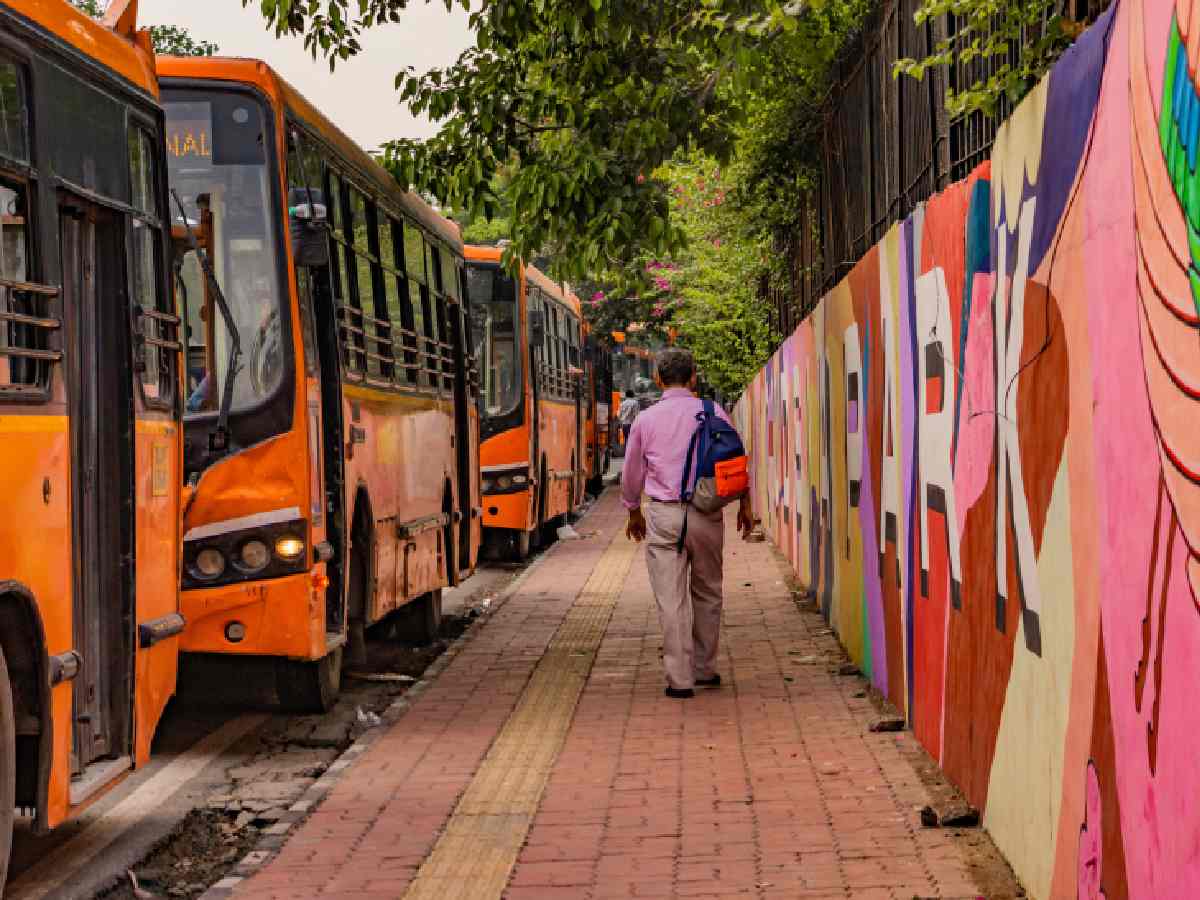
At a bus stop in Shadipur, Manoj, a salesman, watches the road for a Delhi Transport Corporation (DTC) bus that may or may not arrive on time. For workers like him, the ongoing strike by DTC drivers has turned an ordinary commute into a daily calculation of time, money and uncertainty.
The ongoing strike by contractual DTC drivers at various depots has disrupted bus services across the Capital, with the drivers demanding higher wages and employment benefits. The drivers interviewed for this story are contractual workers engaged at different DTC depots. Separately, they have alleged that drivers employed directly by the DTC are being deployed to operate buses run by private operators.
“We have to reach work on time. Buses were already taking so long to arrive, and now the strike has made the wait even longer. What is the fault of an ordinary person who leaves home to earn a living?” he said.
For thousands of Delhi residents who depend on buses to reach workplaces, colleges, schools and markets, the strike has meant fewer buses, longer waits and, in many cases, more expensive alternatives.
The strike, which began on September 15, has reduced bus availability across several parts of the Capital. While some commuters have shifted to the Delhi Metro, autos and e-rickshaws, those living in areas without convenient Metro connectivity have been left with fewer options.
Worst hit
For low-income commuters, however, the problem is not simply finding another mode of transport. It is whether they can afford it.
Radha, who travels every day from Gokulpuri to Faiz Road for work, said the Metro is available but impractical for her route.
“The Metro route is difficult for me. I would have to change lines, and it would take almost twice as long. What I can cover in one bus journey would require multiple Metro connections,” she said.
The additional expense is another concern.
“Every day I spend more on transport. I do not earn much, so even a small increase in my daily travel cost becomes difficult to manage,” she said.
Not an alternative
For Shanta, a 51-year-old woman working at a clothes shop in Karol Bagh, the Metro is not a realistic replacement for the bus.
“I have always travelled by bus. The Metro is confusing for me. I don’t know which line to take, where to change or where to get off,” she said.
Taking an auto every day is equally difficult.
“I cannot afford to take an auto regularly. Travelling to work and then coming back home every day is becoming too expensive,” she said.
For commuters such as her, the disruption is not just about convenience. It directly affects their daily budgets.
Amar, who works at Minto Road and travels from Inderlok, said the shortage of buses had made his journey unpredictable.
“There are very few buses. After waiting for a long time, when we finally manage to board one, the situation remains uncertain. Sometimes the bus stops and passengers are left waiting again because there are not enough drivers,” he said.
The uncertainty is particularly difficult for people working on fixed shifts, vendors and daily-wage workers, for whom reaching work late can mean losing part of a day’s earnings.
Manoj said the delay had become another burden for people already struggling with rising expenses.
“It is already difficult to find work for people like us. We cannot afford to lose hours waiting for a bus. Prices are rising and our earnings have not kept pace,” he said.
Stagnant wages
While commuters are bearing the immediate impact, contractual DTC drivers say the strike is the result of years of complaints over wages and working conditions.
Drivers at the Kashmere Gate City Bus Terminal said their wages had remained largely stagnant despite the demands and pressures of the job.
“One of the biggest problems is that our wages have not increased for years. A daily-wage worker can earn more than us, while we continue doing the same demanding work without proper medical benefits,” one contractual driver said.
Drivers said they were being paid around Rs 862 a day and were demanding an increase to Rs 2,000, along with medical facilities, insurance, bonuses, leave benefits and payment for government holidays.
They also said the pressure of meeting duty requirements while dealing with long hours and difficult road conditions added to the stress of driving public buses.
“We are constantly under pressure to complete our duties. That pressure affects drivers mentally, and when someone is driving a heavy passenger vehicle, stress can have serious consequences,” a driver said.
Mahinder Singh, who has been driving public buses for almost two decades, said drivers were being denied basic workplace protections.
“We do not have proper medical or accident insurance. In some cases, if a fellow driver needs medical treatment, we have to collect money among ourselves to help him,” he said.
He said drivers were not asking only for higher wages.
“Our demand is for a proper wage as well as medical facilities, insurance, bonuses, leave and payment for government holidays. These are basic benefits for people who have spent years keeping public transport running,” he said.
‘Equal pay for equal work’
Gajendra Kumar (name changed), 49, who claimed to have been working with the corporation since 2011, said the dispute was also about the difference between contractual workers and those performing similar duties.
“I have been working in this company for 15 years, since 2011. Equal pay for equal work has been recognised by the Supreme Court and the High Court, but according to us, the corporation is not implementing it,” he said.
Kumar said contractual drivers were performing essentially the same duties as drivers earning substantially more.
“The work being done by a person earning Rs 1 lakh is the same work that a contract driver is doing. We are driving the same buses and carrying the same passengers, but there is a huge difference in what we receive,” he said.
He also alleged that DTC drivers were being assigned to private operators in situations where private drivers were unavailable.
“DTC drivers are being pushed into private companies. There is a reason for this. Earlier, the buses were private and the drivers were from private companies, while the conductors were from DTC,” he said.
Rajinder, a contractual driver at DTC’s Wazirpur depot, said when private drivers went on strike, DTC drivers were assigned to operate those buses.
He said the arrangement was linked to penalties imposed on private operators when buses failed to run because of a shortage of drivers.
“If a private company does not have a driver, it can be fined Rs 5,500 for one shift. For two shifts, that becomes Rs 11,000,” he said.
Using Shadipur as an example, he said: “If there are around 100 buses, the penalty for two shifts could amount to Rs 11 lakh.”
Kumar alleged that instead of enforcing such penalties, drivers were being deployed to keep services running.
“Because of the way the management is handling it, instead of enforcing the penalty, their own drivers are being assigned. On paper the outsourcing is completed, but the buses are not actually running on the road,” he said.
He also alleged that some buses were being parked away from their designated locations.
“The buses are parked two kilometres away or somewhere else. Where is the driver supposed to take them? If something happens to the bus, like a broken window or stone pelting, who will be responsible?” he said.
Rajinder said the consequences were ultimately being borne by passengers.
“The public is facing trouble, and public money is being spent. That is what this entire situation comes down to,” he said.
Cost of missing a bus
For commuters, the dispute between drivers and the transport authorities has translated into a very immediate problem: how to reach work without spending more than they earn.
For a worker travelling from Gokulpuri to central Delhi, the bus had previously offered a direct and relatively predictable journey. The Metro may cover the distance, but changing lines and travelling to and from stations can add both time and cost.
For others, autos and e-rickshaws are the only practical alternatives.
That additional spending can be particularly difficult for domestic workers, vendors, shop workers and other people whose daily earnings are closely tied to attendance.
The strike has also increased pressure on the Delhi Metro as more passengers shift to the rail network.
But the Metro cannot replace buses for everyone.
Large parts of the city remain dependent on buses for first- and last-mile connectivity, particularly neighbourhoods where stations are far away or where passengers need direct routes that the Metro does not provide.
The road ahead
DTC has taken measures to increase the number of buses on the road, including shifting contractual operators from one depot to another. Officials said more than 3,000 buses have been operational since September 18.
Drivers, however, have said the strike will continue until their demands are addressed.
The competing realities have left Delhi’s public transport network caught between two sets of demands.
For commuters, the immediate demand is simple: more buses, shorter waits and an affordable journey to work.
For drivers, the argument is that the people keeping those buses moving should receive better wages and basic employment benefits.
Also Read: Manipuri musician’s killing: Northeastern students in Delhi describe daily racism
The two sides are therefore facing the same public transport crisis from opposite ends. Commuters are paying more because fewer buses are available, while drivers say they have been pushed to strike because their wages and working conditions have failed to improve.
For people such as the woman travelling from Gokulpuri to Faiz Road, the Karol Bagh shop worker and Manoj at Shadipur, the return of regular bus services means more than convenience. It means reaching work without spending a disproportionate share of their income on transport.
For drivers such as Singh and Kumar, however, returning to normal operations also raises a different question: whether the people responsible for keeping Delhi’s bus network running can continue doing so without the wages and protections they say they have been seeking for years.
Protests against CEC Gyanesh Kumar over the SIR of electoral rolls started on October 10.…
Delhi Police books journalist under SC/ST Act for casteist remarks against ACP during a Jantar…
Hindu College staff protests against principal, demanding DU takeover over financial and admission irregularities and…
Delhi Cabinet approves Industrial Policy 2026 with Rs 1,000 crore for top sectors to turn…
Delhi launches DJB command centre with GPS tanker tracking and AI tools to manage water…
ABVP protests at JNU against Congress MP Akoijam over sexual harassment claims, demanding the party…
