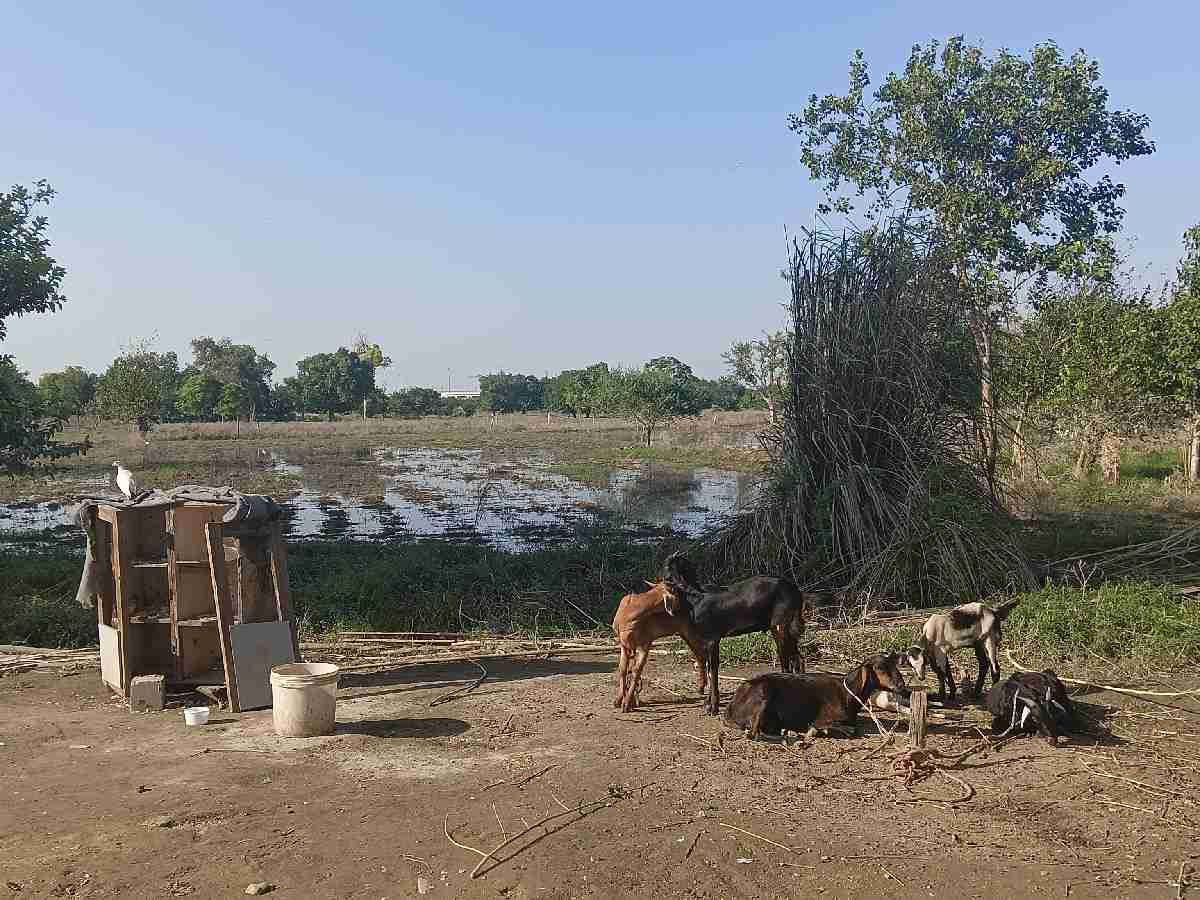
What remains of Sharif's field at Yamuna Bank
Wading through ankle-deep waters, farmer Shivpal Singh walks across his inundated patch of crops, hoping to salvage something. But his search is largely in vain. What was once the product of months of toil has been reduced to puddles and debris. An entire season of harvest has been wiped out.
Singh, who usually grows a range of vegetables including spinach, now stares at a season of negligible yield and mounting losses.
Government’s promise of compensation
On September 9, Delhi Chief Minister Rekha Gupta announced that the government would compensate farmers whose crops had been damaged by floods during the monsoon. She said, “The government will provide assistance to the flood-affected people. We will also compensate farmers who lost crops due to the inundation. The government will help people to ensure that Delhi can get back on its feet again.”
Gupta also held a meeting with district magistrates (DMs) and praised their flood-relief efforts. A senior official explained that the Chief Minister’s Office (CMO) had sought detailed reports from the DMs on farmers’ losses. Six districts — North, Central, East, North East, South East and Shahdara — were among the worst affected, though crops may have been damaged elsewhere too.
The DMs were asked to submit their reports to the divisional commissioner, who would forward them to the CMO. “In many areas, the issues might be localised. The Mungeshpur drain breach had flooded Jharoda Kalan in South West Delhi. Nearly 2,000 people were evacuated from the flooded areas. Those cases will also be considered,” the official added.
On the same day, a section of the Mungeshpur drain in Bahadurgarh, Haryana’s Jhajjar district, collapsed, inundating villages and unauthorised colonies near the Delhi-Haryana border.
Delays in assessment reports
Despite these assurances, sources say the process of compensation has not even begun. While the East district — one of the worst hit — has moved to start the assessment, other districts such as North and North East have yet to identify the worst-affected farmlands.
This delay has not only prolonged farmers’ anxieties but also deepened their financial distress. Farmers estimate that on average, they have collectively lost lakhs of rupees in crop value. Normally, these vegetables would have reached mandis across the national capital, but this year, entire consignments have been lost.
Crops and livelihoods destroyed
For some farmers with larger land parcels, flower harvesting and nurseries provide a secondary source of income. But those with smaller plots have been the hardest hit. Along the Yamuna bank in East Delhi, Jagdish Chaudhary has faced complete devastation. Standing before his inundated fields, he pointed towards two sticks barely visible above the water: “That is the demarcation of my land. It starts from there and ends here.”
Chaudhary, who cultivates cauliflower and spinach across 18 bigha, also runs a nursery and grows roses. While his nursery has survived partially, his primary source of income — vegetables — has been obliterated. “I had put all my money into the crops. Now, whatever I have will go into buying other vegetables from wholesalers to sell. Nobody from the government’s side has come to check with us regarding how much loss we have suffered, so we have all been left to our devices,” he said.
Displaced from his home, Chaudhary now lives with his six-member family under a tent near the Noida Link Road flyover, alongside other families once residing on the Yamuna floodplains.
“We are left to our own devices”
Sharif Ali, whose main harvest is spinach, has also suffered an overwhelming loss on his 33 bigha land. “I had put all my money in maintaining my field. I have a couple of savings but we have to eat as well. I do not know how long I will be able to sustain myself. The government has remained mostly mute when it comes to providing us with compensation. Even during the earlier floods, we had had to manage by ourselves for the longest,” he said.
Ali, like many others, had lived in makeshift tenements along the Yamuna floodplains until the Delhi Development Authority (DDA) carried out repeated eviction drives. Farming, however, remained his only means of livelihood. Now, with his fields under water, survival has become even more precarious.
Several farmers have taken to Azadpur’s wholesale market to buy vegetables in small quantities for resale in local markets. “This is the only thing that I can do now. At least, I have my nursery to sustain myself but since it is off-season, I cannot expect to harvest any flowers at the moment. My family was mostly dependent on my vegetable yield, since we would also use it for our personal consumption — but that is a time far gone,” Ali said.
Floods return to the Yamuna floodplains
In the first week of September, the entire Yamuna floodplain was submerged, destroying hundreds of houses and illegal structures in its path.
The current devastation has revived memories of the 2023 floods. An analysis by the South Asia Network on Dams, Rivers and People (SANDRP) pointed to floodplain encroachments, siltation and faulty dam gate operations as major causes. The Union Jal Shakti Ministry had set up a committee chaired by the Central Water Commission in August 2023, which submitted its report in August 2024.
The report identified three reasons for the floods: very heavy rainfall between July 9 and 13, 2023; incorrect hydrological discharge data from Hathnikund, Wazirabad and Okhla barrages; and encroachments in the floodplain caused by legacy waste and siltation.
Conflicting reports, unanswered questions
A parliamentary standing committee report presented on February 6, 2024, had noted that 3.5 lakh cusecs of water were released from Hathnikund on July 11, 2023, and over 1.13 million cusecs from Wazirabad, causing the flood. But SANDRP criticised both the ministry and parliamentary reports for failing to address the root causes and for offering no corrective action.
Calling the 2023 floods a “man-made disaster”, SANDRP argued that permanent encroachments on the floodplain remained the most likely reason. The group also highlighted that projects such as riverfront beautification and commercial development were further shrinking the Yamuna’s natural course. “The issue of sedimentation raising the riverbed level remains unaddressed,” the analysis noted.
“The 2023 floods remain a puzzle and require an independent scientific investigation and corrective measures to avoid similar adverse events in the future. At the institutional level, the questions of CWC failure, lack of coordination in the operation of barrages and absence of hydrological data of three barrages in Delhi remain unaddressed. Credible answers and course correction are needed,” said Bhim Singh Rawat, Yamuna researcher and associate coordinator at SANDRP.
BNSS caps custody at 24 hours and requires production before a Magistrate; force permitted only…
An SEM court reserved its order on extending the judicial custody of CJP leaders Saurav…
Delhi recorded its first 'poor' air day of the season on Wednesday as AQI hit…
Stage I of GRAP was invoked later this year in Delhi due to govt's preventive…
DDA plans to resume tethered hot air balloon rides at Baanseera park from Nov 14,…
NDMC is consulting RWAs and traders on draft 2026 property tax bye-laws, seeking feedback on…

